The Dead Battery Above the Pharmacy
Una historia gratuita en inglés de nivel B2 para estudiantes, para leer en línea en 7 idiomas, con opción de escucharla en la app gratuita Storyteller.
A dance teacher traces her flat megaphone back through three borrowers to find out who drained its battery before a recital.
¡Ese fue el avance! Escucha la historia completa en la app gratuita Storyteller. Descargar la app
El audio no está disponible en este momento.
The megaphone dies on a Wednesday morning, three days before the biggest recital of the year, and Fatou takes it personally.
El megáfono se muere un miércoles por la mañana, tres días antes del recital más importante del año, y Fatou lo toma como algo personal.
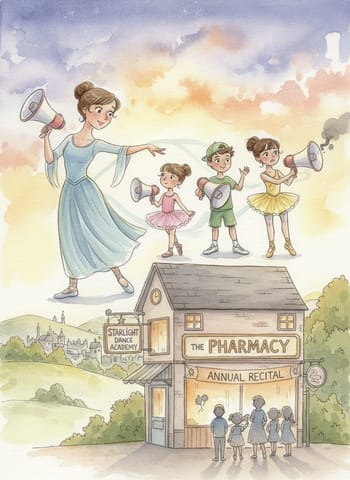
She stands in the middle of her dance studio, which sits on the first floor above a pharmacy. For the fourth time, she presses the trigger. Nothing comes out. The little light stays dark. Thirty small children are due in an hour, and they cannot hear a human voice over their own excitement, let alone Fatou's.
Está de pie en medio de su estudio de baile, que queda en el primer piso sobre una farmacia. Por cuarta vez, aprieta el gatillo. No sale nada. La lucecita sigue apagada. Treinta niños pequeños llegarán en una hora, y no pueden oír una voz humana sobre su propia emoción, y mucho menos la de Fatou.
"Five, six, seven, eight," she says into the empty room, just to prove to herself that she has a voice. It sounds feeble and rather sad.
«Cinco, seis, siete, ocho», dice a la sala vacía, solo para demostrarse que tiene voz. Suena débil y bastante triste.
The megaphone was working on Monday night. She is certain of that, because she used it at the end of the evening class to call the final stretch. The sound bounced off the mirrors so loudly that a woman in the back row clapped her hands over her ears. It lives in the open cupboard by the door, where anyone can reach it. So where did the battery go?
El megáfono funcionaba el lunes por la noche. Está segura de eso, porque lo usó al final de la clase de la tarde para marcar el último tramo. El sonido rebotó en los espejos con tanta fuerza que una mujer de la última fila se tapó los oídos con las manos. Vive en el armario abierto junto a la puerta, donde cualquiera puede alcanzarlo. Entonces, ¿adónde se fue la batería?
Fatou is a person who solves things. She teaches fourteen classes a week, and she keeps the studio keys, the music and a spare pair of shoes in every size. She does not accept that a battery can die on its own. Somebody has used her megaphone, and she intends to find out who.
Fatou es de las personas que resuelven las cosas. Da catorce clases por semana, y guarda las llaves del estudio, la música y un par de zapatos de repuesto en cada talla. No acepta que una batería pueda morirse sola. Alguien ha usado su megáfono, y piensa averiguar quién.
She tucks the dead megaphone under her arm and starts with a list on the back of an attendance sheet. Between Monday night and this morning, the megaphone passed through three sets of hands. She knows that because she asked the cleaner, who laughed and asked her to stop investigating her own cupboard.
Se mete el megáfono muerto bajo el brazo y empieza con una lista en el reverso de una hoja de asistencia. Entre el lunes por la noche y esta mañana, el megáfono pasó por tres pares de manos. Lo sabe porque le preguntó al encargado de la limpieza, que se rio y le pidió que dejara de investigar su propio armario.
The first name on the list is the ballroom teacher, who rents the studio on Tuesday evenings. Fatou finds her in the corridor, wrapping a scarf around her neck.
El primer nombre de la lista es la profesora de baile de salón, que alquila el estudio los martes por la tarde. Fatou la encuentra en el pasillo, envolviéndose una bufanda al cuello.
"Yes, I borrowed it," the ballroom teacher says at once. "For about four minutes. I needed to shout over a very loud waltz. Then I put it straight back in the cupboard."
«Sí, lo usé», dice de inmediato la profesora de baile de salón. «Unos cuatro minutos. Necesitaba gritar por encima de un vals muy fuerte. Luego lo devolví directo al armario».
"Did it work properly when you finished?"
«¿Funcionaba bien cuando terminaste?».
"Of course it did. I even took a photograph of it, because the battery light was green and I wanted to show my husband how modern we are."
«Por supuesto. Hasta le tomé una foto, porque la luz de la batería estaba verde y quise mostrarle a mi marido lo modernos que somos».
She scrolls through her phone and finds the picture. A green light, three solid bars, time stamped half past seven on Tuesday. Fatou studies it with the grim attention of a detective in a film.
Desliza el dedo por su teléfono y encuentra la imagen. Una luz verde, tres barras sólidas, con la hora marcada: siete y media del martes. Fatou la estudia con la atención severa de un detective de película.
"That is useful," she says. "Thank you."
«Eso es útil», dice. «Gracias».
"Is it a crime?" the ballroom teacher asks hopefully.
«¿Es un delito?», pregunta la profesora de baile de salón con esperanza.
"Not yet," says Fatou.
«Todavía no», dice Fatou.
The second name is the courier, a young man with a bicycle. He delivers prescriptions for the pharmacy and sometimes uses the studio stairwell as a shortcut. Fatou catches him in the middle of lifting his bike up the stairs.
El segundo nombre es el mensajero, un joven con una bicicleta. Entrega recetas para la farmacia y a veces usa la escalera del estudio como atajo. Fatou lo atrapa en medio de subir su bicicleta por los escalones.
He goes slightly pale when she says the word megaphone.
Palidece un poco cuando ella dice la palabra megáfono.
"I did take it," he admits, "but only for a minute. A dog escaped from a van outside and started running around the car park. I stood on the steps and shouted at it. It ignored me completely."
«Sí lo tomé», admite, «pero solo un minuto. Un perro se escapó de una furgoneta afuera y empezó a correr por el estacionamiento. Me paré en los escalones y le grité. Me ignoró por completo».
"What did you do with the megaphone afterwards?"
«¿Qué hiciste con el megáfono después?».
"I put it on the shelf by the pharmacy door. The one in the back corridor, next to the boxes. I thought it would be safer there." He looks at his shoes. "Was that wrong?"
«Lo dejé en el estante junto a la puerta de la farmacia. El del pasillo de atrás, junto a las cajas. Pensé que estaría más seguro ahí». Mira sus zapatos. «¿Estuvo mal?».
Fatou writes on the sheet: Courier, Tuesday, about eight. Moved it to the pharmacy shelf. Then, because she is fair, she writes: Why did it come back to my cupboard?
Fatou escribe en la hoja: Mensajero, martes, alrededor de las ocho. Lo movió al estante de la farmacia. Luego, porque es justa, escribe: ¿Por qué volvió a mi armario?
"Someone must have carried it up to me," she says. "Someone who knew whose it was."
«Alguien debió de subírmelo», dice. «Alguien que sabía de quién era».
The courier shrugs. Fatou watches him carry his bicycle away.
El mensajero se encoge de hombros. Fatou lo mira alejarse cargando su bicicleta.
That leaves the third person, and he is the one she was trying not to think about. He is the pharmacist, a tall, patient, untidy man named Nikos. He sells her cough sweets and cheerfully complains about her music through the ceiling every afternoon. The two of them have been neighbours for four years, and she has never once suspected him of anything worse than a bad singing voice.
Eso deja a la tercera persona, y es en quien intentaba no pensar. Es el farmacéutico, un hombre alto, paciente y desordenado llamado Nikos. Le vende caramelos para la tos y se queja alegremente de su música a través del techo todas las tardes. Los dos han sido vecinos durante cuatro años, y ella nunca ha sospechado de él nada peor que una mala voz para cantar.
She finds him behind the counter, writing a label with great care. His eyes are tired. There is a long queue in front of him, and she can see that the queue is not cheerful.
Lo encuentra detrás del mostrador, escribiendo una etiqueta con gran cuidado. Tiene los ojos cansados. Hay una larga fila frente a él, y ella ve que la fila no está de buen humor.
"Nikos," she says. "A word."
«Nikos», dice. «Una palabra».
"Fatou, I would love to, but as you can see, I am drowning." He waves at the line of customers. "The number machine broke on Tuesday, and since then everybody has been standing in a heap and arguing about who arrived first."
«Fatou, me encantaría, pero como ves, me estoy ahogando». Hace un gesto hacia la fila de clientes. «La máquina de turnos se rompió el martes, y desde entonces todos están parados en un montón discutiendo quién llegó primero».
Fatou stops. Something in her head clicks, the way a key clicks into a lock.
Fatou se detiene. Algo en su cabeza hace clic, como una llave que entra en una cerradura.
"Nikos, when did the number machine break?"
«Nikos, ¿cuándo se rompió la máquina de turnos?».
"Tuesday afternoon. Why?"
«El martes por la tarde. ¿Por qué?».
"And how did you call the customers on Tuesday evening?"
«¿Y cómo llamaste a los clientes el martes por la noche?».
He opens his mouth and closes it again. He looks suddenly like a man who has been caught eating the last biscuit. "I had a little help," he says. "From the back corridor shelf."
Él abre la boca y la cierra otra vez. De pronto parece un hombre al que han sorprendido comiéndose la última galleta. «Tuve un poquito de ayuda», dice. «Del estante del pasillo de atrás».
"There is a megaphone on that shelf."
«En ese estante hay un megáfono».
"There was a megaphone on that shelf. It was very useful. It has a lovely loud voice."
«Había un megáfono en ese estante. Fue muy útil. Tiene una voz preciosa y fuerte».
"Nikos," Fatou says, with enormous calm, "where is it now?"
«Nikos», dice Fatou, con enorme calma, «¿dónde está ahora?».
She does not wait for his answer. She lifts the dead megaphone from under her arm and sets it on the counter between them. Nikos looks at it the way a man looks at an old photograph of himself. Then he bends closer and points at the trigger, where a sticky grey stripe shows that clear tape was once wound around it. Beside the stripe, a ragged scrap of paper still clings to the plastic. On it, in the pharmacy's thick black marker, are two words: NEXT, PLEASE.
No espera su respuesta. Saca de debajo del brazo el megáfono muerto y lo pone sobre el mostrador entre los dos. Nikos lo mira como se mira una foto antigua de uno mismo. Luego se inclina y señala el gatillo, donde una pegajosa franja gris muestra que hubo cinta transparente enrollada alrededor. Junto a la franja, un trozo irregular de papel sigue adherido al plástico. En él, con el grueso marcador negro de la farmacia, hay dos palabras: SIGUIENTE, POR FAVOR.
"That is my label," he says weakly. "And that is my tape."
«Esa es mi etiqueta», dice débilmente. «Y esa es mi cinta».
"You taped the trigger down," Fatou says.
«Pegaste el gatillo con cinta», dice Fatou.
"Only so that I would not have to hold it." Nikos is turning an interesting shade of pink. "I peeled the tape off before I brought it back, because I thought you would never notice. But it was not turned off properly when I carried it to the stockroom last night. I left it humming on the shelf. All night."
«Solo para no tener que sostenerlo». Nikos se está poniendo de un interesante tono rosado. «Despegué la cinta antes de devolverlo, porque pensé que nunca lo notarías. Pero no estaba apagado como corresponde cuando lo llevé al depósito anoche. Lo dejé zumbando en el estante. Toda la noche».
"All night, calling for the next customer in an empty pharmacy."
«Toda la noche, llamando al siguiente cliente en una farmacia vacía».
"I am told it was a very polite night."
«Me dicen que fue una noche muy educada».
In the line, someone laughs. Another customer starts to clap, slowly. Fatou presses her lips together, because she does not want to give him the satisfaction. A smile is creeping up on her, and she cannot stop it.
En la fila, alguien se ríe. Otro cliente empieza a aplaudir, lentamente. Fatou aprieta los labios, porque no quiere darle el gusto. Una sonrisa le sube por la cara, y no puede detenerla.
"Three people," she says. "Three people, and the one I should have started with was downstairs the whole time."
«Tres personas», dice. «Tres personas, y por la que debí empezar estaba abajo todo el tiempo».
"In my defence," Nikos says, "I did bring it back to you. I left it in your cupboard this morning, at six, before you came."
«En mi defensa», dice Nikos, «sí te lo devolví. Lo dejé en tu armario esta mañana, a las seis, antes de que llegaras».
"Dead."
«Muerto».
"Humbly dead. I apologise." He pushes the megaphone an inch towards her across the counter. "I will buy you new batteries. I will buy you twelve of them, with a ribbon. And I will stand in the front row on Saturday and call every dance step you want."
«Humildemente muerto. Te pido disculpas». Empuja el megáfono un par de centímetros hacia ella por el mostrador. «Te compraré baterías nuevas. Te compraré doce, con un lazo. Y estaré en la primera fila el sábado y gritaré todos los pasos de baile que quieras».
"That," Fatou says, "is the best offer I have had all week."
«Esa», dice Fatou, «es la mejor oferta que he recibido en toda la semana».
"Left foot, right foot," says Nikos, lifting the dead megaphone to his lips and speaking into it with great seriousness. "Next customer, please."
«Pie izquierdo, pie derecho», dice Nikos, levantando el megáfono muerto hasta los labios y hablando en él con enorme seriedad. «Siguiente cliente, por favor».