The Song of the Dock Trolley
Uma história gratuita em inglês de nível B2 para estudantes, para ler online em 7 idiomas, com opção de ouvir no app gratuito Storyteller.
A canoe dock manager and her new assistant hunt for the cause of a shrill noise that only appears under a heavy load.
Essa foi a prévia! Ouça a história completa no app gratuito Storyteller. Baixar o app
O áudio não está disponível no momento.
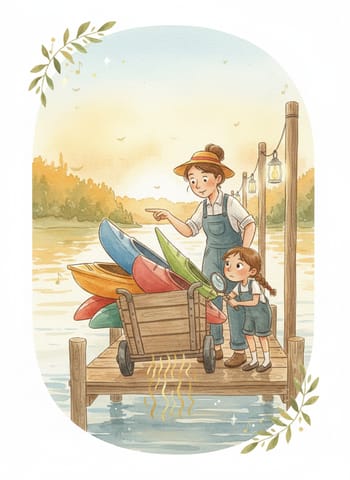
Every morning at ten to eight, the trolley at the canoe dock starts to sing. It is not a pleasant song. It is a thin, rising squeal, like a kettle that has lost its confidence, and it follows Gina down the whole length of the jetty.
Toda manhã, às oito menos dez, o carrinho do cais das canoas começa a cantar. Não é uma canção agradável. É um guincho fino e crescente, como uma chaleira que perdeu a confiança, e ele acompanha Gina por todo o comprimento do píer.
Gina has managed the hire dock for six summers, and she has made her peace with most noises. The water slaps the pontoons. The paddles knock together in their racks. The gulls complain about everything. The squeal is different, because customers have started to mention it.
Gina administra o cais de aluguel há seis verões e fez as pazes com a maioria dos ruídos. A água bate nos pontões. Os remos se chocam nos suportes. As gaivotas reclamam de tudo. O guincho é diferente, porque os clientes começaram a comentar.
"Is that normal?" asks a man in a brand-new sun hat, pointing at the trolley with a paddle.
"Isso é normal?", pergunta um homem de chapéu de sol novinho em folha, apontando o carrinho com um remo.
"It is a feature," Gina says. "It tells the canoes that breakfast is coming."
"É um recurso", diz Gina. "Avisa às canoas que o café da manhã está chegando."
The man does not laugh, and she cannot blame him. She wheels the load of life jackets to the end of the jetty, the squeal keeping time with her steps. The joke, she decides, has run out.
O homem não ri, e ela não pode culpá-lo. Ela empurra a carga de coletes salva-vidas até o fim do píer, com o guincho marcando o ritmo dos seus passos. A piada, conclui, já esgotou.
Jada arrives at eight, carrying two coffees and a toolbag that is too clean to have been used much. She is the new summer assistant, a student of engineering, and she has been told she will mostly be handing out paddles. She stops on the jetty and tilts her head.
Jada chega às oito, carregando dois cafés e uma bolsa de ferramentas limpa demais para ter sido muito usada. É a nova assistente de verão, estudante de engenharia, e lhe disseram que ela vai passar a maior parte do tempo entregando remos. Ela para no píer e inclina a cabeça.
"What is making that sound?" she asks.
"O que está fazendo esse barulho?", pergunta.
"The wheel," Gina says. "It is the squeaky wheel. Everyone knows the squeaky wheel gets the oil."
"A roda", diz Gina. "É a roda que range. Todo mundo sabe que a roda que range é a que leva o óleo."
"Have you tried oil?"
"Você já tentou óleo?"
"I have tried three kinds. I have tried a spray, a thick grease, and some cooking oil from the café. The squeak ignores all of them."
"Já tentei três tipos. Tentei um spray, uma graxa grossa e um óleo de cozinha da cafeteria. O rangido ignora todos eles."
Jada puts down her coffee and crouches beside the trolley. She looks at the front wheel for a long time. It is a small grey wheel on a bent metal fork, and it looks perfectly innocent. Then she stands up, rubs her hands together, and smiles the way people smile when they have been given a puzzle.
Jada larga o café e se agacha ao lado do carrinho. Fica olhando a roda da frente por um bom tempo. É uma rodinha cinza num garfo de metal torto, e parece perfeitamente inocente. Então se levanta, esfrega as mãos e sorri do jeito que as pessoas sorriem quando ganham um enigma.
"I would like to solve this," she says. "If you do not mind."
"Eu gostaria de resolver isso", diz ela. "Se você não se importar."
"I would like you to solve it more than I would like almost anything," says Gina. "Be my guest."
"Eu quero que você resolva mais do que quase qualquer outra coisa", diz Gina. "Fique à vontade."
Jada makes a rule before she starts. They will not touch the wheel until they know something real. First they will listen, and write down what they hear. Gina finds a pencil behind her ear and a crumpled hire form, and she turns it over to make a notebook.
Jada estabelece uma regra antes de começar. Não vão mexer na roda até saberem algo concreto. Primeiro vão escutar e anotar o que ouvem. Gina acha um lápis atrás da orelha e um formulário de aluguel amassado, e o vira para fazer um caderno de anotações.
The first clue arrives within ten minutes. Jada pushes the empty trolley up and down the jetty four times, and it makes no sound at all. It rolls as smoothly as a trolley in an advert. Then Gina loads it with twenty life jackets, and the squeal comes back at once, as shrill as before.
A primeira pista chega em dez minutos. Jada empurra o carrinho vazio para lá e para cá no píer quatro vezes, e ele não faz som algum. Rola tão suavemente quanto um carrinho de propaganda. Então Gina o carrega com vinte coletes, e o guincho volta na hora, tão estridente quanto antes.
"So it is not the wheel," Jada says slowly. "Or not only the wheel. Something in it changes when there is weight."
"Então não é a roda", diz Jada devagar. "Ou não só a roda. Algo nela muda quando há peso."
"The wheel has not changed," says Gina. "I have been looking at that wheel for six years."
"A roda não mudou", diz Gina. "Faz seis anos que olho para essa roda."
"Then the weight is pressing on something else. The frame, maybe, or a part under the load."
"Então o peso está pressionando outra coisa. A estrutura, talvez, ou uma peça sob a carga."
Gina writes on the form: Clue one, silent when empty.
Gina escreve no formulário: Pista um, silencioso quando vazio.
The second clue comes from the customers. A family of four wants canoes at nine, and Gina sends Jada down the jetty with the loaded trolley while she deals with the paperwork. From the desk, she listens. The squeal starts at the top of the ramp, grows louder along the wooden boards. Then, near the very end of the jetty, it stops.
A segunda pista vem dos clientes. Uma família de quatro pessoas quer canoas às nove, e Gina manda Jada píer abaixo com o carrinho carregado enquanto resolve a papelada. Da mesa, ela escuta. O guincho começa no alto da rampa e fica mais alto ao longo das tábuas de madeira. Então, perto do fim do píer, para.
Jada comes back, frowning. "It stopped by itself at the last three boards."
Jada volta, franzindo a testa. "Parou sozinho nas últimas três tábuas."
"It always does that," says Gina. "I assumed the boards were smoother there."
"Sempre faz isso", diz Gina. "Achei que as tábuas fossem mais lisas ali."
"Are they?"
"E são?"
"No. They are the oldest boards on the dock. They are the roughest."
"Não. São as tábuas mais velhas do cais. São as mais ásperas."
They look at each other. A rough surface should make a noise, not silence one. Gina writes: Clue two, stops on the oldest, bumpiest boards. Jada taps the pencil against her chin and watches the wake of a passing paddleboard slide across the water.
Elas se entreolham. Uma superfície áspera deveria fazer barulho, não silenciá-lo. Gina escreve: Pista dois, para nas tábuas mais velhas e mais irregulares. Jada bate o lápis no queixo e observa a marola de uma prancha de remo que passa deslizar pela água.
"What if the squeak is not rolling at all?" she says. "What if the bumps shake it loose?"
"E se o rangido não vem do rolamento?", diz ela. "E se os solavancos o soltam?"
"Shake what loose?"
"Soltam o quê?"
"I do not know yet. Something that gets squeezed when the trolley is heavy and the ground is smooth, and that gets free when the ground is rough."
"Ainda não sei. Algo que fica espremido quando o carrinho está pesado e o chão é liso, e que se solta quando o chão é áspero."
The third clue is the strangest, and it is Gina who finds it, by accident, at lunchtime. She is sitting on an upturned bucket, eating a sandwich, when the youngest child of the morning family comes running up the jetty. Her father is close behind. The girl is about four, and she is crying with the full force of someone who has lost the most important thing in the world.
A terceira pista é a mais estranha, e é Gina quem a encontra, por acaso, na hora do almoço. Está sentada num balde virado, comendo um sanduíche, quando a filha mais nova da família da manhã vem correndo pelo píer. O pai vem logo atrás. A menina tem uns quatro anos e chora com toda a força de quem perdeu a coisa mais importante do mundo.
"Her duck," the father explains, out of breath. "She had it in the canoe. We looked everywhere. It is yellow, about this big. It makes a noise when you press it."
"O patinho dela", explica o pai, sem fôlego. "Ela estava com ele na canoa. Procuramos em todo lugar. É amarelo, deste tamanho. Faz barulho quando se aperta."
Gina is already shaking her head, because nothing yellow has been left in any of her canoes. Then she stops, with the sandwich halfway to her mouth, and she hears something. It is faint. It is the memory of a sound she has been hearing for a month and has never once named.
Gina já está balançando a cabeça, porque nada amarelo foi deixado em nenhuma de suas canoas. Então para, com o sanduíche a meio caminho da boca, e ouve algo. É fraco. É a lembrança de um som que ela escuta há um mês e nunca chegou a nomear.
"Does the duck," she says carefully, "squeak?"
"O patinho", diz ela com cuidado, "chia?"
"Like a mouse with a cold," says the father.
"Como um camundongo resfriado", diz o pai.
Gina puts down her sandwich. She stands up. She walks to the trolley, which is parked in the shade by the desk. She presses down hard on the metal frame above the front wheel. Nothing happens. Then she calls for Jada and asks her to sit on the load of life jackets.
Gina põe o sanduíche de lado. Levanta-se. Caminha até o carrinho, que está estacionado na sombra perto da mesa. Pressiona com força a estrutura de metal acima da roda da frente. Nada acontece. Então chama Jada e pede que ela se sente na carga de coletes.
Jada sits. The trolley sinks a little on its springs. From somewhere deep inside the hollow tube of the handle frame comes a long, thin, unmistakable squeal.
Jada se senta. O carrinho afunda um pouco nas molas. De algum lugar no fundo do tubo oco da estrutura do cabo vem um chiado longo, fino e inconfundível.
"Clue three," Gina says. "It squeaks when somebody squeezes it."
"Pista três", diz Gina. "Chia quando alguém o espreme."
Together they lie flat on the jetty and look up into the open end of the frame. For a moment they see nothing but darkness and a spider's old web. Then Jada shines her phone torch into the tube, and a small round yellow eye looks back at them.
Juntas, elas se deitam no píer e olham para dentro da ponta aberta da estrutura. Por um momento, não veem nada além de escuridão e uma velha teia de aranha. Então Jada aponta a lanterna do celular para dentro do tubo, e um pequeno olho redondo e amarelo olha de volta para elas.
It takes a bent coat hanger and some patience to pull the thing out. The duck comes free with a soft pop, grey with dust and slightly flat. Its beak has been chewed. It has clearly spent a long time wedged in the tube. Every heavy load that rolled over the bumps has squeezed it.
É preciso um cabide torto e um pouco de paciência para tirar a coisa dali. O patinho sai com um estalo suave, cinza de poeira e meio murcho. O bico está mordido. Claramente passou muito tempo entalado no tubo. Cada carga pesada que rolou sobre os solavancos o espremeu.
"It has been in there since the start of summer," says Gina. "Someone's child must have dropped it down the open end of the handle."
"Está aí desde o começo do verão", diz Gina. "O filho de alguém deve ter deixado cair pela ponta aberta do cabo."
"And every time the trolley carries a heavy load," Jada says, "the frame bends a little and squeezes the poor thing."
"E toda vez que o carrinho leva uma carga pesada", diz Jada, "a estrutura se curva um pouco e espreme o coitadinho."
"And on the rough boards the bumps keep shaking it away from the squeezing point."
"E nas tábuas ásperas os solavancos o afastam do ponto de pressão."
"So the sound stops."
"Então o som para."
They sit back on their heels and look at each other, and then they start to laugh. They laugh so hard that a man in a kayak turns his head to see what is wrong with them. A whole summer of oil, of grease, of apologies to customers, and the answer was a duck.
Elas se sentam sobre os calcanhares e se entreolham, e então começam a rir. Riem tanto que um homem de caiaque vira a cabeça para ver o que há de errado com elas. Um verão inteiro de óleo, de graxa, de pedidos de desculpas aos clientes, e a resposta era um patinho.
The four-year-old is called to the desk. Her own duck is still lost somewhere on the lake, and Gina kneels down to her level. The trolley duck is wiped with a damp cloth, and it is held out with great ceremony.
A menina de quatro anos é chamada à mesa. O patinho dela continua perdido em algum lugar do lago, e Gina se ajoelha à altura dela. O patinho do carrinho é limpo com um pano úmido e estendido com grande cerimônia.
"This one has been waiting for a new owner," Gina says.
"Este estava esperando por uma nova dona", diz Gina.
The girl presses it once, to check, and the familiar squeak fills the afternoon. Her tears stop as though someone has switched off a tap.
A menina o aperta uma vez, para conferir, e o conhecido chiado enche a tarde. As lágrimas dela param como se alguém tivesse fechado uma torneira.
"Thank you," says her father. "She will tell this story for years."
"Obrigado", diz o pai. "Ela vai contar essa história por anos."
"So will we," says Gina.
"Nós também", diz Gina.
When the family has gone, the trolley rolls up the jetty in perfect silence. It is the quietest it has been in years.
Quando a família vai embora, o carrinho sobe o píer em perfeito silêncio. Está mais quieto do que esteve em anos.
Jada fetches her clean toolbag and opens it for the first time. Inside is a small screwdriver, a tape measure, and a roll of bright blue tape. She tears off a strip, takes the pencil from Gina's hand, and writes on the tape in neat capital letters: DUCK-FREE SINCE JULY. Then she presses it firmly along the handle of the trolley, just above the open end of the tube.
Jada pega a bolsa de ferramentas limpa e a abre pela primeira vez. Lá dentro há uma chave de fenda pequena, uma fita métrica e um rolo de fita azul-viva. Ela rasga uma tira, pega o lápis da mão de Gina e escreve na fita, em letras maiúsculas caprichadas: SEM PATINHO DESDE JULHO. Depois a cola com firmeza ao longo do cabo do carrinho, logo acima da ponta aberta do tubo.