The Song of the Dock Trolley
Una historia gratuita en inglés de nivel B2 para estudiantes, para leer en línea en 7 idiomas, con opción de escucharla en la app gratuita Storyteller.
A canoe dock manager and her new assistant hunt for the cause of a shrill noise that only appears under a heavy load.
¡Ese fue el avance! Escucha la historia completa en la app gratuita Storyteller. Descargar la app
El audio no está disponible en este momento.
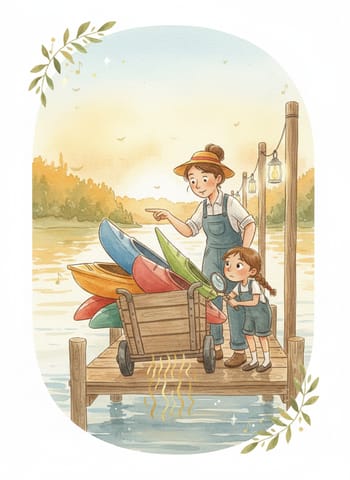
Every morning at ten to eight, the trolley at the canoe dock starts to sing. It is not a pleasant song. It is a thin, rising squeal, like a kettle that has lost its confidence, and it follows Gina down the whole length of the jetty.
Todas las mañanas, a las ocho menos diez, el carrito del muelle de canoas empieza a cantar. No es una canción agradable. Es un chillido fino y creciente, como una tetera que ha perdido la confianza, y sigue a Gina por todo el largo del embarcadero.
Gina has managed the hire dock for six summers, and she has made her peace with most noises. The water slaps the pontoons. The paddles knock together in their racks. The gulls complain about everything. The squeal is different, because customers have started to mention it.
Gina ha dirigido el muelle de alquiler durante seis veranos y ha hecho las paces con casi todos los ruidos. El agua golpea los pontones. Los remos chocan entre sí en sus soportes. Las gaviotas se quejan de todo. El chillido es diferente, porque los clientes han empezado a mencionarlo.
"Is that normal?" asks a man in a brand-new sun hat, pointing at the trolley with a paddle.
«¿Eso es normal?», pregunta un hombre con un sombrero de sol nuevecito, señalando el carrito con un remo.
"It is a feature," Gina says. "It tells the canoes that breakfast is coming."
«Es una característica», dice Gina. «Les avisa a las canoas que viene el desayuno».
The man does not laugh, and she cannot blame him. She wheels the load of life jackets to the end of the jetty, the squeal keeping time with her steps. The joke, she decides, has run out.
El hombre no se ríe, y ella no puede culparlo. Empuja la carga de chalecos salvavidas hasta el final del embarcadero, con el chillido marcando el compás de sus pasos. El chiste, decide, ya se agotó.
Jada arrives at eight, carrying two coffees and a toolbag that is too clean to have been used much. She is the new summer assistant, a student of engineering, and she has been told she will mostly be handing out paddles. She stops on the jetty and tilts her head.
Jada llega a las ocho, con dos cafés y una bolsa de herramientas demasiado limpia para haberse usado mucho. Es la nueva ayudante de verano, estudiante de ingeniería, y le han dicho que sobre todo repartirá remos. Se detiene en el embarcadero e inclina la cabeza.
"What is making that sound?" she asks.
«¿Qué está haciendo ese sonido?», pregunta.
"The wheel," Gina says. "It is the squeaky wheel. Everyone knows the squeaky wheel gets the oil."
«La rueda», dice Gina. «Es la rueda chillona. Todos saben que la rueda que chilla es la que recibe el aceite».
"Have you tried oil?"
«¿Has probado con aceite?».
"I have tried three kinds. I have tried a spray, a thick grease, and some cooking oil from the café. The squeak ignores all of them."
«He probado tres tipos. He probado un aerosol, una grasa espesa y un poco de aceite de cocina del café. Al chillido no le importa ninguno».
Jada puts down her coffee and crouches beside the trolley. She looks at the front wheel for a long time. It is a small grey wheel on a bent metal fork, and it looks perfectly innocent. Then she stands up, rubs her hands together, and smiles the way people smile when they have been given a puzzle.
Jada deja su café y se agacha junto al carrito. Mira la rueda delantera durante un buen rato. Es una pequeña rueda gris sobre una horquilla de metal torcida, y parece perfectamente inocente. Luego se pone de pie, se frota las manos y sonríe como sonríe la gente cuando le dan un rompecabezas.
"I would like to solve this," she says. "If you do not mind."
«Me gustaría resolver esto», dice. «Si no te molesta».
"I would like you to solve it more than I would like almost anything," says Gina. "Be my guest."
«Me gustaría que lo resolvieras más que casi cualquier otra cosa», dice Gina. «Adelante».
Jada makes a rule before she starts. They will not touch the wheel until they know something real. First they will listen, and write down what they hear. Gina finds a pencil behind her ear and a crumpled hire form, and she turns it over to make a notebook.
Jada establece una regla antes de empezar. No tocarán la rueda hasta saber algo real. Primero escucharán y anotarán lo que oigan. Gina encuentra un lápiz detrás de la oreja y un formulario de alquiler arrugado, y le da la vuelta para convertirlo en libreta.
The first clue arrives within ten minutes. Jada pushes the empty trolley up and down the jetty four times, and it makes no sound at all. It rolls as smoothly as a trolley in an advert. Then Gina loads it with twenty life jackets, and the squeal comes back at once, as shrill as before.
La primera pista llega en diez minutos. Jada empuja el carrito vacío de un lado a otro del embarcadero cuatro veces, y no hace ningún ruido. Rueda tan suavemente como un carrito de anuncio. Luego Gina lo carga con veinte chalecos salvavidas y el chillido vuelve de inmediato, tan agudo como antes.
"So it is not the wheel," Jada says slowly. "Or not only the wheel. Something in it changes when there is weight."
«Entonces no es la rueda», dice Jada despacio. «O no solo la rueda. Algo en él cambia cuando hay peso».
"The wheel has not changed," says Gina. "I have been looking at that wheel for six years."
«La rueda no ha cambiado», dice Gina. «Llevo seis años mirando esa rueda».
"Then the weight is pressing on something else. The frame, maybe, or a part under the load."
«Entonces el peso está presionando otra cosa. El armazón, quizá, o alguna pieza bajo la carga».
Gina writes on the form: Clue one, silent when empty.
Gina escribe en el formulario: Pista uno, silencioso cuando está vacío.
The second clue comes from the customers. A family of four wants canoes at nine, and Gina sends Jada down the jetty with the loaded trolley while she deals with the paperwork. From the desk, she listens. The squeal starts at the top of the ramp, grows louder along the wooden boards. Then, near the very end of the jetty, it stops.
La segunda pista viene de los clientes. Una familia de cuatro quiere canoas a las nueve, y Gina manda a Jada por el embarcadero con el carrito cargado mientras ella se ocupa del papeleo. Desde el escritorio, escucha. El chillido empieza en lo alto de la rampa y se hace más fuerte a lo largo de las tablas de madera. Luego, cerca del final mismo del embarcadero, se detiene.
Jada comes back, frowning. "It stopped by itself at the last three boards."
Jada regresa, frunciendo el ceño. «Se detuvo solo en las últimas tres tablas».
"It always does that," says Gina. "I assumed the boards were smoother there."
«Siempre lo hace», dice Gina. «Supuse que las tablas eran más lisas ahí».
"Are they?"
«¿Lo son?».
"No. They are the oldest boards on the dock. They are the roughest."
«No. Son las tablas más viejas del muelle. Son las más ásperas».
They look at each other. A rough surface should make a noise, not silence one. Gina writes: Clue two, stops on the oldest, bumpiest boards. Jada taps the pencil against her chin and watches the wake of a passing paddleboard slide across the water.
Se miran. Una superficie áspera debería hacer ruido, no acallarlo. Gina escribe: Pista dos, se detiene en las tablas más viejas y desparejas. Jada golpea el lápiz contra la barbilla y observa la estela de una tabla de paddle que pasa deslizándose sobre el agua.
"What if the squeak is not rolling at all?" she says. "What if the bumps shake it loose?"
«¿Y si el chillido no tiene nada que ver con rodar?», dice. «¿Y si los golpes lo sacuden y lo sueltan?».
"Shake what loose?"
«¿Sacudir y soltar qué?».
"I do not know yet. Something that gets squeezed when the trolley is heavy and the ground is smooth, and that gets free when the ground is rough."
«Todavía no lo sé. Algo que se aprieta cuando el carrito está pesado y el suelo es liso, y que se libera cuando el suelo es áspero».
The third clue is the strangest, and it is Gina who finds it, by accident, at lunchtime. She is sitting on an upturned bucket, eating a sandwich, when the youngest child of the morning family comes running up the jetty. Her father is close behind. The girl is about four, and she is crying with the full force of someone who has lost the most important thing in the world.
La tercera pista es la más extraña, y es Gina quien la encuentra, por casualidad, a la hora del almuerzo. Está sentada en un balde volteado, comiendo un sándwich, cuando la hija menor de la familia de la mañana llega corriendo por el embarcadero. Su padre viene justo detrás. La niña tiene unos cuatro años y llora con toda la fuerza de quien ha perdido lo más importante del mundo.
"Her duck," the father explains, out of breath. "She had it in the canoe. We looked everywhere. It is yellow, about this big. It makes a noise when you press it."
«Su pato», explica el padre, sin aliento. «Lo tenía en la canoa. Buscamos por todas partes. Es amarillo, más o menos así de grande. Hace un ruido cuando lo aprietas».
Gina is already shaking her head, because nothing yellow has been left in any of her canoes. Then she stops, with the sandwich halfway to her mouth, and she hears something. It is faint. It is the memory of a sound she has been hearing for a month and has never once named.
Gina ya está negando con la cabeza, porque no se ha quedado nada amarillo en ninguna de sus canoas. Entonces se detiene, con el sándwich a medio camino de la boca, y oye algo. Es débil. Es el recuerdo de un sonido que lleva un mes oyendo y al que nunca le ha puesto nombre.
"Does the duck," she says carefully, "squeak?"
«¿El pato», dice con cuidado, «chilla?».
"Like a mouse with a cold," says the father.
«Como un ratón resfriado», dice el padre.
Gina puts down her sandwich. She stands up. She walks to the trolley, which is parked in the shade by the desk. She presses down hard on the metal frame above the front wheel. Nothing happens. Then she calls for Jada and asks her to sit on the load of life jackets.
Gina deja el sándwich. Se pone de pie. Camina hasta el carrito, que está estacionado a la sombra junto al escritorio. Presiona con fuerza el armazón de metal sobre la rueda delantera. No pasa nada. Entonces llama a Jada y le pide que se siente sobre la carga de chalecos salvavidas.
Jada sits. The trolley sinks a little on its springs. From somewhere deep inside the hollow tube of the handle frame comes a long, thin, unmistakable squeal.
Jada se sienta. El carrito se hunde un poco sobre sus resortes. Desde algún lugar profundo dentro del tubo hueco del armazón del manubrio sale un chillido largo, fino e inconfundible.
"Clue three," Gina says. "It squeaks when somebody squeezes it."
«Pista tres», dice Gina. «Chilla cuando alguien lo aprieta».
Together they lie flat on the jetty and look up into the open end of the frame. For a moment they see nothing but darkness and a spider's old web. Then Jada shines her phone torch into the tube, and a small round yellow eye looks back at them.
Juntas se tienden en el embarcadero y miran hacia el extremo abierto del armazón. Por un momento no ven más que oscuridad y una vieja telaraña. Luego Jada alumbra el tubo con la linterna de su teléfono, y un pequeño ojo redondo y amarillo les devuelve la mirada.
It takes a bent coat hanger and some patience to pull the thing out. The duck comes free with a soft pop, grey with dust and slightly flat. Its beak has been chewed. It has clearly spent a long time wedged in the tube. Every heavy load that rolled over the bumps has squeezed it.
Hace falta un gancho de ropa torcido y algo de paciencia para sacar la cosa. El pato sale con un suave pop, gris de polvo y algo aplastado. Tiene el pico mordisqueado. Claramente pasó mucho tiempo atascado en el tubo. Cada carga pesada que rodó sobre los golpes lo ha apretado.
"It has been in there since the start of summer," says Gina. "Someone's child must have dropped it down the open end of the handle."
«Ha estado ahí desde el comienzo del verano», dice Gina. «El hijo de alguien debe de haberlo dejado caer por el extremo abierto del manubrio».
"And every time the trolley carries a heavy load," Jada says, "the frame bends a little and squeezes the poor thing."
«Y cada vez que el carrito lleva una carga pesada», dice Jada, «el armazón se dobla un poco y aprieta a la pobre cosa».
"And on the rough boards the bumps keep shaking it away from the squeezing point."
«Y en las tablas ásperas los golpes lo mantienen alejado del punto donde lo aprietan».
"So the sound stops."
«Así que el sonido se detiene».
They sit back on their heels and look at each other, and then they start to laugh. They laugh so hard that a man in a kayak turns his head to see what is wrong with them. A whole summer of oil, of grease, of apologies to customers, and the answer was a duck.
Se sientan sobre los talones y se miran, y entonces empiezan a reír. Se ríen tanto que un hombre en un kayak vuelve la cabeza para ver qué les pasa. Todo un verano de aceite, de grasa, de disculpas a los clientes, y la respuesta era un pato.
The four-year-old is called to the desk. Her own duck is still lost somewhere on the lake, and Gina kneels down to her level. The trolley duck is wiped with a damp cloth, and it is held out with great ceremony.
Llaman a la niña de cuatro años al escritorio. Su propio pato sigue perdido en algún lugar del lago, y Gina se arrodilla a su altura. El pato del carrito se limpia con un paño húmedo y se le ofrece con gran ceremonia.
"This one has been waiting for a new owner," Gina says.
«Este ha estado esperando a una nueva dueña», dice Gina.
The girl presses it once, to check, and the familiar squeak fills the afternoon. Her tears stop as though someone has switched off a tap.
La niña lo aprieta una vez, para comprobar, y el conocido chillido llena la tarde. Sus lágrimas se detienen como si alguien hubiera cerrado una llave.
"Thank you," says her father. "She will tell this story for years."
«Gracias», dice su padre. «Contará esta historia durante años».
"So will we," says Gina.
«Nosotras también», dice Gina.
When the family has gone, the trolley rolls up the jetty in perfect silence. It is the quietest it has been in years.
Cuando la familia se ha ido, el carrito sube por el embarcadero en perfecto silencio. Es lo más silencioso que ha estado en años.
Jada fetches her clean toolbag and opens it for the first time. Inside is a small screwdriver, a tape measure, and a roll of bright blue tape. She tears off a strip, takes the pencil from Gina's hand, and writes on the tape in neat capital letters: DUCK-FREE SINCE JULY. Then she presses it firmly along the handle of the trolley, just above the open end of the tube.
Jada busca su bolsa de herramientas limpia y la abre por primera vez. Dentro hay un destornillador pequeño, una cinta métrica y un rollo de cinta azul brillante. Arranca una tira, toma el lápiz de la mano de Gina y escribe en la cinta con pulcras letras mayúsculas: SIN PATO DESDE JULIO. Luego la pega con firmeza a lo largo del manubrio del carrito, justo encima del extremo abierto del tubo.