A Wheel for the Yellow Truck
Una historia gratuita en inglés de nivel B2 para estudiantes, para leer en línea en 7 idiomas, con opción de escucharla en la app gratuita Storyteller.
A new cemetery gardener who still struggles with English finds himself repairing a visitor's broken toy in the tool shed.
¡Ese fue el avance! Escucha la historia completa en la app gratuita Storyteller. Descargar la app
El audio no está disponible en este momento.
Yaw has worked at the cemetery for exactly nine days, and in that time he has learned three things. The lawns need cutting twice a week, and the paths need raking every morning. Nobody expects him to understand the head gardener's English the first time.
Yaw lleva exactamente nueve días trabajando en el cementerio, y en ese tiempo ha aprendido tres cosas. Los prados hay que cortarlos dos veces por semana, y los senderos hay que rastrillarlos todas las mañanas. Y nadie espera que entienda el inglés del jardinero jefe a la primera.
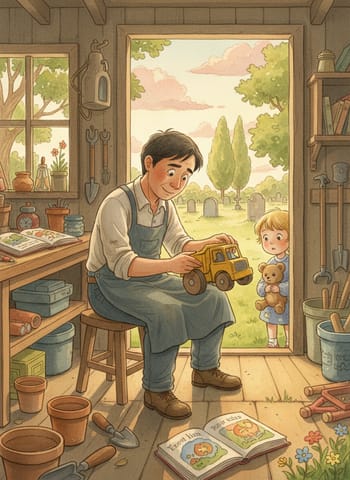
Today the head gardener is away at a supplier, and Yaw has the place to himself. He eats his lunch in the tool shed, where it smells of cut grass and oil. A radio on the shelf plays quietly, and the only other sound is the rustle of a plastic bag in the corner.
Hoy el jardinero jefe está en casa de un proveedor, y Yaw tiene el lugar para él solo. Almuerza en la caseta de herramientas, donde huele a pasto cortado y a aceite. Una radio en el estante suena bajito, y el único otro sonido es el crujido de una bolsa de plástico en el rincón.
He is halfway through his second helping of rice when someone knocks on the open door. A man stands there with a cardboard box in one hand and a small yellow toy truck in the other. He looks like someone who has been apologising for most of the day.
Va por la mitad de su segunda ración de arroz cuando alguien golpea la puerta abierta. Allí hay un hombre con una caja de cartón en una mano y un pequeño camión de juguete amarillo en la otra. Tiene aspecto de alguien que se ha pasado casi todo el día pidiendo disculpas.
"Excuse me," the man says. "I am looking for the office. A woman at the gate said it was behind the chapel, but I think I walked in a circle."
«Disculpe», dice el hombre. «Busco la oficina. Una mujer en la entrada me dijo que estaba detrás de la capilla, pero creo que anduve en círculos».
"The main office is closed today," Yaw says slowly, choosing each word. "Only me. I am the gardener. New gardener."
«La oficina principal está cerrada hoy», dice Yaw despacio, eligiendo cada palabra. «Solo yo. Soy el jardinero. Jardinero nuevo».
The man lets out a long breath and sits down on an upturned bucket, as if his legs have made the decision for him. His name is Madu, and he delivers flowers and stone samples for a company across the city. He has a van parked at the gate and a customer waiting in the chapel office. He also has a problem that has nothing to do with either of them.
El hombre suelta un largo suspiro y se sienta en un balde boca abajo, como si las piernas hubieran tomado la decisión por él. Se llama Madu, y reparte flores y muestras de piedra para una empresa al otro lado de la ciudad. Tiene una camioneta estacionada en la entrada y un cliente esperando en la oficina de la capilla. También tiene un problema que no tiene nada que ver con ninguno de los dos.
"It is my daughter's truck," Madu explains. He turns the toy over, and Yaw sees that one of the back wheels is missing. "She is four. She gave it to me this morning and said, 'Look after him, Papa.' Then, on the gravel path, the wheel just jumped off. I heard it roll away, and I could not find it anywhere."
«Es el camión de mi hija», explica Madu. Le da vuelta al juguete, y Yaw ve que falta una de las ruedas de atrás. «Tiene cuatro años. Me lo dio esta mañana y me dijo: “Cuídalo, papá”. Y luego, en el sendero de grava, la rueda simplemente saltó. La oí rodar y no pude encontrarla por ninguna parte».
Yaw leans closer. The truck is old, painted a cheerful yellow, with a small tipping bed at the back and a name scratched into the roof: BIG TOM. The axle is a thin steel rod, bent slightly at the end where the wheel used to sit.
Yaw se inclina más cerca. El camión es viejo, pintado de un alegre amarillo, con una pequeña caja volcable atrás y un nombre rayado en el techo: BIG TOM. El eje es una delgada varilla de acero, algo doblada en la punta donde estaba la rueda.
"She will ask for him tonight," Madu continues. "If I come home with a broken truck, I will have to explain that her father is a man who loses things. She already thinks I forget everything."
«Esta noche lo va a pedir», continúa Madu. «Si llego a casa con un camión roto, tendré que explicarle que su padre es un hombre que pierde las cosas. Ella ya piensa que yo me olvido de todo».
"Do you forget everything?" Yaw asks, and then worries that the question sounds rude.
«¿Usted se olvida de todo?», pregunta Yaw, y luego se preocupa de que la pregunta suene grosera.
Madu laughs, a short surprised laugh. "Only the important things."
Madu se ríe, una risa corta y sorprendida. «Solo de las cosas importantes».
For a moment neither of them speaks. Yaw looks at the truck, then at the shelves behind him. They are crowded with the odds and ends of a place that repairs everything itself. There are jars of screws, coils of wire, rubber washers, and a battered metal box labelled SPARES. Back home, he fixed bicycles for his cousins every holiday. He has not touched a toy in years, but his hands remember the work better than his English does.
Por un momento ninguno de los dos habla. Yaw mira el camión, luego los estantes detrás de él. Están repletos de los trastos de un lugar que lo repara todo por sí mismo. Hay frascos de tornillos, rollos de alambre, arandelas de goma y una caja de metal abollada con la etiqueta REPUESTOS. En su tierra, arreglaba bicicletas para sus primos todas las vacaciones. Hace años que no toca un juguete, pero sus manos recuerdan el trabajo mejor que su inglés.
"Wait," he says. "I think I can help."
«Espere», dice. «Creo que puedo ayudar».
Madu looks up, doubtful but hopeful. "You can fix a truck?"
Madu levanta la vista, dudoso pero esperanzado. «¿Puede arreglar un camión?».
"I can try. Maybe."
«Puedo intentar. Tal vez».
Yaw clears a corner of the workbench and switches on the lamp. First he straightens the bent end of the axle with a pair of pliers. He taps it gently against the vice so that the metal does not crack. Then he searches the jars for a wheel. He finds a wooden button, a bottle cap, and the lid of a spray can, but none of them is the right size.
Yaw despeja un rincón del banco de trabajo y enciende la lámpara. Primero endereza con unos alicates la punta doblada del eje. La golpea suavemente contra el tornillo de banco para que el metal no se quiebre. Luego busca una rueda en los frascos. Encuentra un botón de madera, una tapa de botella y la tapa de un aerosol, pero ninguno es del tamaño correcto.
"This is more difficult than I thought," Yaw admits.
«Esto es más difícil de lo que pensé», admite Yaw.
"Every repair is," says Madu, who has begun to watch with real interest. "My father was a carpenter. He always said that the first fix is only a rehearsal."
«Toda reparación lo es», dice Madu, que ha empezado a mirar con verdadero interés. «Mi padre era carpintero. Siempre decía que el primer arreglo es solo un ensayo».
Yaw almost smiles at that. He picks up the SPARES box and tips it onto the bench. Among the rusty nails there is a small rubber wheel from a seed trolley. It is about the same width as the other three, though a little greyer and a little newer. It is not a perfect match, but it spins smoothly when he flicks it with a finger.
Yaw casi sonríe al oírlo. Toma la caja de REPUESTOS y la vacía sobre el banco. Entre los clavos oxidados hay una pequeña rueda de goma de un carrito de semillas. Tiene más o menos el mismo ancho que las otras tres, aunque es un poco más gris y un poco más nueva. No es una pareja perfecta, pero gira con suavidad cuando le da un golpecito con el dedo.
"This one," he says. "It is not yellow."
«Esta», dice. «No es amarilla».
"It does not need to be yellow," Madu says. "It needs to roll."
«No necesita ser amarilla», dice Madu. «Necesita rodar».
The hole in the middle of the wheel is too wide for the thin axle. Yaw cuts a short piece from an old garden hose. He slides it inside as a sleeve. He presses the wheel on, adds a washer, and bends the tip of the axle over with the pliers so that nothing can slip off. The whole job takes twelve minutes, and by the end he has forgotten that he is supposed to be on his lunch break.
El agujero del centro de la rueda es demasiado ancho para el eje delgado. Yaw corta un trozo corto de una manguera de jardín vieja. Lo desliza adentro a modo de manguito. Presiona la rueda, añade una arandela y dobla la punta del eje con los alicates para que nada se salga. Todo el trabajo le toma doce minutos, y al final ya se ha olvidado de que se supone que está en su hora de almuerzo.
He sets the truck on the bench and gives it a push. It rolls straight and true all the way to the edge, and Madu catches it before it falls.
Pone el camión sobre el banco y lo empuja. Rueda recto y firme hasta el borde, y Madu lo atrapa antes de que caiga.
"Incredible," Madu whispers. He turns the truck over, checks the new wheel, and tests it once more across his palm. "It runs better than before. She will not believe this."
«Increíble», susurra Madu. Le da vuelta al camión, revisa la rueda nueva y lo prueba una vez más sobre la palma de la mano. «Rueda mejor que antes. No lo va a creer».
"One wheel is grey," Yaw warns him. "She will see."
«Una rueda es gris», le advierte Yaw. «Ella lo verá».
"Of course she will see. She sees everything." Madu pauses, thinking. "I will tell her that Big Tom had an accident and a doctor fixed him. Children understand that kind of story. The scar will be a good detail."
«Claro que lo verá. Ella lo ve todo». Madu hace una pausa, pensando. «Le diré que Big Tom tuvo un accidente y que un doctor lo arregló. Los niños entienden esa clase de historias. La cicatriz será un buen detalle».
Yaw feels a strange warmth in his chest, and it takes him a moment to recognise it. For nine days he has been the person who asks for help. He nods at instructions he only half understands, and he writes new words on the back of his hand. Now a stranger is thanking him, and the words are simple enough that he understands every one.
Yaw siente una extraña calidez en el pecho, y le toma un momento reconocerla. Durante nueve días ha sido la persona que pide ayuda. Asiente ante instrucciones que solo entiende a medias, y se anota palabras nuevas en el dorso de la mano. Ahora un desconocido le da las gracias, y las palabras son tan sencillas que entiende cada una.
Madu stands up, tucks the truck carefully into his jacket pocket, and picks up his box. At the door he stops.
Madu se pone de pie, guarda con cuidado el camión en el bolsillo de su chaqueta y recoge su caja. En la puerta se detiene.
"Please, tell me how I can pay you."
«Por favor, dígame cómo puedo pagarle».
"No payment," Yaw says. "It was a small job. Just show me the office."
«No hay pago», dice Yaw. «Fue un trabajo pequeño. Solo muéstreme la oficina».
"I will do better than that. I will walk you there myself, so that the next person who asks you can say, 'Yaw knows the way.'"
«Haré algo mejor. Lo acompañaré yo mismo, para que la próxima persona que le pregunte pueda decir: “Yaw conoce el camino”».
They leave the shed together and cross the lawn, where the grass is damp from the sprinkler. The paths are marked by neat lines from Yaw's rake. Madu points out a group of tall trees. His daughter likes to count them when he drives past on the main road. Yaw tells him their names in the language of his home, and Madu repeats them badly, and both of them laugh.
Salen juntos de la caseta y cruzan el prado, donde el pasto está húmedo por el aspersor. Los senderos están marcados por las líneas pulcras del rastrillo de Yaw. Madu señala un grupo de árboles altos. A su hija le gusta contarlos cuando él pasa en auto por la carretera principal. Yaw le dice sus nombres en la lengua de su tierra, y Madu los repite mal, y los dos se ríen.
At the chapel, Madu delivers his box to the woman in the chapel office, who signs without looking up. Then he turns back to the doorway where Yaw is waiting with his hands in his pockets.
En la capilla, Madu entrega su caja a la mujer de la oficina, que firma sin levantar la vista. Luego se vuelve hacia la puerta donde Yaw lo espera con las manos en los bolsillos.
"One last question," Madu says. "If the wheel breaks again, where do I bring him?"
«Una última pregunta», dice Madu. «Si la rueda se rompe otra vez, ¿adónde lo traigo?».
Yaw considers this seriously, with the full weight of his nine days of experience.
Yaw lo considera con seriedad, con todo el peso de sus nueve días de experiencia.
"Here," he says at last. "We are the best workshop in the city. Our customers never complain."
«Aquí», dice por fin. «Somos el mejor taller de la ciudad. Nuestros clientes nunca se quejan».