The Guard Dog Who Slept Through Everything
Una historia gratuita en inglés de nivel B2 para estudiantes, para leer en línea en 7 idiomas, con opción de escucharla en la app gratuita Storyteller.
A sister and brother selling their mother's things at a field sale discover that the day's takings went home in a box of cheap books.
¡Ese fue el avance! Escucha la historia completa en la app gratuita Storyteller. Descargar la app
El audio no está disponible en este momento.
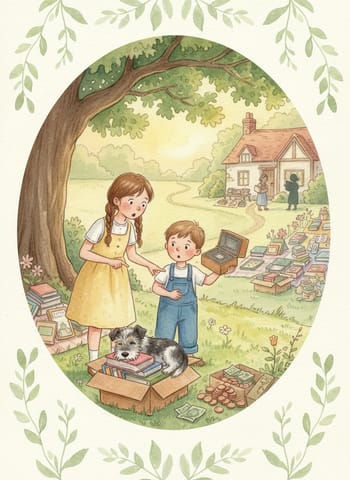
The car boot sale opened at seven, in a muddy field behind the garden centre. By half past seven, Kavya had already made her first mistake of the day. She had agreed to bring the dog.
La venta de maleteros de autos abría a las siete, en un campo embarrado detrás del vivero. A las siete y media, Kavya ya había cometido su primer error del día. Había aceptado traer al perro.
The dog was Luca's, an enormous grey animal with a face like a disappointed judge. Luca called him Security, and he had told everyone, with a completely straight face, that the dog had a professional background. In truth, Security's career had been short. He had never barked at a stranger, never chased a ball, and never been awake before ten. He lay under the pasting table with his chin on his paws and let the whole world walk past him.
El perro era de Luca, un enorme animal gris con cara de juez decepcionado. Luca lo llamaba Security, y le había dicho a todo el mundo, con total seriedad, que el perro tenía experiencia profesional. En realidad, la carrera de Security había sido corta. Nunca le había ladrado a un extraño, nunca había perseguido una pelota y nunca había estado despierto antes de las diez. Yacía bajo la mesa de empapelar con la barbilla sobre las patas y dejaba que el mundo entero pasara frente a él.
"He is a deterrent," Luca said, placing a bowl of water near the dog's nose. "Thieves see him and they think, that dog is trained."
«Es un elemento disuasorio», dijo Luca, poniendo un cuenco de agua cerca del hocico del perro. «Los ladrones lo ven y piensan: ese perro está entrenado».
"Thieves see him snoring," Kavya said.
«Los ladrones lo ven roncando», dijo Kavya.
"They see a trained dog, resting."
«Ven a un perro entrenado, descansando».
Their stall stood in the third row, between a man selling garden gnomes and a woman with a mountain of children's coats. They were emptying their mother's old flat. She had moved to a smaller one near the sea. Every drawer had given up something. Lamps, vases, a typewriter without its ribbon, a fondue set still in its box. Kavya had written the prices on bits of card, with a thick pen and not very much thought.
Su puesto estaba en la tercera fila, entre un hombre que vendía gnomos de jardín y una mujer con una montaña de abrigos de niño. Estaban vaciando el viejo departamento de su madre. Ella se había mudado a uno más pequeño cerca del mar. Cada cajón había entregado algo. Lámparas, jarrones, una máquina de escribir sin cinta, un juego de fondue todavía en su caja. Kavya había escrito los precios en trocitos de cartulina, con un marcador grueso y no mucha reflexión.
By ten they were doing well. A man bought the typewriter for the price of a lunch and walked away looking as if he had stolen a painting. A girl bought three vases and a lampshade. A family argued happily about the fondue set for twenty minutes and then bought it.
A las diez les iba bien. Un hombre compró la máquina de escribir por el precio de un almuerzo y se fue con aspecto de haber robado un cuadro. Una chica compró tres jarrones y una pantalla de lámpara. Una familia discutió felizmente sobre el juego de fondue durante veinte minutos y luego lo compró.
At noon, Kavya decided that the takings were getting too heavy for her apron pocket. She counted them quickly, a thick wad of notes and a pile of heavy coins, and she looked around for somewhere safe.
A mediodía, Kavya decidió que lo recaudado pesaba demasiado para el bolsillo de su delantal. Lo contó rápido, un grueso fajo de billetes y un montón de monedas pesadas, y buscó con la mirada un lugar seguro.
The old biscuit tin was right beside her, one of the tins from the flat that had once held biscuits and now held nothing. It had a tight lid and a picture of a cottage. She put the money inside and pressed the lid down. Then she carried it to the end of the table and tucked it into a cardboard box, out of sight.
La vieja lata de galletas estaba justo a su lado, una de las latas del departamento que alguna vez había contenido galletas y ahora no contenía nada. Tenía una tapa ajustada y la imagen de una casita de campo. Puso el dinero adentro y apretó la tapa. Luego la llevó al extremo de la mesa y la metió en una caja de cartón, fuera de la vista.
She was pleased with herself. It was a careful thing to do, and she did not often do careful things.
Estaba contenta consigo misma. Era algo prudente, y no solía hacer cosas prudentes.
The cardboard box was labelled in her own big handwriting: BOOKS, 50p EACH.
La caja de cartón estaba rotulada con su propia letra grande: LIBROS, 50 PENIQUES C/U.
At ten minutes past one, a woman in a green cap wandered up to the stall with a very large shopping bag. She picked through the cheap paperbacks and found a gardening guide, a book of crosswords and a dictionary with a broken spine. Then she looked up with a hopeful face.
A la una y diez, una mujer con gorra verde se acercó al puesto con una bolsa de compras muy grande. Revisó los libros de bolsillo baratos y encontró una guía de jardinería, un libro de crucigramas y un diccionario con el lomo roto. Luego levantó la vista con cara esperanzada.
"Could I take the whole box?" she asked. "I am furnishing a little reading room at my sister's house. I would give you ten pounds for all of it."
«¿Podría llevarme la caja entera?», preguntó. «Estoy armando una pequeña sala de lectura en casa de mi hermana. Le daría diez libras por todo».
"The whole box?" Kavya said. She was busy with a customer who wanted to know whether the lamps worked, and she was happy to see anything leave. "Of course. Ten pounds. That is very kind."
«¿La caja entera?», dijo Kavya. Estaba ocupada con un cliente que quería saber si las lámparas funcionaban, y se alegraba de ver salir cualquier cosa. «Claro. Diez libras. Es muy amable».
The woman lifted the box with a grunt, thanked her warmly, and disappeared into the crowd.
La mujer levantó la caja con un gruñido, le dio las gracias calurosamente y desapareció entre la multitud.
It was Luca who noticed. He had gone through the day with a pencil, keeping a rough count of what they had sold. Now he sat at the back of the stall adding up the figures. He added them once. Then he added them again, with the frown of a man who suspects the numbers of lying.
Fue Luca quien se dio cuenta. Había pasado el día con un lápiz, llevando una cuenta aproximada de lo vendido. Ahora estaba sentado al fondo del puesto sumando las cifras. Las sumó una vez. Luego las sumó otra vez, con el ceño fruncido de quien sospecha que los números mienten.
"Kavya," he said carefully. "Where did you put the money?"
«Kavya», dijo con cuidado. «¿Dónde pusiste el dinero?».
"In the tin. The cottage tin. I put it in the box of books, to hide it."
«En la lata. La lata de la casita. La puse en la caja de los libros, para esconderla».
"Which box?"
«¿Qué caja?».
"The one at the end of the table."
«La del extremo de la mesa».
Both of them turned to look at the end of the table, where the box had been. There was a clean square in the dust, and nothing else. Under the pasting table, Security sighed in his sleep and stretched out one paw, like a very expensive rug.
Los dos se volvieron a mirar el extremo de la mesa, donde había estado la caja. Había un cuadrado limpio en el polvo, y nada más. Bajo la mesa de empapelar, Security suspiró en sueños y estiró una pata, como una alfombra carísima.
"Kavya," said Luca, in a small voice. "You sold the money."
«Kavya», dijo Luca, con una voz pequeña. «Vendiste el dinero».
"I sold ten pounds of books."
«Vendí diez libras de libros».
"You sold one hundred and eighty pounds, a cottage tin, and some dictionaries."
«Vendiste ciento ochenta libras, una lata con una casita y unos diccionarios».
For a moment neither of them moved. Then Kavya seized her coat and her phone and ran. Luca followed her with the cash tray under his arm, calling out to the gnome seller to watch their table.
Por un momento ninguno de los dos se movió. Luego Kavya agarró su abrigo y su teléfono y salió corriendo. Luca la siguió con la bandeja de caja bajo el brazo, gritándole al vendedor de gnomos que cuidara su mesa.
The field was bigger than it had looked at seven in the morning. It went on and on, row after row of tables and open car boots, and every second person wore a cap. They checked the food van, where a long queue of people stood waiting for sausage rolls. They checked the toilets. They checked the dark corner behind the garden centre, where a man sat on a folding chair and sold lawn ornaments. He had seen a woman with a big box going toward the far gate. He could not say what colour her cap was.
El campo era más grande de lo que había parecido a las siete de la mañana. Seguía y seguía, fila tras fila de mesas y maleteros abiertos, y una de cada dos personas llevaba gorra. Revisaron la camioneta de comida, donde una larga cola de gente esperaba rollitos de salchicha. Revisaron los baños. Revisaron el rincón oscuro detrás del vivero, donde un hombre sentado en una silla plegable vendía adornos de césped. Había visto a una mujer con una caja grande camino a la puerta del fondo. No pudo decir de qué color era su gorra.
"Green," said Kavya, who could think of nothing else. "She was wearing green."
«Verde», dijo Kavya, que no podía pensar en nada más. «Llevaba verde».
"This is a field," Luca said. "Half the people here are wearing green."
«Esto es un campo», dijo Luca. «La mitad de la gente aquí lleva verde».
"We should have woken the dog."
«Deberíamos haber despertado al perro».
"The dog cannot track anything. The dog would sleep through an earthquake."
«El perro no puede rastrear nada. El perro dormiría durante un terremoto».
"Then why did we take him?"
«Entonces, ¿por qué lo trajimos?».
"For morale," said Luca, and he put his hands over his face.
«Por moral», dijo Luca, y se tapó la cara con las manos.
They ran back along the third row, out of breath, with a plan they both knew was hopeless. They would split up and search the far gate. They would ask every green cap. They would put up a sign.
Volvieron corriendo por la tercera fila, sin aliento, con un plan que ambos sabían que era inútil. Se separarían y buscarían en la puerta del fondo. Preguntarían a cada gorra verde. Pondrían un cartel.
Then Kavya stopped so suddenly that Luca walked into her.
Entonces Kavya se detuvo tan de golpe que Luca se chocó con ella.
The woman in the green cap was standing at their stall.
La mujer de la gorra verde estaba parada en su puesto.
She stood next to the pasting table with the cardboard box in her arms. She was looking carefully left and right, like someone trying to find the owner of a parcel. Beside her feet lay Security, who had not so much as opened one eye. A small crowd of the gnome seller's customers was watching with great interest.
Estaba junto a la mesa de empapelar con la caja de cartón en los brazos. Miraba con cuidado a izquierda y derecha, como alguien que busca al dueño de un paquete. Junto a sus pies yacía Security, que no había abierto ni un ojo. Un pequeño grupo de clientes del vendedor de gnomos observaba con gran interés.
"Oh, thank goodness," the woman said, as Kavya reached her. She lifted the lid of the biscuit tin. "I opened it at my car to put my change in. I thought, goodness, that is not mine. I have been walking around for twenty minutes trying to remember your table."
«Ay, gracias al cielo», dijo la mujer cuando Kavya llegó hasta ella. Levantó la tapa de la lata de galletas. «La abrí en mi auto para guardar mi cambio. Y pensé: cielos, esto no es mío. Llevo veinte minutos caminando tratando de acordarme de su mesa».
"You came back," Kavya said weakly. "You walked all the way back with a hundred and eighty pounds."
«Volvió», dijo Kavya débilmente. «Caminó todo el camino de vuelta con ciento ochenta libras».
"I could hardly keep it. That is far too much to pay for a dictionary." The woman handed over the tin with a smile, and then she glanced down at the enormous grey shape snoring beside her ankles. "I have to say, I was a little worried about passing the dog. But he did not even look up."
«No podía quedármelo. Es demasiado para pagar por un diccionario». La mujer le entregó la lata con una sonrisa, y luego miró hacia abajo la enorme forma gris que roncaba junto a sus tobillos. «Debo decir que me preocupaba un poco pasar junto al perro. Pero ni siquiera levantó la vista».
"No," said Luca, pressing the tin to his chest. "That is his speciality."
«No», dijo Luca, apretando la lata contra su pecho. «Esa es su especialidad».
"Is he not a guard dog?"
«¿No es un perro guardián?».
"He is a very advanced guard dog," Luca said. "He guards the stall from stress. Most days he does it better than we do."
«Es un perro guardián muy avanzado», dijo Luca. «Protege el puesto del estrés. La mayoría de los días lo hace mejor que nosotros».
Kavya took a twenty-pound note from the tin and pressed it into the woman's hand. Then she insisted that the dictionary was a gift, which seemed only fair. Then she knelt on the grass and scratched Security gently behind the ear. He opened one enormous brown eye, looked at her with perfect contentment, and went back to sleep.
Kavya sacó un billete de veinte libras de la lata y se lo puso en la mano a la mujer. Luego insistió en que el diccionario era un regalo, lo cual parecía lo justo. Luego se arrodilló en el pasto y le rascó suavemente detrás de la oreja a Security. Él abrió un enorme ojo café, la miró con perfecto contento, y volvió a dormirse.
"Pay him in sausage rolls," she told Luca. "Two. He just saved our whole day."
«Págale en rollitos de salchicha», le dijo a Luca. «Dos. Acaba de salvarnos todo el día».
"Technically," said Luca, "he slept through it."
«Técnicamente», dijo Luca, «lo durmió».
"That," said Kavya, "is exactly what we are paying him for."
«Eso», dijo Kavya, «es exactamente por lo que le estamos pagando».