The Hilltop Shelter and the Wrong Shoes
A free B2-level English story for language learners, readable online in 7 languages, with an option to listen via the free Storyteller app.
The new chairman of a village running club discovers, twenty-five minutes before his first race, that he is wearing two completely different shoes.
That was the preview! Hear the full story in the free Storyteller app. Get the app
Audio isn't available right now.
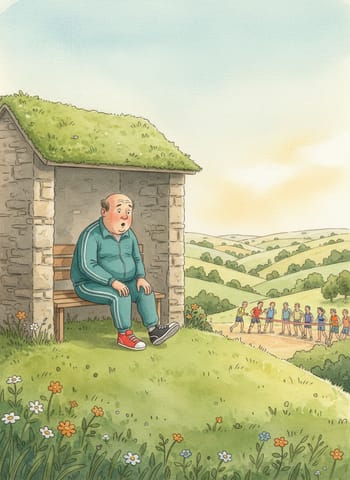
At twenty-five to seven on the morning of the Hill Dash, Hendrik arrives at the bus shelter on top of the hill. He carries a starting flag and a stopwatch, and he has a feeling that he has forgotten something. He is the new chairman of the village running club, and this is his first race as the person in charge. He has laid out his clothes the night before. He has set two alarms. He has rehearsed his welcome speech in the bathroom mirror until his toothbrush looks bored.
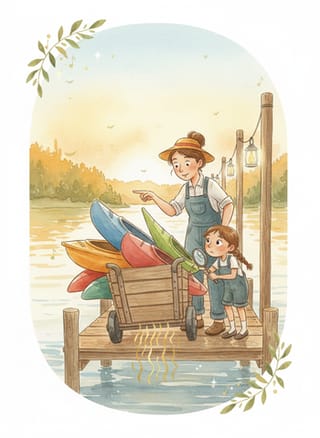
The shelter is an odd place for a race finish, but it is the only building for a mile. It is a small brick box with a tin roof and a long wooden bench. A notice board is crowded with posters for lost cats and yoga classes. Nobody has waited for a bus here for years. Instead the village uses it as a meeting point, a lookout and, once a month, a collection point for the school's shoe drive.
Giulia is already there, standing next to a big blue crate with a hand-painted sign that says OUTGROWN SHOES, PLEASE. She runs the shoe drive, and she also chairs the Hill Dash committee. She has a clipboard, a flask of coffee and the unhurried air of someone who has done this before.
"Good morning, Chairman," she says. "You are early."
"I like to be prepared," Hendrik says, with dignity.
He strides up to the bench, sets down his flag and checks his watch. Then he sits, stretches out his legs and looks at his feet.
On his left foot he is wearing a heavy brown leather walking boot. On his right foot he is wearing a thin white running shoe with a bright green stripe.
For a few seconds he does not move at all. Perhaps it is a trick of the early light, he thinks. He closes his eyes and opens them again, and the shoes are still different.
"Giulia," he says carefully. "How long have you been standing there?"
"Since six," Giulia says. "I noticed the shoes when you came up the lane. I thought it might be a fashion choice."
"It is not a fashion choice."
"Then it is a very confident mistake."
Hendrik looks down the hill. Far below, on the village green, a small crowd is already gathering at the starting line. There are runners in bright shirts, children on their parents' shoulders and a man with a trumpet. The race begins at seven. The starter must give the signal from the top. The starter must be Hendrik, because the club rules say so, and he wrote them himself.
"It was dark in the kitchen," he says, in a thin voice. "I dressed quietly because my family was still asleep. I picked up two shoes by the back door, and I did not look."
"Don't worry," Giulia says. "It happens. Last year the mayor wore two different socks, and nobody said a word."
"Because he is the mayor."
"Because they were too busy laughing."
Hendrik puts his head in his hands. Then, because there is nothing else to do, he walks to the notice board and back, to find out how bad it really is. It is very bad. The boot is too stiff, the shoe is too light, and the result is a slow, lopsided limp that makes him look like a pirate. A boy of about ten, who has just reached the top of the hill with his mother, stops dead and stares.
"Why is that man wearing a boot on one foot?" the boy asks, loudly.
"He is a very dedicated runner," Giulia says, without blinking.
Hendrik sits down again and unlaces both shoes. For a moment he considers going home, but home is forty minutes away on foot, and the race starts in twenty. He considers starting the race in his socks. He considers moving to another country.
"Wait," Giulia says. She puts down her coffee and looks at the blue crate. "What size do you take?"
"Forty-five."
"Hmm. That is large for a school shoe drive. But let's see."
They kneel together on the concrete floor and begin to lift out the shoes. The crate is full of the small, hopeful objects that children leave behind as they grow. There are tiny sandals, football boots with the studs worn flat and a single glittery slipper with no partner. Giulia pulls out a pair of ballet shoes and holds them up to Hendrik's foot. They are the size of his hand.
"Not those," he says.
"No. Probably not those."
By a quarter to seven, the floor of the shelter is covered with shoes in a wide, colourful circle. The boy and his mother have settled on the bench to watch. He offers advice. He suggests a rubber boot. He suggests tying the walking boot to the running shoe with string and wearing them as a pair. Hendrik thanks him, politely, for neither.
At ten minutes to seven, Giulia says, "Oh."
She is holding a pair of faded blue running shoes, very large and slightly cracked at the toes. She turns one over and reads the label inside the tongue, where someone has written a name in black marker.
"Hendrik," she says slowly, "these are yours."
He takes the shoe from her hand and looks. It is true. His own handwriting stares back at him. He remembers now. Last month he bought a new pair, and his wife told him to be sensible about the old ones. So he dropped them into this very crate on his way to the shop. He had felt rather noble about it. He had told the story twice at dinner.
"I gave away my own shoes," he says, "and now I have come to take them back."
"Technically," Giulia says, "you are borrowing them. The school will get the new ones."
"I don't understand."
"You will leave a donation in the tin for a replacement pair. The children lose nothing, and you lose a little pride. It is a fair arrangement."
Hendrik considers this, then nods. He takes two coins from his pocket, drops them in the tin on the bench, and adds a third for the boy's good advice. He laces up the blue shoes with quick, steady fingers, and they feel like old friends who forgive everything. He stuffs the walking boot and the white running shoe into his bag, to be dealt with later at home.
At two minutes to seven he stands at the edge of the hill and looks down. The crowd has become a bright blur of colour. Somebody blows a note on the trumpet. Giulia stands beside him with her coffee, and the boy stands beside her. All three of them watch the second hand of the stopwatch crawl towards the top.
Hendrik takes the starting flag in both hands, lifts it high above his head, and waits for every face below to turn up towards him.
Then he brings it down.