The Hilltop Shelter and the Wrong Shoes
Una historia gratuita en inglés de nivel B2 para estudiantes, para leer en línea en 7 idiomas, con opción de escucharla en la app gratuita Storyteller.
The new chairman of a village running club discovers, twenty-five minutes before his first race, that he is wearing two completely different shoes.
¡Ese fue el avance! Escucha la historia completa en la app gratuita Storyteller. Descargar la app
El audio no está disponible en este momento.
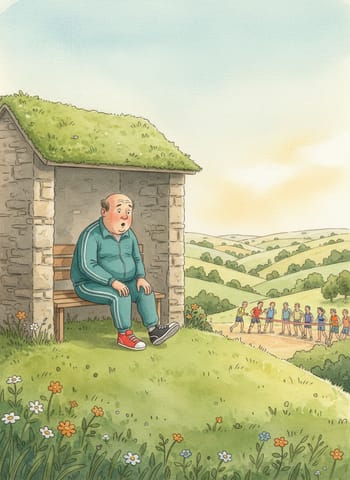
At twenty-five to seven on the morning of the Hill Dash, Hendrik arrives at the bus shelter on top of the hill. He carries a starting flag and a stopwatch, and he has a feeling that he has forgotten something. He is the new chairman of the village running club, and this is his first race as the person in charge. He has laid out his clothes the night before. He has set two alarms. He has rehearsed his welcome speech in the bathroom mirror until his toothbrush looks bored.
A las siete menos veinticinco de la mañana de la Carrera de la Colina, Hendrik llega a la parada de autobús en lo alto de la colina. Lleva una bandera de salida y un cronómetro, y tiene la sensación de haber olvidado algo. Es el nuevo presidente del club de corredores del pueblo, y esta es su primera carrera como responsable. Dejó su ropa preparada la noche anterior. Puso dos alarmas. Ensayó su discurso de bienvenida frente al espejo del baño hasta que su cepillo de dientes parecía aburrido.
The shelter is an odd place for a race finish, but it is the only building for a mile. It is a small brick box with a tin roof and a long wooden bench. A notice board is crowded with posters for lost cats and yoga classes. Nobody has waited for a bus here for years. Instead the village uses it as a meeting point, a lookout and, once a month, a collection point for the school's shoe drive.
La parada es un lugar extraño para una meta, pero es el único edificio en una milla a la redonda. Es una pequeña caja de ladrillo con techo de lata y una larga banca de madera. Un tablero de anuncios está repleto de carteles de gatos perdidos y clases de yoga. Hace años que nadie espera un autobús aquí. En cambio, el pueblo la usa como punto de encuentro, mirador y, una vez al mes, punto de recolección de la campaña de zapatos de la escuela.
Giulia is already there, standing next to a big blue crate with a hand-painted sign that says OUTGROWN SHOES, PLEASE. She runs the shoe drive, and she also chairs the Hill Dash committee. She has a clipboard, a flask of coffee and the unhurried air of someone who has done this before.
Giulia ya está ahí, de pie junto a un gran cajón azul con un letrero pintado a mano que dice ZAPATOS QUE YA NO LES QUEDAN, POR FAVOR. Ella dirige la campaña de zapatos y también preside el comité de la Carrera de la Colina. Tiene una tabla con papeles, un termo de café y el aire tranquilo de quien ya ha hecho esto antes.
"Good morning, Chairman," she says. "You are early."
«Buenos días, presidente», dice. «Llegó temprano».
"I like to be prepared," Hendrik says, with dignity.
«Me gusta estar preparado», dice Hendrik, con dignidad.
He strides up to the bench, sets down his flag and checks his watch. Then he sits, stretches out his legs and looks at his feet.
Avanza a grandes pasos hasta la banca, deja la bandera y revisa su reloj. Luego se sienta, estira las piernas y se mira los pies.
On his left foot he is wearing a heavy brown leather walking boot. On his right foot he is wearing a thin white running shoe with a bright green stripe.
En el pie izquierdo lleva una pesada bota de cuero marrón para caminar. En el pie derecho lleva un delgado zapato blanco de correr con una brillante franja verde.
For a few seconds he does not move at all. Perhaps it is a trick of the early light, he thinks. He closes his eyes and opens them again, and the shoes are still different.
Durante unos segundos no se mueve en absoluto. Quizás sea un truco de la luz temprana, piensa. Cierra los ojos y los abre otra vez, y los zapatos siguen siendo distintos.
"Giulia," he says carefully. "How long have you been standing there?"
«Giulia», dice con cuidado. «¿Cuánto tiempo llevas ahí parada?».
"Since six," Giulia says. "I noticed the shoes when you came up the lane. I thought it might be a fashion choice."
«Desde las seis», dice Giulia. «Noté los zapatos cuando subías por el camino. Pensé que podía ser una decisión de moda».
"It is not a fashion choice."
«No es una decisión de moda».
"Then it is a very confident mistake."
«Entonces es un error muy seguro de sí mismo».
Hendrik looks down the hill. Far below, on the village green, a small crowd is already gathering at the starting line. There are runners in bright shirts, children on their parents' shoulders and a man with a trumpet. The race begins at seven. The starter must give the signal from the top. The starter must be Hendrik, because the club rules say so, and he wrote them himself.
Hendrik mira colina abajo. Muy abajo, en la plaza del pueblo, una pequeña multitud ya se reúne en la línea de salida. Hay corredores con camisetas brillantes, niños en los hombros de sus padres y un hombre con una trompeta. La carrera empieza a las siete. El juez de salida debe dar la señal desde arriba. El juez de salida debe ser Hendrik, porque lo dicen las reglas del club, y él mismo las escribió.
"It was dark in the kitchen," he says, in a thin voice. "I dressed quietly because my family was still asleep. I picked up two shoes by the back door, and I did not look."
«Estaba oscuro en la cocina», dice con voz débil. «Me vestí en silencio porque mi familia seguía dormida. Agarré dos zapatos junto a la puerta trasera y no miré».
"Don't worry," Giulia says. "It happens. Last year the mayor wore two different socks, and nobody said a word."
«No te preocupes», dice Giulia. «Pasa. El año pasado el alcalde llevó dos calcetines distintos y nadie dijo una palabra».
"Because he is the mayor."
«Porque es el alcalde».
"Because they were too busy laughing."
«Porque estaban demasiado ocupados riéndose».
Hendrik puts his head in his hands. Then, because there is nothing else to do, he walks to the notice board and back, to find out how bad it really is. It is very bad. The boot is too stiff, the shoe is too light, and the result is a slow, lopsided limp that makes him look like a pirate. A boy of about ten, who has just reached the top of the hill with his mother, stops dead and stares.
Hendrik se hunde la cabeza entre las manos. Luego, como no hay nada más que hacer, camina hasta el tablero de anuncios y regresa, para averiguar qué tan mal está en realidad. Está muy mal. La bota es demasiado rígida, el zapato demasiado ligero, y el resultado es una cojera lenta y torcida que lo hace parecer un pirata. Un niño de unos diez años, que acaba de llegar a la cima con su madre, se detiene en seco y se queda mirando.
"Why is that man wearing a boot on one foot?" the boy asks, loudly.
«¿Por qué ese señor lleva una bota en un pie?», pregunta el niño en voz alta.
"He is a very dedicated runner," Giulia says, without blinking.
«Es un corredor muy dedicado», dice Giulia, sin parpadear.
Hendrik sits down again and unlaces both shoes. For a moment he considers going home, but home is forty minutes away on foot, and the race starts in twenty. He considers starting the race in his socks. He considers moving to another country.
Hendrik vuelve a sentarse y se desata los dos zapatos. Por un momento piensa en irse a casa, pero su casa queda a cuarenta minutos a pie y la carrera empieza en veinte. Piensa en empezar la carrera en calcetines. Piensa en mudarse a otro país.
"Wait," Giulia says. She puts down her coffee and looks at the blue crate. "What size do you take?"
«Espera», dice Giulia. Deja su café y mira el cajón azul. «¿Qué talla calzas?».
"Forty-five."
«Cuarenta y cinco».
"Hmm. That is large for a school shoe drive. But let's see."
«Mmm. Es mucho para una campaña de zapatos escolares. Pero veamos».
They kneel together on the concrete floor and begin to lift out the shoes. The crate is full of the small, hopeful objects that children leave behind as they grow. There are tiny sandals, football boots with the studs worn flat and a single glittery slipper with no partner. Giulia pulls out a pair of ballet shoes and holds them up to Hendrik's foot. They are the size of his hand.
Se arrodillan juntos sobre el piso de concreto y empiezan a sacar los zapatos. El cajón está lleno de esos objetos pequeños y esperanzados que los niños dejan atrás al crecer. Hay diminutas sandalias, zapatos de fútbol con los tacos gastados hasta quedar planos y una única zapatilla con brillos, sin su pareja. Giulia saca un par de zapatillas de ballet y las sostiene junto al pie de Hendrik. Son del tamaño de su mano.
"Not those," he says.
«Esas no», dice él.
"No. Probably not those."
«No. Probablemente esas no».
By a quarter to seven, the floor of the shelter is covered with shoes in a wide, colourful circle. The boy and his mother have settled on the bench to watch. He offers advice. He suggests a rubber boot. He suggests tying the walking boot to the running shoe with string and wearing them as a pair. Hendrik thanks him, politely, for neither.
Para cuando faltan quince para las siete, el piso de la parada está cubierto de zapatos en un amplio círculo de colores. El niño y su madre se han instalado en la banca para mirar. Él ofrece consejos. Sugiere una bota de goma. Sugiere atar la bota de caminar al zapato de correr con un cordel y usarlos como un par. Hendrik le agradece con cortesía, pero no acepta ninguna.
At ten minutes to seven, Giulia says, "Oh."
A las siete menos diez, Giulia dice: «Oh».
She is holding a pair of faded blue running shoes, very large and slightly cracked at the toes. She turns one over and reads the label inside the tongue, where someone has written a name in black marker.
Sostiene un par de zapatillas azules desteñidas, muy grandes y un poco agrietadas en la punta. Le da la vuelta a una y lee la etiqueta dentro de la lengüeta, donde alguien escribió un nombre con marcador negro.
"Hendrik," she says slowly, "these are yours."
«Hendrik», dice despacio, «estas son tuyas».
He takes the shoe from her hand and looks. It is true. His own handwriting stares back at him. He remembers now. Last month he bought a new pair, and his wife told him to be sensible about the old ones. So he dropped them into this very crate on his way to the shop. He had felt rather noble about it. He had told the story twice at dinner.
Él toma el zapato de su mano y mira. Es verdad. Su propia letra le devuelve la mirada. Ahora lo recuerda. El mes pasado compró un par nuevo, y su esposa le dijo que fuera sensato con los viejos. Así que los dejó caer en este mismo cajón de camino a la tienda. Se había sentido bastante noble. Había contado la historia dos veces en la cena.
"I gave away my own shoes," he says, "and now I have come to take them back."
«Regalé mis propios zapatos», dice, «y ahora vine a llevármelos de vuelta».
"Technically," Giulia says, "you are borrowing them. The school will get the new ones."
«Técnicamente», dice Giulia, «te los estás prestando. La escuela recibirá los nuevos».
"I don't understand."
«No entiendo».
"You will leave a donation in the tin for a replacement pair. The children lose nothing, and you lose a little pride. It is a fair arrangement."
«Dejarás una donación en la lata para un par de reemplazo. Los niños no pierden nada, y tú pierdes un poco de orgullo. Es un trato justo».
Hendrik considers this, then nods. He takes two coins from his pocket, drops them in the tin on the bench, and adds a third for the boy's good advice. He laces up the blue shoes with quick, steady fingers, and they feel like old friends who forgive everything. He stuffs the walking boot and the white running shoe into his bag, to be dealt with later at home.
Hendrik lo considera y luego asiente. Saca dos monedas del bolsillo, las echa en la lata de la banca y añade una tercera por el buen consejo del niño. Se ata las zapatillas azules con dedos rápidos y firmes, y se sienten como viejos amigos que lo perdonan todo. Mete la bota de caminar y el zapato blanco de correr en su bolsa, para ocuparse de ellos más tarde en casa.
At two minutes to seven he stands at the edge of the hill and looks down. The crowd has become a bright blur of colour. Somebody blows a note on the trumpet. Giulia stands beside him with her coffee, and the boy stands beside her. All three of them watch the second hand of the stopwatch crawl towards the top.
A las siete menos dos minutos se para en el borde de la colina y mira hacia abajo. La multitud se ha vuelto una borrosa mancha de colores brillantes. Alguien suelta una nota en la trompeta. Giulia está a su lado con su café, y el niño está a su lado. Los tres miran cómo el segundero del cronómetro avanza arrastrándose hacia la cima.
Hendrik takes the starting flag in both hands, lifts it high above his head, and waits for every face below to turn up towards him.
Hendrik toma la bandera de salida con ambas manos, la levanta muy alto sobre su cabeza y espera a que todos los rostros de abajo se vuelvan hacia él.
Then he brings it down.
Entonces la baja.