The Crocodile Under Larch Bridge
Uma história gratuita em inglês de nível B1 para estudantes, para ler online em 7 idiomas, com opção de ouvir no app gratuito Storyteller.
Two street performers fight over the best echo in town until a city rule forces them to make one act together.
Essa foi a prévia! Ouça a história completa no app gratuito Storyteller. Baixar o app
O áudio não está disponível no momento.
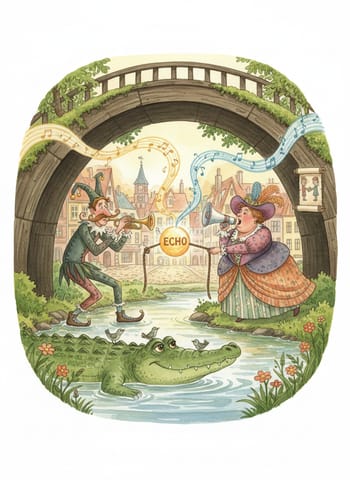
Xavi plays the guitar under Larch Bridge every afternoon at four. He chooses the spot for one reason. The curved stone roof makes every note sound twice as big. Even a bad chord sounds like a church organ down there.
Xavi toca violão debaixo da Ponte Larch todas as tardes às quatro. Ele escolhe o lugar por um único motivo. O teto curvo de pedra faz cada nota soar duas vezes maior. Até um acorde errado soa como um órgão de igreja lá embaixo.
Today he arrives with his guitar case and finds a girl in his place. She sits on an upturned bucket with a milk crate in front of her. On the crate lie two big oven gloves, one green and one yellow. She is humming to them.
Hoje ele chega com o estojo do violão e encontra uma menina no lugar dele. Ela está sentada num balde virado de cabeça para baixo, com um caixote de leite à frente. Em cima do caixote há duas luvas de forno grandes, uma verde e uma amarela. Ela está cantarolando para elas.
"Excuse me," says Xavi. "That is my pitch."
"Com licença", diz Xavi. "Esse é o meu ponto."
"I don't see your name on it," the girl says. She does not look up.
"Não vejo seu nome nele", diz a menina. Ela não levanta os olhos.
"I have played here for two years."
"Toco aqui há dois anos."
"And I have wanted to play here for two years. Today I am here first."
"E eu quero tocar aqui há dois anos. Hoje eu cheguei primeiro."
Xavi opens his mouth to argue. But a man in a long coat stops to hear the girl hum. Then he drops a coin on the crate. Xavi stares at the coin as if it is a personal insult.
Xavi abre a boca para discutir. Mas um homem de casaco comprido para para ouvir a menina cantarolar. Então ele deixa cair uma moeda no caixote. Xavi encara a moeda como se fosse um insulto pessoal.
"Fine," he says. "I will stand at the other end."
"Tudo bem", diz ele. "Eu fico na outra ponta."
The other end of the bridge is a bad spot. The echo is weak, and a noisy road runs next to it. Xavi plays his best song twice, and nobody stops. He hears the girl at the far end, and she is laughing. A small crowd has formed around her.
A outra ponta da ponte é um lugar ruim. O eco é fraco, e uma estrada barulhenta passa ao lado. Xavi toca sua melhor música duas vezes, e ninguém para. Ele ouve a menina na outra ponta, e ela está rindo. Uma pequena multidão se formou em volta dela.
He walks back to look. The girl, whose name is Sigrid, has pushed her hands into the oven gloves. The green glove is a crocodile with a huge mouth. The yellow glove is a very nervous duck. The crocodile tries to eat the duck, and the duck makes a speech to stop it. The children scream with joy.
Ele volta para ver. A menina, que se chama Sigrid, enfiou as mãos nas luvas de forno. A luva verde é um crocodilo com uma bocarra enorme. A luva amarela é um pato muito nervoso. O crocodilo tenta comer o pato, e o pato faz um discurso para impedi-lo. As crianças gritam de alegria.
Xavi hates how good it is. He also notices that the stone roof makes the duck sound brave.
Xavi odeia como é bom. Também percebe que o teto de pedra faz o pato soar corajoso.
The next day he arrives at three, one hour early, with a folding chair. Sigrid is already there, sitting on her bucket, and she smiles like a cat.
No dia seguinte, ele chega às três, uma hora mais cedo, com uma cadeira dobrável. Sigrid já está lá, sentada no balde, e sorri como um gato.
"You are early," she says.
"Você chegou cedo", diz ela.
"So are you."
"Você também."
"I live next to the bridge. I win."
"Eu moro ao lado da ponte. Eu ganho."
For a week they fight over the pitch without saying much. One day he plays so loudly that the duck cannot be heard. The next day she turns the crocodile into a monster that chases his guitar. Nobody enjoys the contest more than the crowd. On Friday a woman gives Xavi a coin and whispers, "Please don't stop arguing."
Durante uma semana, eles brigam pelo ponto sem dizer muito. Um dia ele toca tão alto que não se ouve o pato. No dia seguinte ela transforma o crocodilo num monstro que persegue o violão dele. Ninguém aproveita mais a disputa do que o público. Na sexta-feira, uma mulher dá uma moeda a Xavi e sussurra: "Por favor, não parem de brigar."
Then a man in a green jacket arrives with a clipboard. He is from the city office, and he does not smile at anyone.
Então um homem de jaqueta verde chega com uma prancheta. Ele é da prefeitura e não sorri para ninguém.
"I have a complaint," he says. "Two street acts in one pitch is against the rules. Under this bridge, only one act is allowed."
"Tenho uma reclamação", diz ele. "Dois números de rua no mesmo ponto vão contra as regras. Debaixo desta ponte, só é permitido um."
"Which one?" asks Sigrid.
"Qual deles?", pergunta Sigrid.
"That is for me to decide. Come to my office on Monday with your act, and I will choose."
"Isso eu é que decido. Venham ao meu escritório na segunda-feira com o número de vocês, e eu escolho."
Xavi and Sigrid look at each other. Each of them thinks the other act is a danger to the pitch. Neither of them speaks until the man has gone.
Xavi e Sigrid se entreolham. Cada um acha que o número do outro é uma ameaça ao ponto. Nenhum dos dois fala até o homem ir embora.
"If I lose this spot," Xavi says finally, "I lose my best echo."
"Se eu perder este lugar", diz Xavi por fim, "perco meu melhor eco."
"If I lose it, I lose my best audience," Sigrid says. "Nobody stops on the other side of the road."
"Se eu perder, perco meu melhor público", diz Sigrid. "Ninguém para do outro lado da estrada."
"We could play for him at the same time. As one act."
"Podíamos tocar para ele ao mesmo tempo. Como um número só."
"A guitar and a crocodile?" She laughs, but she does not say no.
"Um violão e um crocodilo?" Ela ri, mas não diz não.
They have three days. They spend the first one in Xavi's garage. His father keeps old paint tins there, and a broken lawn mower. Sigrid brings the gloves in a shopping bag. Xavi brings his guitar and a big pot of glue.
Eles têm três dias. Passam o primeiro na garagem de Xavi. O pai dele guarda ali latas de tinta velhas e um cortador de grama quebrado. Sigrid traz as luvas numa sacola de compras. Xavi traz o violão e um pote grande de cola.
"The gloves need eyes," he says. "At the moment the crocodile looks like a kitchen accident."
"As luvas precisam de olhos", diz ele. "No momento, o crocodilo parece um acidente de cozinha."
"You can't glue eyes on. They must move."
"Você não pode colar os olhos. Eles precisam se mexer."
"Then I will sew buttons."
"Então vou costurar botões."
"You can't sew," she says.
"Você não sabe costurar", diz ela.
"I can learn."
"Posso aprender."
By the end of the afternoon he has sewn two big white buttons on the green glove. One of them hangs by a thread, and the crocodile looks dizzy. Sigrid claps her hands over her mouth and laughs until she cries. Xavi pretends to be angry, but he is laughing too.
No fim da tarde, ele costurou dois botões brancos grandes na luva verde. Um deles pende de um fio, e o crocodilo parece tonto. Sigrid cobre a boca com as mãos e ri até chorar. Xavi finge estar bravo, mas também está rindo.
On the second day the real work begins, and it is harder. Xavi plays a quiet song, and Sigrid says it is too sad for a crocodile. She hums a new tune, and Xavi says it has no rhythm. They both lose their patience. For an hour they sit at opposite ends of the garage. The only sound is a dripping tap.
No segundo dia, o trabalho de verdade começa, e é mais difícil. Xavi toca uma música tranquila, e Sigrid diz que é triste demais para um crocodilo. Ela cantarola uma melodia nova, e Xavi diz que não tem ritmo. Os dois perdem a paciência. Por uma hora, ficam sentados em extremos opostos da garagem. O único som é uma torneira pingando.
"I have an idea," Sigrid says at last. "You always play the same chords. What happens if the crocodile hates them?"
"Tenho uma ideia", diz Sigrid por fim. "Você sempre toca os mesmos acordes. E se o crocodilo os odiasse?"
"Why would he hate my chords?"
"Por que ele odiaria meus acordes?"
"Because they sleep. He wants them to wake up."
"Porque eles dormem. Ele quer que acordem."
Xavi thinks about that. Then he plays the chords fast, with a funny jump at the end. The green glove snaps its mouth on the last note. The sound is perfect. The crocodile looks at the guitar, then at Xavi, and then it bites his sleeve.
Xavi pensa nisso. Então toca os acordes rápido, com um pulinho engraçado no final. A luva verde fecha a boca na última nota. O som é perfeito. O crocodilo olha para o violão, depois para Xavi, e então morde a manga dele.
"Again," Xavi says. "But slower."
"De novo", diz Xavi. "Mas mais devagar."
On the third day they practise until the sun goes down. Sigrid learns that Xavi taps his foot when he is nervous. Xavi learns that she says "hmm" before every joke, so that the audience feels it coming. Each of them hides a small smile every time the other does something clever.
No terceiro dia, ensaiam até o sol se pôr. Sigrid descobre que Xavi bate o pé quando está nervoso. Xavi descobre que ela diz "hmm" antes de cada piada, para o público sentir que ela vem vindo. Cada um esconde um sorrisinho toda vez que o outro faz algo esperto.
On Monday they walk into the city office with their instruments, the gloves and a plan. The man in the green jacket sits at a desk with a cup of coffee. He does not look pleased to see them. Sigrid puts the crocodile on her right hand, and Xavi sits on a chair and starts to play.
Na segunda-feira, entram na prefeitura com os instrumentos, as luvas e um plano. O homem de jaqueta verde está sentado a uma mesa com uma xícara de café. Não parece contente em vê-los. Sigrid põe o crocodilo na mão direita, e Xavi senta numa cadeira e começa a tocar.
The show lasts four minutes. The duck gets lost in the office. The crocodile finds the duck and wants to eat it, but the duck sings a sad song instead. The crocodile stops, because it has never heard a duck sing. In the end the two gloves dance on the man's desk. The guitar plays so fast that the coffee shakes.
O espetáculo dura quatro minutos. O pato se perde no escritório. O crocodilo encontra o pato e quer comê-lo, mas o pato canta uma canção triste em vez disso. O crocodilo para, porque nunca ouviu um pato cantar. No fim, as duas luvas dançam na mesa do homem. O violão toca tão rápido que o café treme.
The man does not smile. He writes something on his clipboard and tears off the page.
O homem não sorri. Escreve algo na prancheta e arranca a folha.
"One permit," he says. "Both of you on it. One act, one pitch."
"Uma licença", diz ele. "Os dois nela. Um número, um ponto."
"Is that a yes?" asks Xavi.
"Isso é um sim?", pergunta Xavi.
"It is a yes. And please, no more arguing under the bridge." He turns his face away, but his shoulders are shaking.
"É um sim. E por favor, chega de brigas debaixo da ponte." Ele vira o rosto, mas seus ombros estão tremendo.
They walk back to Larch Bridge in the late light. The stone roof glows gold. For the first time that week the place feels like it belongs to both of them. A small crowd is already waiting. A boy holds up a sign that says CROCODILE.
Eles voltam à Ponte Larch na luz do fim de tarde. O teto de pedra brilha dourado. Pela primeira vez naquela semana, o lugar parece pertencer aos dois. Uma pequena multidão já espera. Um menino ergue uma placa que diz CROCODILO.
After the show, the hat is so full of coins that Xavi needs both hands to hold it. Sigrid sits on her bucket with the green glove still on her hand. She is out of breath. The crocodile turns slowly towards Xavi and opens its mouth.
Depois do espetáculo, o chapéu está tão cheio de moedas que Xavi precisa das duas mãos para segurá-lo. Sigrid está sentada no balde, com a luva verde ainda na mão. Está sem fôlego. O crocodilo se vira devagar para Xavi e abre a boca.
"Excuse me," it says in a squeaky voice. "Does the guitar player want to hold my hand?"
"Com licença", diz com uma voz esganiçada. "O violonista quer segurar a minha mão?"