The Boat on the Drying Shelf
Uma história gratuita em inglês de nível A2 para estudantes, para ler online em 7 idiomas, com opção de ouvir no app gratuito Storyteller.
Bowls vanish from a pottery studio, and a girl answers the thief with a paper boat of her own.
Essa foi a prévia! Ouça a história completa no app gratuito Storyteller. Baixar o app
O áudio não está disponível no momento.
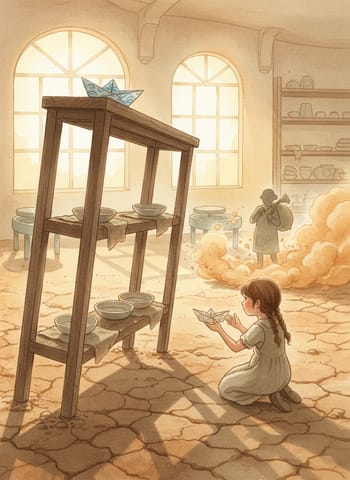
Tala loved the Thursday pottery class. The studio smelled of wet clay and warm stone. Long wooden shelves ran along one wall. On the shelves, the new bowls dried slowly.
Tala adorava a aula de cerâmica das quintas-feiras. O ateliê cheirava a argila molhada e pedra morna. Longas prateleiras de madeira corriam ao longo de uma parede. Nelas, as tigelas novas secavam devagar.
Every student had a place on the shelf, with a name card. Tala's place was number nine. Una's place, next to hers, was number ten.
Cada aluno tinha um lugar na prateleira, com uma etiqueta de nome. O lugar de Tala era o número nove. O de Una, ao lado, era o número dez.
One Thursday, Tala came in and stopped at the door. Number nine was empty. Her blue bowl was gone. In its place sat a small paper boat.
Numa quinta-feira, Tala entrou e parou na porta. O número nove estava vazio. A tigela azul dela tinha sumido. No lugar havia um barquinho de papel.
"Una," she said. "Where is my bowl?"
"Una", disse ela. "Cadê a minha tigela?"
Una came over and looked at the shelf. "Maybe you put it somewhere else."
Una se aproximou e olhou a prateleira. "Talvez você tenha deixado em outro lugar."
"I put it here. It took me two weeks to make it."
"Eu deixei aqui. Levei duas semanas para fazer."
"Then somebody took it." Una picked up the boat. It was plain white paper, folded small, and it was dry. "And left this."
"Então alguém levou." Una pegou o barquinho. Era de papel branco liso, dobrado pequeno, e estava seco. "E deixou isto."
"Why does a thief leave a boat?"
"Por que um ladrão deixaria um barquinho?"
"A very polite thief," said Una.
"Um ladrão muito educado", disse Una.
Tala did not laugh. She looked along the shelf. Nine other bowls sat in their places. Nothing else was missing. The door was locked every night. The instructor and the owner of the studio each had a key.
Tala não riu. Olhou ao longo da prateleira. Nove outras tigelas estavam em seus lugares. Nada mais faltava. A porta era trancada toda noite. A instrutora e o dono do ateliê tinham, cada um, uma chave.
"I want to know who did it," Tala said.
"Quero saber quem foi", disse Tala.
"It is only a bowl."
"É só uma tigela."
"It is my bowl."
"É a minha tigela."
The next Thursday, another bowl vanished. This time it was a green cup. It belonged to the girl at number four. Again, a paper boat sat in its place. The studio buzzed with talk all evening.
Na quinta seguinte, sumiu outra peça. Dessa vez, uma xícara verde. Era da menina do número quatro. De novo, um barquinho de papel ocupava o lugar. O ateliê zumbiu de conversa a noite inteira.
Tala made a plan. She wanted to find footprints. All week, she thought about it. On Wednesday, she asked the instructor if she could stay late. She said she wanted to clean the shelves. The instructor agreed. Tala spread a thin layer of dry clay dust on the floor. She put it right under the shelf.
Tala fez um plano. Queria encontrar pegadas. A semana toda, pensou nisso. Na quarta-feira, perguntou à instrutora se podia ficar até mais tarde. Disse que queria limpar as prateleiras. A instrutora concordou. Tala espalhou uma camada fina de pó seco de argila no chão. Colocou bem embaixo da prateleira.
"If someone walks here, we will see the shoes," she told Una.
"Se alguém passar por aqui, vamos ver os sapatos", disse ela a Una.
On Thursday morning, they came in together. The studio was quiet. Tala's new bowl, a small yellow one, was gone from number nine. A paper boat stood in its place.
Na quinta de manhã, elas entraram juntas. O ateliê estava quieto. A tigela nova de Tala, uma pequena e amarela, tinha sumido do número nove. Um barquinho de papel estava no lugar.
Tala looked at the floor. The dust was full of footprints. There were small ones and big ones. There were round marks from a broom. The instructor walked there every morning. So did the cleaner and two students who came early.
Tala olhou para o chão. O pó estava cheio de pegadas. Havia pequenas e grandes. Havia marcas redondas de vassoura. A instrutora passava ali toda manhã. A faxineira também, e dois alunos que chegavam cedo.
"That is no good," said Una.
"Isso não serve", disse Una.
"I know." Tala frowned. "Everyone walks here. This plan was foolish."
"Eu sei." Tala franziu a testa. "Todo mundo passa aqui. Esse plano foi bobo."
"It was a good idea. It just did not work."
"Foi uma boa ideia. Só não funcionou."
Tala sat down on a stool. She held the third paper boat in her hands. "We looked at the floor. But the boats are the real message."
Tala se sentou num banquinho. Segurava nas mãos o terceiro barquinho de papel. "A gente ficou olhando o chão. Mas os barquinhos é que são a verdadeira mensagem."
"What do you mean?"
"Como assim?"
"The thief does not hide. The thief leaves a boat each time. It is a note, like a letter." Tala turned the paper over and over. "So let us answer it."
"O ladrão não se esconde. O ladrão deixa um barquinho toda vez. É um bilhete, como uma carta." Tala virava o papel de um lado para o outro. "Então vamos responder."
Una's eyes grew bright. "You want to write to the thief?"
Os olhos de Una brilharam. "Você quer escrever para o ladrão?"
"Not write. Fold." Tala took a sheet of paper from her bag. She folded it carefully into a boat. It had the same shape as the others. Inside the boat, she wrote one small line in pencil. Where do my bowls go?
"Escrever, não. Dobrar." Tala tirou uma folha de papel da bolsa. Dobrou com cuidado até fazer um barquinho. Tinha o mesmo formato dos outros. Dentro do barquinho, escreveu a lápis uma linha pequena. Para onde vão as minhas tigelas?
She put the boat on the shelf at number nine. Then she went home.
Ela colocou o barquinho na prateleira do número nove. Depois foi para casa.
On Friday, the studio was closed. On Saturday, too. Tala thought about it all weekend. Maybe nothing happened. Maybe the thief laughed at her.
Na sexta, o ateliê estava fechado. No sábado, também. Tala pensou nisso o fim de semana todo. Talvez nada acontecesse. Talvez o ladrão risse dela.
On Monday, the instructor opened the studio early for a special class. Tala was the first one in. She ran to the shelf.
Na segunda, a instrutora abriu o ateliê mais cedo para uma aula especial. Tala foi a primeira a entrar. Correu até a prateleira.
The boat was gone.
O barquinho tinha sumido.
In its place lay another boat, folded from the same white paper. It was smaller than the first. Tala opened it with shaking fingers. The pencil line read, Follow the water.
No lugar, havia outro barquinho, dobrado do mesmo papel branco. Era menor que o primeiro. Tala o abriu com os dedos trêmulos. A linha a lápis dizia: Siga a água.
"Una!" Tala shouted, though Una was not there yet. "Una, come and see!"
"Una!", gritou Tala, embora Una ainda não tivesse chegado. "Una, venha ver!"
Una arrived ten minutes later. She read the note twice. "Water," she said. "The sink?"
Una chegou dez minutos depois. Leu o bilhete duas vezes. "Água", disse. "A pia?"
"The sink is in here. The note says follow it. Where does the water go?"
"A pia fica aqui dentro. O bilhete diz para seguir a água. Para onde a água vai?"
They went to the big sink at the back of the studio. A pipe ran from it along the wall. It went out through a small hole. They followed the pipe outside. It led to a narrow stream behind the building. The stream ran past an old stone wall. Then it went into green bushes.
Foram até a pia grande, no fundo do ateliê. Um cano saía dela e corria pela parede. Saía por um buraco pequeno. Elas seguiram o cano para fora. Ele levava a um riacho estreito atrás do prédio. O riacho passava por um velho muro de pedra. Depois entrava em arbustos verdes.
At the edge of the stream, Tala stopped.
À beira do riacho, Tala parou.
On a flat rock, in a shallow pool, sat her blue bowl. It was full of clear water. A tiny bird stood on its edge and drank. Next to it sat the green cup and the yellow bowl. Each held a small paper boat that floated on the water.
Numa pedra chata, numa poça rasa, estava a tigela azul dela. Estava cheia de água limpa. Um passarinho minúsculo pousava na borda e bebia. Ao lado estavam a xícara verde e a tigela amarela. Cada uma continha um barquinho de papel flutuando na água.
"They are bird baths," Una whispered.
"São bebedouros de passarinho", sussurrou Una.
"Someone set them here for the birds." Tala knelt beside the rock. The bowls were clean and bright. The birds did not seem afraid. "Someone who takes care of this place."
"Alguém colocou aqui para os pássaros." Tala se ajoelhou ao lado da pedra. As tigelas estavam limpas e brilhantes. Os pássaros não pareciam ter medo. "Alguém que cuida deste lugar."
"But who? The instructor?"
"Mas quem? A instrutora?"
"The instructor does not hide things," said Tala.
"A instrutora não esconde as coisas", disse Tala.
They looked around. There were no other footprints in the mud. Only a small animal left paw prints. Past the thicket, a path led up a little hill. The grass on the path was flat. People walked there often.
Elas olharam em volta. Não havia outras pegadas na lama. Apenas um animalzinho deixara marcas de patas. Depois do matagal, uma trilha subia um pequeno morro. A grama da trilha estava amassada. Gente passava por ali com frequência.
Tala lifted her blue bowl from the water. She turned it over in her hands. On the bottom, below her own mark, was a tiny boat. Someone drew it in pencil. Beside it were two words in a neat, careful hand.
Tala tirou a tigela azul da água. Virou-a nas mãos. No fundo, abaixo da marca dela, havia um barquinho minúsculo. Alguém o havia desenhado a lápis. Ao lado, duas palavras numa letra caprichada e miúda.
Thank you.
Obrigado.
"I do not understand," said Una.
"Não entendo", disse Una.
"Neither do I." Tala smiled. "But I am not angry any more."
"Nem eu." Tala sorriu. "Mas não estou mais com raiva."
Una pointed up the path. A light shone in a small window up the hill. A thin line of smoke rose from the roof. The window had a paper boat on it.
Una apontou trilha acima. Uma luz brilhava numa janelinha lá em cima do morro. Um fio de fumaça subia do telhado. Na janela havia um barquinho de papel.
Tala put the blue bowl gently back on the rock. The birds came back at once.
Tala colocou a tigela azul com delicadeza de volta na pedra. Os pássaros voltaram na mesma hora.
"Do we go up?" asked Una.
"A gente sobe?", perguntou Una.
Tala looked at the window for a long time. The boat in the window was larger than the others. Along its side, in neat pencil, was her name.
Tala ficou olhando a janela por um longo tempo. O barquinho na janela era maior que os outros. Ao longo do casco, a lápis, num traço caprichado, estava o nome dela.