The Boat on the Drying Shelf
Una historia gratuita en inglés de nivel A2 para estudiantes, para leer en línea en 7 idiomas, con opción de escucharla en la app gratuita Storyteller.
Bowls vanish from a pottery studio, and a girl answers the thief with a paper boat of her own.
¡Ese fue el avance! Escucha la historia completa en la app gratuita Storyteller. Descargar la app
El audio no está disponible en este momento.
Tala loved the Thursday pottery class. The studio smelled of wet clay and warm stone. Long wooden shelves ran along one wall. On the shelves, the new bowls dried slowly.
A Tala le encantaba la clase de cerámica de los jueves. El taller olía a arcilla mojada y a piedra tibia. Largos estantes de madera recorrían una pared. En los estantes, los cuencos nuevos se secaban lentamente.
Every student had a place on the shelf, with a name card. Tala's place was number nine. Una's place, next to hers, was number ten.
Cada alumno tenía su lugar en el estante, con una tarjeta con su nombre. El lugar de Tala era el número nueve. El de Una, junto al suyo, era el número diez.
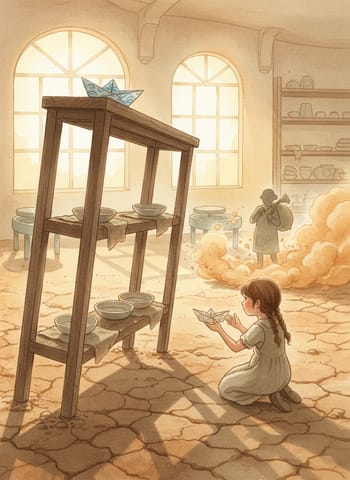
One Thursday, Tala came in and stopped at the door. Number nine was empty. Her blue bowl was gone. In its place sat a small paper boat.
Un jueves, Tala entró y se detuvo en la puerta. El número nueve estaba vacío. Su cuenco azul había desaparecido. En su lugar había un pequeño barquito de papel.
"Una," she said. "Where is my bowl?"
«Una», dijo. «¿Dónde está mi cuenco?».
Una came over and looked at the shelf. "Maybe you put it somewhere else."
Una se acercó y miró el estante. «Quizás lo pusiste en otro lugar».
"I put it here. It took me two weeks to make it."
«Lo puse aquí. Me tomó dos semanas hacerlo».
"Then somebody took it." Una picked up the boat. It was plain white paper, folded small, and it was dry. "And left this."
«Entonces alguien se lo llevó». Una tomó el barquito. Era de papel blanco liso, doblado pequeño, y estaba seco. «Y dejó esto».
"Why does a thief leave a boat?"
«¿Por qué un ladrón deja un barquito?».
"A very polite thief," said Una.
«Un ladrón muy educado», dijo Una.
Tala did not laugh. She looked along the shelf. Nine other bowls sat in their places. Nothing else was missing. The door was locked every night. The instructor and the owner of the studio each had a key.
Tala no se rio. Miró a lo largo del estante. Otros nueve cuencos estaban en sus lugares. No faltaba nada más. La puerta se cerraba con llave todas las noches. La instructora y el dueño del taller tenían cada uno una llave.
"I want to know who did it," Tala said.
«Quiero saber quién fue», dijo Tala.
"It is only a bowl."
«Es solo un cuenco».
"It is my bowl."
«Es mi cuenco».
The next Thursday, another bowl vanished. This time it was a green cup. It belonged to the girl at number four. Again, a paper boat sat in its place. The studio buzzed with talk all evening.
El jueves siguiente desapareció otro cuenco. Esta vez era una taza verde. Pertenecía a la chica del número cuatro. Otra vez, un barquito de papel estaba en su lugar. El taller zumbó de comentarios toda la tarde.
Tala made a plan. She wanted to find footprints. All week, she thought about it. On Wednesday, she asked the instructor if she could stay late. She said she wanted to clean the shelves. The instructor agreed. Tala spread a thin layer of dry clay dust on the floor. She put it right under the shelf.
Tala hizo un plan. Quería encontrar huellas. Durante toda la semana pensó en ello. El miércoles le preguntó a la instructora si podía quedarse hasta tarde. Dijo que quería limpiar los estantes. La instructora aceptó. Tala esparció una fina capa de polvo de arcilla seca en el suelo. La puso justo debajo del estante.
"If someone walks here, we will see the shoes," she told Una.
«Si alguien camina aquí, veremos los zapatos», le dijo a Una.
On Thursday morning, they came in together. The studio was quiet. Tala's new bowl, a small yellow one, was gone from number nine. A paper boat stood in its place.
El jueves por la mañana, entraron juntas. El taller estaba en silencio. El cuenco nuevo de Tala, uno amarillo y pequeño, ya no estaba en el número nueve. Un barquito de papel ocupaba su lugar.
Tala looked at the floor. The dust was full of footprints. There were small ones and big ones. There were round marks from a broom. The instructor walked there every morning. So did the cleaner and two students who came early.
Tala miró el suelo. El polvo estaba lleno de huellas. Había pequeñas y grandes. Había marcas redondas de una escoba. La instructora caminaba por ahí todas las mañanas. También la persona de la limpieza y dos alumnos que llegaban temprano.
"That is no good," said Una.
«Eso no sirve», dijo Una.
"I know." Tala frowned. "Everyone walks here. This plan was foolish."
«Ya lo sé». Tala frunció el ceño. «Todos caminan aquí. Este plan fue tonto».
"It was a good idea. It just did not work."
«Fue una buena idea. Solo que no funcionó».
Tala sat down on a stool. She held the third paper boat in her hands. "We looked at the floor. But the boats are the real message."
Tala se sentó en un taburete. Sostenía el tercer barquito de papel en las manos. «Miramos el suelo. Pero los barquitos son el verdadero mensaje».
"What do you mean?"
«¿Qué quieres decir?».
"The thief does not hide. The thief leaves a boat each time. It is a note, like a letter." Tala turned the paper over and over. "So let us answer it."
«El ladrón no se esconde. El ladrón deja un barquito cada vez. Es una nota, como una carta». Tala daba vueltas al papel una y otra vez. «Así que respondámosle».
Una's eyes grew bright. "You want to write to the thief?"
A Una se le iluminaron los ojos. «¿Quieres escribirle al ladrón?».
"Not write. Fold." Tala took a sheet of paper from her bag. She folded it carefully into a boat. It had the same shape as the others. Inside the boat, she wrote one small line in pencil. Where do my bowls go?
«No escribir. Doblar». Tala sacó una hoja de papel de su bolso. La dobló con cuidado en forma de barquito. Tenía la misma forma que los otros. Dentro del barquito escribió una pequeña línea a lápiz. ¿Adónde van mis cuencos?
She put the boat on the shelf at number nine. Then she went home.
Puso el barquito en el estante del número nueve. Luego se fue a casa.
On Friday, the studio was closed. On Saturday, too. Tala thought about it all weekend. Maybe nothing happened. Maybe the thief laughed at her.
El viernes, el taller estuvo cerrado. El sábado también. Tala lo pensó todo el fin de semana. Quizás no pasó nada. Quizás el ladrón se rio de ella.
On Monday, the instructor opened the studio early for a special class. Tala was the first one in. She ran to the shelf.
El lunes, la instructora abrió el taller temprano para una clase especial. Tala fue la primera en entrar. Corrió al estante.
The boat was gone.
El barquito había desaparecido.
In its place lay another boat, folded from the same white paper. It was smaller than the first. Tala opened it with shaking fingers. The pencil line read, Follow the water.
En su lugar había otro barquito, doblado del mismo papel blanco. Era más pequeño que el primero. Tala lo abrió con dedos temblorosos. La línea a lápiz decía: Sigue el agua.
"Una!" Tala shouted, though Una was not there yet. "Una, come and see!"
«¡Una!», gritó Tala, aunque Una todavía no había llegado. «¡Una, ven a ver!».
Una arrived ten minutes later. She read the note twice. "Water," she said. "The sink?"
Una llegó diez minutos después. Leyó la nota dos veces. «Agua», dijo. «¿La pileta?».
"The sink is in here. The note says follow it. Where does the water go?"
«La pileta está aquí dentro. La nota dice que la sigamos. ¿Adónde va el agua?».
They went to the big sink at the back of the studio. A pipe ran from it along the wall. It went out through a small hole. They followed the pipe outside. It led to a narrow stream behind the building. The stream ran past an old stone wall. Then it went into green bushes.
Fueron a la pileta grande del fondo del taller. Un tubo salía de ella a lo largo de la pared. Salía por un agujero pequeño. Siguieron el tubo hacia afuera. Llevaba a un arroyo angosto detrás del edificio. El arroyo pasaba junto a un viejo muro de piedra. Luego se metía entre unos arbustos verdes.
At the edge of the stream, Tala stopped.
En la orilla del arroyo, Tala se detuvo.
On a flat rock, in a shallow pool, sat her blue bowl. It was full of clear water. A tiny bird stood on its edge and drank. Next to it sat the green cup and the yellow bowl. Each held a small paper boat that floated on the water.
Sobre una roca plana, en una poza poco profunda, estaba su cuenco azul. Estaba lleno de agua clara. Un pajarito estaba posado en su borde y bebía. Junto a él estaban la taza verde y el cuenco amarillo. Cada uno contenía un pequeño barquito de papel que flotaba sobre el agua.
"They are bird baths," Una whispered.
«Son bebederos para pájaros», susurró Una.
"Someone set them here for the birds." Tala knelt beside the rock. The bowls were clean and bright. The birds did not seem afraid. "Someone who takes care of this place."
«Alguien los puso aquí para los pájaros». Tala se arrodilló junto a la roca. Los cuencos estaban limpios y brillantes. Los pájaros no parecían tener miedo. «Alguien que cuida este lugar».
"But who? The instructor?"
«¿Pero quién? ¿La instructora?».
"The instructor does not hide things," said Tala.
«La instructora no esconde cosas», dijo Tala.
They looked around. There were no other footprints in the mud. Only a small animal left paw prints. Past the thicket, a path led up a little hill. The grass on the path was flat. People walked there often.
Miraron alrededor. No había otras huellas en el barro. Solo un animal pequeño había dejado marcas de patas. Más allá del matorral, un sendero subía por una pequeña colina. El pasto del sendero estaba aplastado. La gente caminaba por ahí a menudo.
Tala lifted her blue bowl from the water. She turned it over in her hands. On the bottom, below her own mark, was a tiny boat. Someone drew it in pencil. Beside it were two words in a neat, careful hand.
Tala sacó su cuenco azul del agua. Le dio la vuelta entre las manos. En el fondo, debajo de su propia marca, había un diminuto barquito. Alguien lo había dibujado a lápiz. Junto a él había dos palabras con una letra pulcra y cuidadosa.
Thank you.
Gracias.
"I do not understand," said Una.
«No entiendo», dijo Una.
"Neither do I." Tala smiled. "But I am not angry any more."
«Yo tampoco». Tala sonrió. «Pero ya no estoy enojada».
Una pointed up the path. A light shone in a small window up the hill. A thin line of smoke rose from the roof. The window had a paper boat on it.
Una señaló sendero arriba. Una luz brillaba en una ventanita colina arriba. Una fina línea de humo subía del techo. En la ventana había un barquito de papel.
Tala put the blue bowl gently back on the rock. The birds came back at once.
Tala puso el cuenco azul con delicadeza otra vez sobre la roca. Los pájaros regresaron de inmediato.
"Do we go up?" asked Una.
«¿Subimos?», preguntó Una.
Tala looked at the window for a long time. The boat in the window was larger than the others. Along its side, in neat pencil, was her name.
Tala miró la ventana durante mucho rato. El barquito de la ventana era más grande que los otros. A lo largo de su costado, en lápiz pulcro, estaba su nombre.