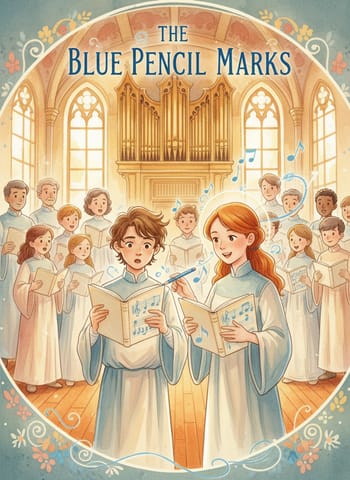
The Blue Pencil Marks
Uma história gratuita em inglês de nível A1 para estudantes, para ler online em 7 idiomas, com opção de ouvir no app gratuito Storyteller.
A choir singer who cannot read music gets quiet help from the young woman in front of him.
Essa foi a prévia! Ouça a história completa no app gratuito Storyteller. Baixar o app
O áudio não está disponível no momento.
Yosef joined the town choir in September. He did not join because he sang well. He joined because his doctor said, "Do something new."
Yosef entrou no coral da cidade em setembro. Ele não entrou porque cantava bem. Entrou porque o médico dele disse: "Faça algo novo."
The choir met on Thursday nights in a church hall. There were thirty singers. Yosef stood in the back row with the men.
O coral se reunia nas noites de quinta-feira, num salão de igreja. Havia trinta cantores. Yosef ficava na fileira de trás, com os homens.
He had one big problem. He could not read music. The black dots on the page meant nothing to him. When the choir sang, he waited one second. Then he followed the man next to him.
Ele tinha um grande problema. Não sabia ler partitura. Os pontinhos pretos na página não significavam nada para ele. Quando o coral cantava, ele esperava um segundo. Depois seguia o homem ao lado.
The man next to him was often wrong.
O homem ao lado errava com frequência.
Zoe sat in the row in front. She was the youngest singer in the choir. She had a loud, clear voice. She turned around a lot.
Zoe ficava na fileira da frente. Era a cantora mais jovem do coral. Tinha uma voz forte e clara. Ela se virava muito.
On the second Thursday, Zoe turned around after a song. "You are always a little late," she said. "Do you know that?"
Na segunda quinta-feira, Zoe se virou depois de uma música. "Você está sempre um pouco atrasado", disse ela. "Sabia?"
Yosef's face went hot. "I know," he said. "I cannot read the notes."
O rosto de Yosef ficou quente. "Eu sei", disse ele. "Não sei ler as notas."
"Not at all?"
"Nenhuma?"
"Not at all."
"Nenhuma."
Zoe looked at him. She did not laugh. "Give me your page," she said.
Zoe olhou para ele. Não riu. "Me dê a sua folha", disse ela.
He gave it to her. She took a blue pencil from her hair. She made marks on the music. She drew a small arrow where the tune went up. She drew a line where it went down. She made a little circle where he must breathe.
Ele entregou a folha. Ela pegou um lápis azul que estava no cabelo dela. Fez marcas na partitura. Desenhou uma setinha onde a melodia subia. Desenhou uma linha onde ela descia. Fez um pequeno círculo onde ele devia respirar.
"Now it is a picture," she said. "Not dots. Follow the arrows."
"Agora é um desenho", disse ela. "Não são pontinhos. Siga as setas."
"Thank you," said Yosef. "That is very kind."
"Obrigado", disse Yosef. "Você é muito gentil."
"It is a pencil," said Zoe. "Pencils are cheap."
"É só um lápis", disse Zoe. "Lápis são baratos."
The next Thursday, Yosef sang the first line on time. Zoe turned around and gave him a small smile. He felt taller.
Na quinta-feira seguinte, Yosef cantou o primeiro verso na hora certa. Zoe se virou e deu um sorrisinho para ele. Ele se sentiu mais alto.
Every week she marked his new page before the lesson. She came early. She sat next to him in the back row. They shared a chair and talked while the others arrived.
Toda semana ela marcava a folha nova dele antes do ensaio. Chegava cedo. Sentava ao lado dele, na fileira de trás. Eles dividiam uma cadeira e conversavam enquanto os outros chegavam.
She told him about her job at a pet shop. He told her about his old job. It was at the post office. She told him her favorite song. He told her his. It was a slow, sad song about a river.
Ela contou a ele sobre o trabalho dela numa loja de animais. Ele contou sobre o antigo trabalho dele. Era no correio. Ela contou qual era a música favorita dela. Ele contou a dele. Era uma canção lenta e triste sobre um rio.
"We will sing it at the spring concert," Zoe said. "I will ask the leader."
"Vamos cantá-la no concerto de primavera", disse Zoe. "Vou pedir à regente."
"Do you think she will say yes?"
"Você acha que ela vai aceitar?"
"She always says yes to me," Zoe said. "I am loud."
"Ela sempre aceita o que eu peço", disse Zoe. "Eu sou barulhenta."
In March, the leader said yes. The river song was on the program. Yosef had a solo of four lines. He practiced at home every night. He sang to his cat.
Em março, a regente disse que sim. A canção do rio entrou no programa. Yosef ganhou um solo de quatro versos. Ele ensaiava em casa todas as noites. Cantava para o gato.
On the night of the concert, the church was full. Yosef stood on the stage. His hands were cold. He opened his folder and looked at the page.
Na noite do concerto, a igreja estava lotada. Yosef subiu ao palco. Suas mãos estavam frias. Ele abriu a pasta e olhou para a folha.
The marks were there. The arrows and the lines and the circles for breathing. At the bottom of the page, he saw something new.
As marcas estavam lá. As setas, as linhas e os círculos para respirar. Embaixo da página, ele viu algo novo.
In small blue letters, Zoe wrote, "Slow down. Smile here. I hear every note."
Em letrinhas azuis, Zoe tinha escrito: "Vá devagar. Sorria aqui. Eu ouço cada nota."
Yosef looked up. Zoe stood in the front row. She did not turn around. She lifted her pencil over her shoulder, just a little.
Yosef levantou os olhos. Zoe estava na fileira da frente. Ela não se virou. Levantou o lápis por cima do ombro, só um pouquinho.
He took a breath in the circle. Then he sang his four lines. He was not late.
Ele respirou no círculo. Depois cantou seus quatro versos. Não se atrasou.