Six on the White Ground
Uma história gratuita em inglês de nível B2 para estudantes, para ler online em 7 idiomas, com opção de ouvir no app gratuito Storyteller.
A teenage photographer at a salt flat stop invents a strange dice game with a stranded survey intern, and one afternoon changes his routine.
Essa foi a prévia! Ouça a história completa no app gratuito Storyteller. Baixar o app
O áudio não está disponível no momento.
At seven in the morning the salt flat is already white enough to hurt. Oded drags the folding table to the edge of the parking area, the way he does every day. He sets out his props in the same order.
Às sete da manhã, o salar já está branco o bastante para machucar os olhos. Oded arrasta a mesa dobrável até a beira do estacionamento, como faz todos os dias. Ele monta seus adereços sempre na mesma ordem.
First comes the plastic palm tree. Then comes the toy truck, which looks enormous in photos if the tourist stands far enough away. Last comes the canvas sack of dice, which his mother calls his collection and which Oded calls his problem.
Primeiro vem a palmeira de plástico. Depois vem o caminhão de brinquedo, que parece enorme nas fotos se o turista ficar bem longe. Por último vem o saco de lona com dados, que a mãe dele chama de coleção e que Oded chama de problema.
The sack holds thirty-six dice, and no two of them match. Some are wooden, some are glass, and one is the size of a plum. A few have lost their dots. Oded has gathered them over three summers from the broken board games that visitors leave in the bin by the toilets.
O saco guarda trinta e seis dados, e não há dois iguais. Alguns são de madeira, alguns são de vidro, e um tem o tamanho de uma ameixa. Alguns perderam os pontinhos. Oded os juntou ao longo de três verões, de jogos de tabuleiro quebrados que os visitantes deixam na lixeira perto dos banheiros.
His mother stacks water bottles in the kiosk window. Oded shakes the sack, and the dice clatter like a small landslide.
A mãe dele empilha garrafas de água na janela do quiosque. Oded sacode o saco, e os dados fazem barulho como um pequeno deslizamento de pedras.
This is his morning habit. He pulls one die from the sack without looking, rolls it on the table, and reads the number. Whatever it shows is the number of photos he will give away for free that day. Today a chipped green cube shows a three. It is a silly rule, but Oded likes that the decision is not his.
Esse é o hábito dele de manhã. Ele tira um dado do saco sem olhar, rola na mesa e lê o número. O que aparecer é o número de fotos que ele vai dar de graça naquele dia. Hoje um cubo verde lascado mostra um três. É uma regra boba, mas Oded gosta que a decisão não seja dele.
The first tourists arrive at nine, in loud, sunburned groups. For an hour and a half the routine runs by itself. Oded poses a couple so that one of them seems to hold the other in a giant hand. He gives a free photo to a small boy who has no one to take his picture. The ground begins to shimmer, and the horizon disappears, which is the whole attraction.
Os primeiros turistas chegam às nove, em grupos barulhentos e queimados de sol. Por uma hora e meia, a rotina anda sozinha. Oded posiciona um casal de modo que um pareça estar nas mãos gigantes do outro. Dá uma foto grátis a um menino que não tem ninguém para tirar a sua. O chão começa a tremeluzir, e o horizonte desaparece, que é toda a atração.
At half past ten, the routine breaks.
Às dez e meia, a rotina se quebra.
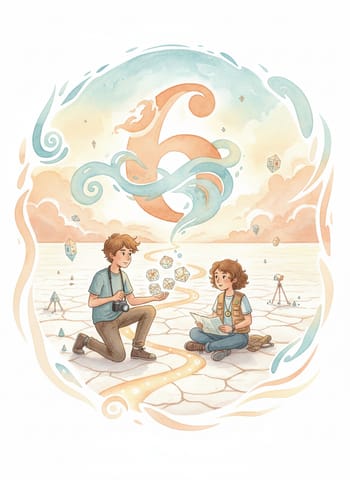
A dusty pickup stops at the far end of the parking area. It drops off a boy and three metal cases, then drives away without waiting. The boy looks about seventeen, the same as Oded. He wears a floppy hat and carries a tripod on his shoulder, and he walks across the crust very slowly, as if it might crack.
Uma caminhonete empoeirada para na outra ponta do estacionamento. Deixa um garoto e três caixas de metal, depois vai embora sem esperar. O garoto parece ter uns dezessete anos, a mesma idade de Oded. Usa um chapéu mole, leva um tripé no ombro e atravessa a crosta bem devagar, como se ela pudesse rachar.
"It will not break," Oded calls out. "Last year a truck drove across it. A small truck, but still."
"Ela não quebra", grita Oded. "No ano passado um caminhão passou por cima. Um caminhão pequeno, mas mesmo assim."
The boy stops and looks at him. "Good to know. I have been worrying about that for the last ten kilometres."
O garoto para e olha para ele. "Bom saber. Estou preocupado com isso há dez quilômetros."
His name is Ferran. He is an intern with a survey company, and his job is to measure how the salt crust moves during the day. The readings must be taken every hour until sunset. His supervisor has gone to inspect another site and has promised to come back by evening.
O nome dele é Ferran. Ele é estagiário de uma empresa de topografia, e seu trabalho é medir como a crosta de sal se move ao longo do dia. As leituras precisam ser feitas a cada hora até o pôr do sol. O supervisor dele foi inspecionar outro local e prometeu voltar à noite.
"So you are stuck here for seven hours," Oded says.
"Então você está preso aqui por sete horas", diz Oded.
"I am stuck here with a laser, a notebook and no shade," Ferran says. "Is there somewhere to sit?"
"Estou preso aqui com um laser, um caderno e nenhuma sombra", diz Ferran. "Tem algum lugar para sentar?"
Because the boy looks so miserable, Oded pushes his own folding chair across the salt with his foot.
Como o garoto parece tão infeliz, Oded empurra a própria cadeira dobrável pelo sal com o pé.
Ferran sets up the tripod and takes his first reading. Oded pretends to straighten the palm tree while he watches.
Ferran monta o tripé e faz a primeira leitura. Oded finge endireitar a palmeira enquanto observa.
"You are staring," Ferran says, without looking up.
"Você está encarando", diz Ferran, sem levantar os olhos.
"I am working. You are standing in my frame."
"Estou trabalhando. Você está parado no meu enquadramento."
"What frame?"
"Que enquadramento?"
"The one in my head. A boy in a hat, a tripod, a lot of nothing behind him."
"O da minha cabeça. Um garoto de chapéu, um tripé, um monte de nada atrás dele."
Ferran looks up at last. He seems to decide whether he has been insulted, and then he laughs. It is a short, surprised laugh.
Ferran finalmente levanta os olhos. Parece decidir se foi insultado, e então ri. É uma risada curta e surpresa.
At noon he takes his next reading, and afterwards he wanders over to the table. His eyes stop on the sack of dice.
Ao meio-dia ele faz a leitura seguinte e depois se aproxima da mesa. Seus olhos param no saco de dados.
"What are those for?"
"Para que servem esses?"
"Nothing. They are mine. I roll one every morning to decide how many free photos I give away."
"Para nada. São meus. Eu rolo um toda manhã para decidir quantas fotos grátis eu dou."
"Thirty-six dice and not one matches," Ferran says, tipping a few into his palm. "This is the best thing I have seen all week. Do you know what you could do with these?"
"Trinta e seis dados e nenhum igual", diz Ferran, despejando alguns na palma da mão. "Esta é a melhor coisa que vi a semana toda. Você sabe o que dá para fazer com eles?"
"Lose them in the salt?"
"Perdê-los no sal?"
"Make a game. Listen. Each player pulls two dice from the sack without looking, and rolls them together. A blank face counts as zero, and the big one counts double. Whoever has the lower total must answer a question from the other player. A true answer, no jokes."
"Fazer um jogo. Escute. Cada jogador tira dois dados do saco sem olhar e rola os dois juntos. Uma face em branco vale zero, e o grande vale em dobro. Quem tiver o total mais baixo precisa responder a uma pergunta do outro jogador. Uma resposta verdadeira, sem piadas."
Oded raises an eyebrow. "That is a very strange game."
Oded ergue uma sobrancelha. "Que jogo mais estranho."
"It is a very strange sack," Ferran says.
"É um saco muito estranho", diz Ferran.
They play the first round on the table while the tourists wander around them. Oded rolls a four and a blank. Ferran rolls a five on the plum-sized die, which doubles to ten. Oded loses badly.
Eles jogam a primeira rodada na mesa enquanto os turistas passeiam ao redor. Oded tira um quatro e um branco. Ferran tira um cinco no dado do tamanho de uma ameixa, que dobra para dez. Oded perde feio.
"Why do you really give away free photos?" Ferran asks.
"Por que você realmente dá fotos grátis?", pergunta Ferran.
Oded thinks about it longer than he expects to. "Because the first summer nobody smiled in my photos. They were all too hot and too tired. A free one made them laugh, and then the paid ones were better."
Oded pensa nisso por mais tempo do que esperava. "Porque no primeiro verão ninguém sorria nas minhas fotos. Estavam todos com muito calor e muito cansados. Uma grátis os fazia rir, e aí as pagas ficavam melhores."
"That is clever."
"Isso é esperto."
"It is only business," Oded says, and he busies himself with the palm tree for a while.
"É só negócio", diz Oded, e se ocupa por um tempo com a palmeira.
The afternoon changes shape. Every hour Ferran walks out to his tripod, reads the numbers aloud like a doctor, and walks back. Every hour they play one round. Oded learns that Ferran hates the sea and loves empty places. He learns that Ferran's mother wants him to study law, and that Ferran would rather draw maps.
A tarde muda de forma. A cada hora Ferran vai até o tripé, lê os números em voz alta como um médico e volta. A cada hora eles jogam uma rodada. Oded descobre que Ferran odeia o mar e adora lugares vazios. Descobre que a mãe de Ferran quer que ele estude direito, e que Ferran preferiria desenhar mapas.
Ferran learns things too. He learns that the toy truck is a copy of Oded's father's real one, which no longer runs. Oded does not plan to say that. The dice seem to pull it out of him.
Ferran também descobre coisas. Descobre que o caminhão de brinquedo é uma cópia do caminhão de verdade do pai de Oded, que não anda mais. Oded não planejava contar isso. Os dados parecem arrancar isso dele.
Around three, the tourists retreat to their cars, and the flat grows quiet.
Por volta das três, os turistas se recolhem aos carros, e o salar fica quieto.
"You should take a photo of me," Ferran says suddenly. "With the props. I want proof that I survived."
"Você devia tirar uma foto minha", diz Ferran de repente. "Com os adereços. Quero uma prova de que sobrevivi."
"Photos cost five coins."
"Fotos custam cinco moedas."
"I will pay."
"Eu pago."
"No, you will not," Oded says. "I still have a free one left from this morning."
"Não, você não paga", diz Oded. "Ainda tenho uma grátis de hoje de manhã."
He places Ferran far from the camera and puts the toy truck close to the lens. In the photo, the truck seems to rest on Ferran's open hand, and the boy behind it looks small, tanned and slightly amazed. Ferran leans over his shoulder to see the screen.
Ele coloca Ferran longe da câmera e põe o caminhão de brinquedo perto da lente. Na foto, o caminhão parece repousar na mão aberta de Ferran, e o garoto atrás dele parece pequeno, bronzeado e levemente espantado. Ferran se inclina por cima do ombro dele para ver a tela.
"That is a good one," he says.
"Ficou boa", diz ele.
"It is all right."
"Está razoável."
"It is a good one, Oded."
"Ficou boa, Oded."
They stand there a moment longer than the photo needs.
Eles ficam ali um instante a mais do que a foto exige.
At half past five a pale cloud of dust appears on the horizon and slowly becomes the pickup. Ferran packs his cases with the speed of someone who would prefer to be slower.
Às cinco e meia, uma nuvem pálida de poeira aparece no horizonte e aos poucos se torna a caminhonete. Ferran guarda as caixas com a pressa de quem preferiria ser mais lento.
"Last round?" he asks.
"Última rodada?", pergunta ele.
"Last round."
"Última rodada."
Oded pulls the chipped green cube and a glass die with one blank face. Ferran pulls the plum. They roll together, and the dice skid across the table, spin, and settle. Oded gets a two. Ferran gets a blank and a one, and the plum doubles nothing.
Oded tira o cubo verde lascado e um dado de vidro com uma face em branco. Ferran pega o grande. Eles rolam juntos, e os dados deslizam pela mesa, giram e param. Oded tira um dois. Ferran tira um branco e um um, e o grande não dobra nada.
"I lose," Ferran says. "Ask me."
"Eu perdi", diz Ferran. "Pergunte."
Oded has a dozen questions ready, and now every one of them leaves his head. "Which one of the dice would you keep?"
Oded tem uma dúzia de perguntas prontas, e agora todas somem da cabeça dele. "Qual dos dados você ficaria?"
Ferran does not answer at once. He searches the sack until he finds the smallest die of all, a grey stone cube with three dots worn away.
Ferran não responde na hora. Ele procura no saco até encontrar o menor de todos, um cubo de pedra cinza com três pontos gastos.
"This one. It is the ugliest."
"Este. É o mais feio."
"It is also the oldest," Oded says. "Take it."
"Também é o mais antigo", diz Oded. "Leve."
"That is not part of the game."
"Isso não faz parte do jogo."
"The game is mine. I change the rules."
"O jogo é meu. Eu mudo as regras."
Ferran closes his hand around the die, and the pickup honks twice at the edge of the lot. He walks across the salt without testing the crust this time. At the door of the pickup he turns around, lifts his arm, and throws something small and white in a slow arc.
Ferran fecha a mão em volta do dado, e a caminhonete buzina duas vezes na beira do estacionamento. Ele atravessa o sal sem testar a crosta desta vez. Na porta da caminhonete, vira-se, ergue o braço e joga algo pequeno e branco num arco lento.
Oded catches it with both hands. It is a folded page from the notebook. On it is a map, drawn in careful lines, of a white flat with a table, a palm tree and a boy.
Oded pega com as duas mãos. É uma página dobrada do caderno. Nela há um mapa, desenhado com linhas cuidadosas, de um salar branco com uma mesa, uma palmeira e um garoto.
The pickup drives away until it is only a bright speck in the glare. His mother says nothing from the kiosk window, which is a kindness in itself.
A caminhonete se afasta até virar só um ponto brilhante no clarão. A mãe dele não diz nada da janela do quiosque, o que já é uma gentileza.
Oded puts the map in his shirt pocket. Then he reaches into the sack, pulls out the chipped green cube, and rolls it one last time, to decide tomorrow's free photos. The cube bounces off the table leg, spins on the white ground, and stops.
Oded põe o mapa no bolso da camisa. Depois enfia a mão no saco, tira o cubo verde lascado e o rola uma última vez, para decidir as fotos grátis de amanhã. O cubo bate na perna da mesa, gira no chão branco e para.
Six.
Seis.