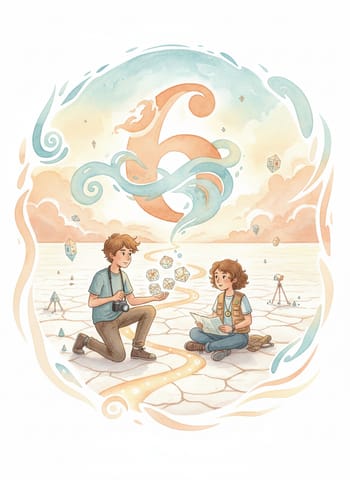
Six on the White Ground
A free B2-level English story for language learners, readable online in 7 languages, with an option to listen via the free Storyteller app.
A teenage photographer at a salt flat stop invents a strange dice game with a stranded survey intern, and one afternoon changes his routine.
That was the preview! Hear the full story in the free Storyteller app. Get the app
Audio isn't available right now.
At seven in the morning the salt flat is already white enough to hurt. Oded drags the folding table to the edge of the parking area, the way he does every day. He sets out his props in the same order.
First comes the plastic palm tree. Then comes the toy truck, which looks enormous in photos if the tourist stands far enough away. Last comes the canvas sack of dice, which his mother calls his collection and which Oded calls his problem.
The sack holds thirty-six dice, and no two of them match. Some are wooden, some are glass, and one is the size of a plum. A few have lost their dots. Oded has gathered them over three summers from the broken board games that visitors leave in the bin by the toilets.
His mother stacks water bottles in the kiosk window. Oded shakes the sack, and the dice clatter like a small landslide.
This is his morning habit. He pulls one die from the sack without looking, rolls it on the table, and reads the number. Whatever it shows is the number of photos he will give away for free that day. Today a chipped green cube shows a three. It is a silly rule, but Oded likes that the decision is not his.
The first tourists arrive at nine, in loud, sunburned groups. For an hour and a half the routine runs by itself. Oded poses a couple so that one of them seems to hold the other in a giant hand. He gives a free photo to a small boy who has no one to take his picture. The ground begins to shimmer, and the horizon disappears, which is the whole attraction.
At half past ten, the routine breaks.
A dusty pickup stops at the far end of the parking area. It drops off a boy and three metal cases, then drives away without waiting. The boy looks about seventeen, the same as Oded. He wears a floppy hat and carries a tripod on his shoulder, and he walks across the crust very slowly, as if it might crack.
"It will not break," Oded calls out. "Last year a truck drove across it. A small truck, but still."
The boy stops and looks at him. "Good to know. I have been worrying about that for the last ten kilometres."
His name is Ferran. He is an intern with a survey company, and his job is to measure how the salt crust moves during the day. The readings must be taken every hour until sunset. His supervisor has gone to inspect another site and has promised to come back by evening.
"So you are stuck here for seven hours," Oded says.
"I am stuck here with a laser, a notebook and no shade," Ferran says. "Is there somewhere to sit?"
Because the boy looks so miserable, Oded pushes his own folding chair across the salt with his foot.
Ferran sets up the tripod and takes his first reading. Oded pretends to straighten the palm tree while he watches.
"You are staring," Ferran says, without looking up.
"I am working. You are standing in my frame."
"What frame?"
"The one in my head. A boy in a hat, a tripod, a lot of nothing behind him."
Ferran looks up at last. He seems to decide whether he has been insulted, and then he laughs. It is a short, surprised laugh.
At noon he takes his next reading, and afterwards he wanders over to the table. His eyes stop on the sack of dice.
"What are those for?"
"Nothing. They are mine. I roll one every morning to decide how many free photos I give away."
"Thirty-six dice and not one matches," Ferran says, tipping a few into his palm. "This is the best thing I have seen all week. Do you know what you could do with these?"
"Lose them in the salt?"
"Make a game. Listen. Each player pulls two dice from the sack without looking, and rolls them together. A blank face counts as zero, and the big one counts double. Whoever has the lower total must answer a question from the other player. A true answer, no jokes."
Oded raises an eyebrow. "That is a very strange game."
"It is a very strange sack," Ferran says.
They play the first round on the table while the tourists wander around them. Oded rolls a four and a blank. Ferran rolls a five on the plum-sized die, which doubles to ten. Oded loses badly.
"Why do you really give away free photos?" Ferran asks.
Oded thinks about it longer than he expects to. "Because the first summer nobody smiled in my photos. They were all too hot and too tired. A free one made them laugh, and then the paid ones were better."
"That is clever."
"It is only business," Oded says, and he busies himself with the palm tree for a while.
The afternoon changes shape. Every hour Ferran walks out to his tripod, reads the numbers aloud like a doctor, and walks back. Every hour they play one round. Oded learns that Ferran hates the sea and loves empty places. He learns that Ferran's mother wants him to study law, and that Ferran would rather draw maps.
Ferran learns things too. He learns that the toy truck is a copy of Oded's father's real one, which no longer runs. Oded does not plan to say that. The dice seem to pull it out of him.
Around three, the tourists retreat to their cars, and the flat grows quiet.
"You should take a photo of me," Ferran says suddenly. "With the props. I want proof that I survived."
"Photos cost five coins."
"I will pay."
"No, you will not," Oded says. "I still have a free one left from this morning."
He places Ferran far from the camera and puts the toy truck close to the lens. In the photo, the truck seems to rest on Ferran's open hand, and the boy behind it looks small, tanned and slightly amazed. Ferran leans over his shoulder to see the screen.
"That is a good one," he says.
"It is all right."
"It is a good one, Oded."
They stand there a moment longer than the photo needs.
At half past five a pale cloud of dust appears on the horizon and slowly becomes the pickup. Ferran packs his cases with the speed of someone who would prefer to be slower.
"Last round?" he asks.
"Last round."
Oded pulls the chipped green cube and a glass die with one blank face. Ferran pulls the plum. They roll together, and the dice skid across the table, spin, and settle. Oded gets a two. Ferran gets a blank and a one, and the plum doubles nothing.
"I lose," Ferran says. "Ask me."
Oded has a dozen questions ready, and now every one of them leaves his head. "Which one of the dice would you keep?"
Ferran does not answer at once. He searches the sack until he finds the smallest die of all, a grey stone cube with three dots worn away.
"This one. It is the ugliest."
"It is also the oldest," Oded says. "Take it."
"That is not part of the game."
"The game is mine. I change the rules."
Ferran closes his hand around the die, and the pickup honks twice at the edge of the lot. He walks across the salt without testing the crust this time. At the door of the pickup he turns around, lifts his arm, and throws something small and white in a slow arc.
Oded catches it with both hands. It is a folded page from the notebook. On it is a map, drawn in careful lines, of a white flat with a table, a palm tree and a boy.
The pickup drives away until it is only a bright speck in the glare. His mother says nothing from the kiosk window, which is a kindness in itself.
Oded puts the map in his shirt pocket. Then he reaches into the sack, pulls out the chipped green cube, and rolls it one last time, to decide tomorrow's free photos. The cube bounces off the table leg, spins on the white ground, and stops.
Six.