The Carriage on Siding Nine
A free B2-level English story for language learners, readable online in 7 languages, with an option to listen via the free Storyteller app.
Two quarrelling restorers must save an old railway carriage before an inspection when its heater breaks down overnight.
That was the preview! Hear the full story in the free Storyteller app. Get the app
Audio isn't available right now.
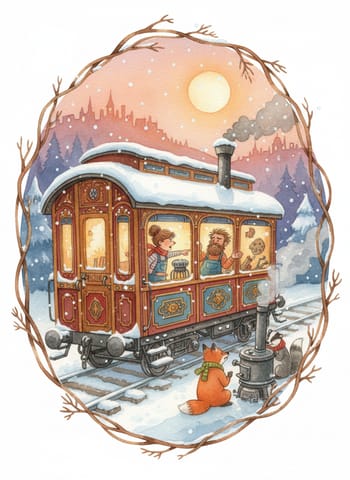
The old carriage had stood on Siding Nine for thirty years. The railway society wanted it ready for a visitor inspection by nine o'clock the next morning. Anneke had been restoring its woodwork since spring. Luca had been hired three weeks earlier to replace the wiring. In all that time, they had agreed on nothing.
"You've drilled a hole in the original panel," Anneke said that evening, standing in the aisle with her arms crossed.
"I've drilled a small hole in a panel that was already cracked," Luca answered. "If I had waited for your permission, we would still be sitting in the dark."
"Some of us think the dark has character."
"Some of us have to pass an inspection."
It was a familiar argument. Anneke believed the carriage should look exactly as it had in its best years, with brass lamps, leather straps and varnished walnut. Luca believed that nobody would pay to visit a museum that might catch fire. They had been polite for the first week and rude for the second. By the third they had simply stopped looking at each other when they talked.
At seven o'clock, the heater died. It was an ancient iron box under the floor, and it gave a long sigh, a short rattle, and then nothing. Within an hour the carriage felt like the inside of a refrigerator.
"We can't leave," Anneke said, rubbing her hands together. "The varnish on the ceiling is still wet. If it gets too cold overnight, it will cloud over, and the inspector will see every mark."
"And I can't leave either," said Luca. "Half of the lamps aren't connected yet. If the board arrives tomorrow and finds the lights out, they'll replace me with someone cheaper."
They looked at each other for the first time in days. Neither of them enjoyed what they saw, because each recognised the same tired, stubborn face.
"I suppose," Anneke said slowly, "that we should have started working together a week ago."
"That is the closest thing to an apology I have ever heard from you."
"Don't get used to it."
They made a plan, though neither of them would have called it that. Luca brought two work lamps and a long extension cable from his van. Anneke found a metal tray and a stack of old bricks in the storeroom. If the bricks were warmed under the lamps, they could stand around the wet varnish like small radiators. It was a crude idea, and it might easily have failed, but there was no one else to ask.
By ten o'clock the carriage glowed with a yellow light, and the air near the ceiling had become tolerable. Luca crouched on the floor and wired the first brass lamp, while Anneke held it steady on the step ladder. For the first time, she watched his hands instead of his mistakes. They were quick and careful, and he talked quietly to the cables as he worked.
"You do that a lot," she said.
"Do what?"
"Talk to the wires. You were doing it yesterday as well."
"Habit," he said, and shrugged. "Wires respond better to kindness than to shouting. People are the same, from what I've heard."
Anneke laughed before she could stop herself, and the sound seemed to surprise them both.
At midnight, a fuse blew. The work lamps went out, and the whole carriage dropped into darkness so thick that Anneke could not see her own hand. She heard Luca swear softly somewhere near the floor.
"Don't move," he said. "The fuse box is behind the third seat, and I'm not sure my phone has any charge left."
"Wait," said Anneke. "Look up."
Above the luggage rack on the left side, a small pale-green shape had begun to shine. It was a star, no bigger than a coin, glowing faintly against the dark wood. They both stared at it, as though it were a visitor.
"That wasn't there this morning," Luca said.
"It was. It's one of those stickers children press onto windows. It must have been charging up under the work lamps all evening." Anneke squinted at it. "I've varnished around that rack six times and never noticed it. Somebody stuck it underneath, where only a person lying on the floor would see it."
"That could have been decades ago."
"Maybe the last time the carriage ran. Maybe a child on the last summer train, lying on the seat with nothing to do."
For a while neither of them spoke. The little star gave off just enough light to show the outline of the roof and the pale shape of Luca's face. Anneke found that it was easier to say things in the dark.
"I should have listened to you about the wiring," she said at last. "I wanted the carriage to look the way it did when I was small. My father used to bring me here, and I think I've been trying to rebuild the afternoon more than the carriage."
"I wanted to fix it because I didn't want it to burn," Luca answered. "But I could have asked what mattered to you before I started drilling."
"You could have."
"So could you."
He found the fuse box by following the star as a landmark, and he replaced the fuse without another word. When the lamps came back on, the carriage seemed warmer than before, although it must have been the same temperature as ever. Anneke was surprised to find that she was disappointed the star had disappeared into the ordinary light.
They worked until five. Luca's solution was a compromise that neither of them had expected to accept. Anneke's brass lamps would stay, but each would hold a low-heat bulb and a hidden cable. The panel he had cracked was repaired with a thin strip of the same walnut, matched by Anneke's careful sanding. They carried the warm bricks along the ceiling one by one, and the varnish dried clear and smooth as glass.
At nine o'clock the inspector walked through the carriage with a clipboard. She nodded slowly at the lamps and touched the walls with her fingertips. She asked two questions about the wiring and none about the heater. At the end she paused beneath the luggage rack on the left side and pointed upward.
"Is this star part of the restoration?"
Anneke opened her mouth, but Luca spoke first. "We haven't decided yet."
The inspector made a note and moved on. When she had gone, Anneke leaned against the wall and laughed until her eyes were wet.
"We haven't decided yet," she repeated. "You could have just said it was an accident."
"It wasn't an accident, though, was it?" Luca said. He picked up his toolbox from the seat. As he turned, Anneke caught sight of a small, faded green shape on the back of it. It was the same pale colour and the same five-pointed outline, a little scratched, as though it had been there for years.
She looked at it, and then at him.
Luca closed the lid, picked up the box, and walked out into the morning without saying a word. Anneke stayed where she was, counting the stars on the ceiling that were not there.