Six on the White Ground
Una historia gratuita en inglés de nivel B2 para estudiantes, para leer en línea en 7 idiomas, con opción de escucharla en la app gratuita Storyteller.
A teenage photographer at a salt flat stop invents a strange dice game with a stranded survey intern, and one afternoon changes his routine.
¡Ese fue el avance! Escucha la historia completa en la app gratuita Storyteller. Descargar la app
El audio no está disponible en este momento.
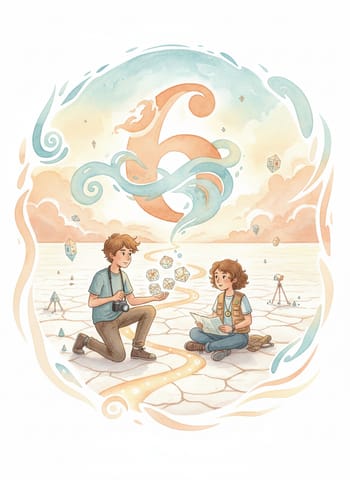
At seven in the morning the salt flat is already white enough to hurt. Oded drags the folding table to the edge of the parking area, the way he does every day. He sets out his props in the same order.
A las siete de la mañana el salar ya es lo bastante blanco como para lastimar. Oded arrastra la mesa plegable hasta el borde del estacionamiento, como todos los días. Dispone su utilería en el mismo orden.
First comes the plastic palm tree. Then comes the toy truck, which looks enormous in photos if the tourist stands far enough away. Last comes the canvas sack of dice, which his mother calls his collection and which Oded calls his problem.
Primero va la palmera de plástico. Luego va el camión de juguete, que se ve enorme en las fotos si el turista se para lo bastante lejos. Al final va el saco de lona con los dados, que su madre llama su colección y que Oded llama su problema.
The sack holds thirty-six dice, and no two of them match. Some are wooden, some are glass, and one is the size of a plum. A few have lost their dots. Oded has gathered them over three summers from the broken board games that visitors leave in the bin by the toilets.
El saco contiene treinta y seis dados, y no hay dos iguales. Unos son de madera, otros de vidrio, y uno tiene el tamaño de una ciruela. A algunos se les han borrado los puntos. Oded los ha reunido a lo largo de tres veranos de los juegos de mesa rotos que los visitantes dejan en el basurero junto a los baños.
His mother stacks water bottles in the kiosk window. Oded shakes the sack, and the dice clatter like a small landslide.
Su madre apila botellas de agua en la ventanilla del quiosco. Oded sacude el saco, y los dados repiquetean como un pequeño derrumbe.
This is his morning habit. He pulls one die from the sack without looking, rolls it on the table, and reads the number. Whatever it shows is the number of photos he will give away for free that day. Today a chipped green cube shows a three. It is a silly rule, but Oded likes that the decision is not his.
Es su costumbre matinal. Saca un dado del saco sin mirar, lo lanza sobre la mesa y lee el número. Lo que marque es la cantidad de fotos que regalará ese día. Hoy un cubo verde descascarado muestra un tres. Es una regla tonta, pero a Oded le gusta que la decisión no sea suya.
The first tourists arrive at nine, in loud, sunburned groups. For an hour and a half the routine runs by itself. Oded poses a couple so that one of them seems to hold the other in a giant hand. He gives a free photo to a small boy who has no one to take his picture. The ground begins to shimmer, and the horizon disappears, which is the whole attraction.
Los primeros turistas llegan a las nueve, en grupos ruidosos y quemados por el sol. Durante una hora y media la rutina funciona sola. Oded coloca a una pareja de modo que uno parezca sostener al otro en una mano gigante. Le regala una foto a un niño pequeño que no tiene quién le saque una. El suelo empieza a centellear, y el horizonte desaparece, que es toda la atracción.
At half past ten, the routine breaks.
A las diez y media, la rutina se rompe.
A dusty pickup stops at the far end of the parking area. It drops off a boy and three metal cases, then drives away without waiting. The boy looks about seventeen, the same as Oded. He wears a floppy hat and carries a tripod on his shoulder, and he walks across the crust very slowly, as if it might crack.
Una camioneta polvorienta se detiene en el extremo lejano del estacionamiento. Deja a un chico y tres maletas metálicas, y se va sin esperar. El chico parece de unos diecisiete años, igual que Oded. Lleva un sombrero flexible y un trípode al hombro, y camina sobre la costra muy despacio, como si pudiera quebrarse.
"It will not break," Oded calls out. "Last year a truck drove across it. A small truck, but still."
«No se rompe», grita Oded. «El año pasado pasó un camión por encima. Un camión chico, pero aun así».
The boy stops and looks at him. "Good to know. I have been worrying about that for the last ten kilometres."
El chico se detiene y lo mira. «Bueno saberlo. Llevo diez kilómetros preocupado por eso».
His name is Ferran. He is an intern with a survey company, and his job is to measure how the salt crust moves during the day. The readings must be taken every hour until sunset. His supervisor has gone to inspect another site and has promised to come back by evening.
Se llama Ferran. Es pasante en una empresa de topografía, y su trabajo es medir cómo se mueve la costra de sal durante el día. Las lecturas deben tomarse cada hora hasta la puesta del sol. Su supervisor se fue a inspeccionar otro sitio y prometió volver al atardecer.
"So you are stuck here for seven hours," Oded says.
«O sea que estás atrapado aquí siete horas», dice Oded.
"I am stuck here with a laser, a notebook and no shade," Ferran says. "Is there somewhere to sit?"
«Estoy atrapado aquí con un láser, un cuaderno y nada de sombra», dice Ferran. «¿Hay algún lugar donde sentarse?».
Because the boy looks so miserable, Oded pushes his own folding chair across the salt with his foot.
Como el chico se ve tan desdichado, Oded empuja con el pie su propia silla plegable por la sal.
Ferran sets up the tripod and takes his first reading. Oded pretends to straighten the palm tree while he watches.
Ferran monta el trípode y toma su primera lectura. Oded finge enderezar la palmera mientras lo observa.
"You are staring," Ferran says, without looking up.
«Me estás mirando fijo», dice Ferran, sin levantar la vista.
"I am working. You are standing in my frame."
«Estoy trabajando. Estás parado en mi encuadre».
"What frame?"
«¿Qué encuadre?».
"The one in my head. A boy in a hat, a tripod, a lot of nothing behind him."
«El de mi cabeza. Un chico con sombrero, un trípode, mucho nada detrás».
Ferran looks up at last. He seems to decide whether he has been insulted, and then he laughs. It is a short, surprised laugh.
Ferran por fin levanta la vista. Parece decidir si lo han insultado, y luego se ríe. Es una risa corta y sorprendida.
At noon he takes his next reading, and afterwards he wanders over to the table. His eyes stop on the sack of dice.
A mediodía toma su siguiente lectura, y después se acerca a la mesa. Sus ojos se detienen en el saco de dados.
"What are those for?"
«¿Para qué son esos?».
"Nothing. They are mine. I roll one every morning to decide how many free photos I give away."
«Para nada. Son míos. Lanzo uno cada mañana para decidir cuántas fotos gratis regalo».
"Thirty-six dice and not one matches," Ferran says, tipping a few into his palm. "This is the best thing I have seen all week. Do you know what you could do with these?"
«Treinta y seis dados y ninguno igual», dice Ferran, vaciando unos cuantos en la palma. «Es lo mejor que he visto en toda la semana. ¿Sabes lo que podrías hacer con esto?».
"Lose them in the salt?"
«¿Perderlos en la sal?».
"Make a game. Listen. Each player pulls two dice from the sack without looking, and rolls them together. A blank face counts as zero, and the big one counts double. Whoever has the lower total must answer a question from the other player. A true answer, no jokes."
«Un juego. Escucha. Cada jugador saca dos dados del saco sin mirar y los lanza juntos. Una cara en blanco cuenta cero, y el grande cuenta doble. El que tenga el total más bajo debe responder una pregunta del otro jugador. Una respuesta verdadera, sin bromas».
Oded raises an eyebrow. "That is a very strange game."
Oded arquea una ceja. «Es un juego rarísimo».
"It is a very strange sack," Ferran says.
«Es un saco rarísimo», dice Ferran.
They play the first round on the table while the tourists wander around them. Oded rolls a four and a blank. Ferran rolls a five on the plum-sized die, which doubles to ten. Oded loses badly.
Juegan la primera ronda sobre la mesa mientras los turistas deambulan a su alrededor. Oded saca un cuatro y un blanco. Ferran saca un cinco en el dado del tamaño de una ciruela, que se duplica a diez. Oded pierde por mucho.
"Why do you really give away free photos?" Ferran asks.
«¿Por qué regalas fotos gratis en realidad?», pregunta Ferran.
Oded thinks about it longer than he expects to. "Because the first summer nobody smiled in my photos. They were all too hot and too tired. A free one made them laugh, and then the paid ones were better."
Oded lo piensa más de lo que esperaba. «Porque el primer verano nadie sonreía en mis fotos. Todos estaban con demasiado calor y demasiado cansados. Una gratis los hacía reír, y entonces las que cobraba salían mejor».
"That is clever."
«Es ingenioso».
"It is only business," Oded says, and he busies himself with the palm tree for a while.
«Es solo negocio», dice Oded, y se ocupa un rato con la palmera.
The afternoon changes shape. Every hour Ferran walks out to his tripod, reads the numbers aloud like a doctor, and walks back. Every hour they play one round. Oded learns that Ferran hates the sea and loves empty places. He learns that Ferran's mother wants him to study law, and that Ferran would rather draw maps.
La tarde cambia de forma. Cada hora Ferran camina hasta su trípode, lee los números en voz alta como un médico y regresa. Cada hora juegan una ronda. Oded se entera de que Ferran odia el mar y ama los lugares vacíos. Se entera de que la mamá de Ferran quiere que estudie derecho, y que Ferran preferiría dibujar mapas.
Ferran learns things too. He learns that the toy truck is a copy of Oded's father's real one, which no longer runs. Oded does not plan to say that. The dice seem to pull it out of him.
Ferran también se entera de cosas. Se entera de que el camión de juguete es una copia del verdadero de su padre, que ya no anda. Oded no pensaba decirlo. Los dados parecen sacárselo.
Around three, the tourists retreat to their cars, and the flat grows quiet.
Hacia las tres, los turistas se repliegan a sus autos, y el salar se queda en silencio.
"You should take a photo of me," Ferran says suddenly. "With the props. I want proof that I survived."
«Deberías tomarme una foto», dice Ferran de pronto. «Con la utilería. Quiero una prueba de que sobreviví».
"Photos cost five coins."
«Las fotos cuestan cinco monedas».
"I will pay."
«Pagaré».
"No, you will not," Oded says. "I still have a free one left from this morning."
«No, no pagarás», dice Oded. «Todavía me queda una gratis de esta mañana».
He places Ferran far from the camera and puts the toy truck close to the lens. In the photo, the truck seems to rest on Ferran's open hand, and the boy behind it looks small, tanned and slightly amazed. Ferran leans over his shoulder to see the screen.
Coloca a Ferran lejos de la cámara y pone el camión de juguete cerca del lente. En la foto, el camión parece descansar sobre la mano abierta de Ferran, y el chico detrás se ve pequeño, moreno y un poco asombrado. Ferran se inclina sobre su hombro para ver la pantalla.
"That is a good one," he says.
«Esa está buena», dice.
"It is all right."
«Está más o menos».
"It is a good one, Oded."
«Está buena, Oded».
They stand there a moment longer than the photo needs.
Se quedan allí un momento más de lo que la foto necesita.
At half past five a pale cloud of dust appears on the horizon and slowly becomes the pickup. Ferran packs his cases with the speed of someone who would prefer to be slower.
A las cinco y media aparece en el horizonte una pálida nube de polvo que poco a poco se convierte en la camioneta. Ferran guarda sus maletas con la rapidez de alguien que preferiría ser más lento.
"Last round?" he asks.
«¿Última ronda?», pregunta.
"Last round."
«Última ronda».
Oded pulls the chipped green cube and a glass die with one blank face. Ferran pulls the plum. They roll together, and the dice skid across the table, spin, and settle. Oded gets a two. Ferran gets a blank and a one, and the plum doubles nothing.
Oded saca el cubo verde descascarado y un dado de vidrio con una cara en blanco. Ferran saca el de la ciruela. Lanzan juntos, y los dados patinan por la mesa, giran y se detienen. Oded saca un dos. Ferran saca un blanco y un uno, y el de la ciruela no duplica nada.
"I lose," Ferran says. "Ask me."
«Pierdo», dice Ferran. «Pregúntame».
Oded has a dozen questions ready, and now every one of them leaves his head. "Which one of the dice would you keep?"
Oded tiene una docena de preguntas listas, y ahora todas se le van de la cabeza. «¿Cuál de los dados te quedarías?».
Ferran does not answer at once. He searches the sack until he finds the smallest die of all, a grey stone cube with three dots worn away.
Ferran no responde de inmediato. Busca en el saco hasta encontrar el más pequeño de todos, un cubo de piedra gris con tres puntos borrados.
"This one. It is the ugliest."
«Este. Es el más feo».
"It is also the oldest," Oded says. "Take it."
«También es el más viejo», dice Oded. «Llévatelo».
"That is not part of the game."
«Eso no es parte del juego».
"The game is mine. I change the rules."
«El juego es mío. Cambio las reglas».
Ferran closes his hand around the die, and the pickup honks twice at the edge of the lot. He walks across the salt without testing the crust this time. At the door of the pickup he turns around, lifts his arm, and throws something small and white in a slow arc.
Ferran cierra la mano alrededor del dado, y la camioneta toca la bocina dos veces en el borde del estacionamiento. Camina por la sal sin probar la costra esta vez. En la puerta de la camioneta se da vuelta, levanta el brazo y lanza algo pequeño y blanco en un arco lento.
Oded catches it with both hands. It is a folded page from the notebook. On it is a map, drawn in careful lines, of a white flat with a table, a palm tree and a boy.
Oded lo atrapa con ambas manos. Es una hoja doblada del cuaderno. En ella hay un mapa, dibujado con líneas cuidadosas, de un salar blanco con una mesa, una palmera y un chico.
The pickup drives away until it is only a bright speck in the glare. His mother says nothing from the kiosk window, which is a kindness in itself.
La camioneta se aleja hasta ser solo una mota brillante en el resplandor. Su madre no dice nada desde la ventanilla del quiosco, lo cual es una amabilidad en sí misma.
Oded puts the map in his shirt pocket. Then he reaches into the sack, pulls out the chipped green cube, and rolls it one last time, to decide tomorrow's free photos. The cube bounces off the table leg, spins on the white ground, and stops.
Oded se guarda el mapa en el bolsillo de la camisa. Luego mete la mano en el saco, saca el cubo verde descascarado y lo lanza una última vez, para decidir las fotos gratis de mañana. El cubo rebota en la pata de la mesa, gira sobre el suelo blanco y se detiene.
Six.
Seis.