Duck Forty-Seven
Uma história gratuita em inglês de nível A1 para estudantes, para ler online em 7 idiomas, com opção de ouvir no app gratuito Storyteller.
At the town duck race, a girl's lucky rubber duck refuses to leave the start and earns a surprise prize.
Essa foi a prévia! Ouça a história completa no app gratuito Storyteller. Baixar o app
O áudio não está disponível no momento.
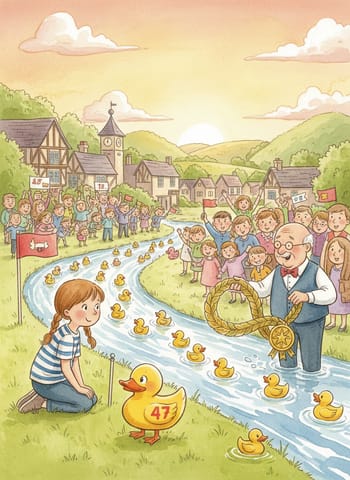
Every June, Hazel's town held a duck race. Two hundred rubber ducks floated down to the park. You paid two dollars for a duck. The money bought books for the school library. The first duck to reach the park won a bicycle.
Todo mês de junho, a cidade da Hazel fazia uma corrida de patinhos. Duzentos patinhos de borracha desciam o rio até o parque. Cada patinho custava dois dólares. O dinheiro comprava livros para a biblioteca da escola. O primeiro patinho a chegar ao parque ganhava uma bicicleta.
Hazel was eleven years old. She wanted that bicycle very much. She saved her money for three weeks. On race morning, she bought duck number forty-seven.
Hazel tinha onze anos. Ela queria muito aquela bicicleta. Juntou dinheiro por três semanas. Na manhã da corrida, comprou o patinho número quarenta e sete.
"It is a lucky number," the seller said.
"É um número de sorte", disse o vendedor.
"Why?" Hazel asked.
"Por quê?", perguntou Hazel.
"I do not know. People just say it." Hazel held the duck in her hands. It was small and shiny, with a tiny orange beak. She kissed it.
"Não sei. As pessoas só dizem isso." Hazel segurou o patinho nas mãos. Era pequeno e brilhante, com um biquinho laranja. Ela o beijou.
"Please win," she whispered.
"Por favor, ganhe", sussurrou.
At noon, everyone stood on the old bridge. The mayor wore a bright green hat. She counted down from ten. People shouted the numbers. At zero, men tipped a big box over the rail. Two hundred ducks fell into the river. Splash!
Ao meio-dia, todos ficaram na ponte velha. A prefeita usava um chapéu verde brilhante. Ela fez a contagem regressiva a partir de dez. As pessoas gritavam os números. No zero, homens viraram uma caixa grande sobre a grade. Duzentos patinhos caíram no rio. Splash!
Hazel ran along the bank with her friends. The ducks floated away in a yellow line. The water moved slowly, and the sun was hot. Hazel looked at the ducks and saw many numbers. Twelve was in front. Then ninety. Then a duck with a green dot.
Hazel correu pela margem com as amigas. Os patinhos se afastaram numa fila amarela. A água corria devagar, e o sol estava quente. Hazel olhou os patinhos e viu muitos números. O doze estava na frente. Depois o noventa. Depois um patinho com uma bolinha verde.
"Where is forty-seven?" her friend asked. Hazel stopped. She looked at the bridge. Then she saw it. Duck number forty-seven was still near the bridge. It sat in a small circle of water. It turned round and round, like a dancer.
"Cadê o quarenta e sete?", perguntou a amiga. Hazel parou. Olhou para a ponte. Então viu. O patinho número quarenta e sete ainda estava perto da ponte. Estava num pequeno círculo de água. Girava e girava, como um dançarino.
"No," Hazel said.
"Não", disse Hazel.
"No, no, no." She ran back. The other ducks went on down the river. Soon the yellow line was far away. People cheered at the park. Duck forty-seven turned slowly, round and round. Hazel stood on the stone path. She called to the duck.
"Não, não, não." Ela correu de volta. Os outros patinhos seguiam rio abaixo. Logo a fila amarela estava longe. As pessoas comemoravam no parque. O patinho quarenta e sete girava devagar, e girava. Hazel ficou parada no caminho de pedra. Chamou o patinho.
"Come on! Go! Please!"
"Vai! Anda! Por favor!"
The duck did not go. It turned again, and again. A tourist took a photo. A dog barked at it. A child asked, "Why is that one not racing?"
O patinho não foi. Girou de novo, e de novo. Um turista tirou uma foto. Um cachorro latiu para ele. Uma criança perguntou: "Por que aquele não está correndo?"
"It does not want to," a man said.
"Ele não quer", disse um homem.
"It likes it there."
"Ele gosta de ficar ali."
Hazel's face was red. She wanted to laugh. She wanted to cry. She took a long stick. She put it in the water. She pushed gently. The duck moved a little, and the river took it. For about five seconds, the duck floated well. Then it hit a stone again and stopped.
O rosto de Hazel estava vermelho. Ela queria rir. Queria chorar. Pegou um galho comprido. Colocou-o na água. Empurrou com cuidado. O patinho se moveu um pouco, e o rio o levou. Por uns cinco segundos, o patinho flutuou bem. Então bateu numa pedra de novo e parou.
"It is the worst duck in the world," Hazel said.
"É o pior patinho do mundo", disse Hazel.
"Maybe," said her friend.
"Talvez", disse a amiga.
"But it is your duck." She sat on the bank to watch the duck. It turned and turned, and slowly she started to laugh. She laughed until her stomach hurt.
"Mas é o seu patinho." Hazel sentou na margem para olhar o patinho. Ele girava e girava, e aos poucos ela começou a rir. Riu até a barriga doer.
At the park, the first duck arrived. The winner was number one hundred and twelve. A man in a blue shirt jumped up and down. He got the bicycle.
No parque, o primeiro patinho chegou. O vencedor foi o número cento e doze. Um homem de camisa azul pulava de alegria. Ele ganhou a bicicleta.
Hazel did not go to the park. She stayed at the bridge with her duck. Later, the mayor walked back along the river. She stopped next to Hazel.
Hazel não foi ao parque. Ficou na ponte com seu patinho. Mais tarde, a prefeita voltou andando pelo rio. Parou ao lado de Hazel.
"Which one is yours?" she asked.
"Qual é o seu?", perguntou.
"Forty-seven," said Hazel.
"O quarenta e sete", disse Hazel.
"It never left." The mayor looked at the duck. She looked at Hazel. Then she took off her green hat and bowed.
"Ele nunca saiu daqui." A prefeita olhou para o patinho. Olhou para Hazel. Então tirou o chapéu verde e fez uma reverência.
"We have a second prize," she said.
"Temos um segundo prêmio", disse ela.
"It is for the very last duck. Every year, I say we do not need it. Every year, I am wrong." She gave Hazel a small paper bag. Inside was a lemon cake and a card. The card said, "Last place. First in our hearts."
"É para o último patinho. Todo ano eu digo que não precisamos dele. Todo ano eu estou errada." Ela deu a Hazel uma sacolinha de papel. Dentro havia um bolo de limão e um cartão. O cartão dizia: "Último lugar. Primeiro em nosso coração."
Hazel laughed. She took the duck from the water. She put it on her shoulder. "Next year," she said, "I buy two. And I will teach them to swim."
Hazel riu. Tirou o patinho da água. Colocou-o no ombro. "Ano que vem", disse ela, "eu compro dois. E vou ensiná-los a nadar."