Duck Forty-Seven
Una historia gratuita en inglés de nivel A1 para estudiantes, para leer en línea en 7 idiomas, con opción de escucharla en la app gratuita Storyteller.
At the town duck race, a girl's lucky rubber duck refuses to leave the start and earns a surprise prize.
¡Ese fue el avance! Escucha la historia completa en la app gratuita Storyteller. Descargar la app
El audio no está disponible en este momento.
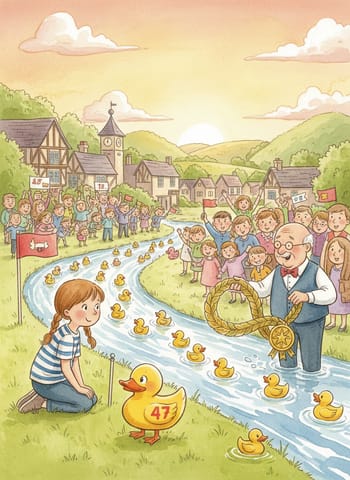
Every June, Hazel's town held a duck race. Two hundred rubber ducks floated down to the park. You paid two dollars for a duck. The money bought books for the school library. The first duck to reach the park won a bicycle.
Cada junio, el pueblo de Hazel organizaba una carrera de patos. Doscientos patos de hule flotaban río abajo hasta el parque. Se pagaban dos dólares por un pato. El dinero servía para comprar libros para la biblioteca de la escuela. El primer pato en llegar al parque ganaba una bicicleta.
Hazel was eleven years old. She wanted that bicycle very much. She saved her money for three weeks. On race morning, she bought duck number forty-seven.
Hazel tenía once años. Quería muchísimo esa bicicleta. Ahorró su dinero durante tres semanas. La mañana de la carrera compró el pato número cuarenta y siete.
"It is a lucky number," the seller said.
«Es un número de la suerte», dijo el vendedor.
"Why?" Hazel asked.
«¿Por qué?», preguntó Hazel.
"I do not know. People just say it." Hazel held the duck in her hands. It was small and shiny, with a tiny orange beak. She kissed it.
«No lo sé. La gente solo lo dice». Hazel sostuvo el pato en las manos. Era pequeño y brillante, con un piquito naranja. Lo besó.
"Please win," she whispered.
«Por favor, gana», susurró.
At noon, everyone stood on the old bridge. The mayor wore a bright green hat. She counted down from ten. People shouted the numbers. At zero, men tipped a big box over the rail. Two hundred ducks fell into the river. Splash!
Al mediodía, todos se reunieron en el puente viejo. La alcaldesa llevaba un sombrero verde brillante. Contó desde diez. La gente gritaba los números. En cero, unos hombres inclinaron una caja grande sobre el barandal. Doscientos patos cayeron al río. ¡Splash!
Hazel ran along the bank with her friends. The ducks floated away in a yellow line. The water moved slowly, and the sun was hot. Hazel looked at the ducks and saw many numbers. Twelve was in front. Then ninety. Then a duck with a green dot.
Hazel corrió por la orilla con sus amigos. Los patos se alejaron flotando en una línea amarilla. El agua se movía despacio y el sol estaba fuerte. Hazel miró los patos y vio muchos números. El doce iba adelante. Luego el noventa. Luego un pato con un punto verde.
"Where is forty-seven?" her friend asked. Hazel stopped. She looked at the bridge. Then she saw it. Duck number forty-seven was still near the bridge. It sat in a small circle of water. It turned round and round, like a dancer.
«¿Dónde está el cuarenta y siete?», preguntó su amiga. Hazel se detuvo. Miró hacia el puente. Entonces lo vio. El pato número cuarenta y siete seguía cerca del puente. Estaba en un pequeño círculo de agua. Giraba y giraba, como un bailarín.
"No," Hazel said.
«No», dijo Hazel.
"No, no, no." She ran back. The other ducks went on down the river. Soon the yellow line was far away. People cheered at the park. Duck forty-seven turned slowly, round and round. Hazel stood on the stone path. She called to the duck.
«No, no, no». Volvió corriendo. Los otros patos siguieron río abajo. Pronto la línea amarilla quedó muy lejos. En el parque la gente aplaudía. El pato cuarenta y siete giraba despacio, una y otra vez. Hazel se quedó en el camino de piedra. Le gritó al pato.
"Come on! Go! Please!"
«¡Vamos! ¡Anda! ¡Por favor!».
The duck did not go. It turned again, and again. A tourist took a photo. A dog barked at it. A child asked, "Why is that one not racing?"
El pato no se fue. Giró otra vez, y otra más. Una turista le tomó una foto. Un perro le ladró. Un niño preguntó: «¿Por qué ese no está corriendo?».
"It does not want to," a man said.
«No quiere», dijo un hombre.
"It likes it there."
«Le gusta estar ahí».
Hazel's face was red. She wanted to laugh. She wanted to cry. She took a long stick. She put it in the water. She pushed gently. The duck moved a little, and the river took it. For about five seconds, the duck floated well. Then it hit a stone again and stopped.
Hazel tenía la cara roja. Quería reírse. Quería llorar. Tomó un palo largo. Lo metió en el agua. Empujó con suavidad. El pato avanzó un poco y el río se lo llevó. Durante unos cinco segundos, el pato flotó muy bien. Luego chocó otra vez contra una piedra y se detuvo.
"It is the worst duck in the world," Hazel said.
«Es el peor pato del mundo», dijo Hazel.
"Maybe," said her friend.
«Tal vez», dijo su amiga.
"But it is your duck." She sat on the bank to watch the duck. It turned and turned, and slowly she started to laugh. She laughed until her stomach hurt.
«Pero es tu pato». Se sentó en la orilla a mirar al pato. Giraba y giraba, y poco a poco ella empezó a reírse. Se rió hasta que le dolió la panza.
At the park, the first duck arrived. The winner was number one hundred and twelve. A man in a blue shirt jumped up and down. He got the bicycle.
En el parque llegó el primer pato. El ganador fue el número ciento doce. Un hombre con camisa azul saltaba de alegría. Se llevó la bicicleta.
Hazel did not go to the park. She stayed at the bridge with her duck. Later, the mayor walked back along the river. She stopped next to Hazel.
Hazel no fue al parque. Se quedó en el puente con su pato. Más tarde, la alcaldesa volvió caminando por el río. Se detuvo junto a Hazel.
"Which one is yours?" she asked.
«¿Cuál es el tuyo?», preguntó.
"Forty-seven," said Hazel.
«El cuarenta y siete», dijo Hazel.
"It never left." The mayor looked at the duck. She looked at Hazel. Then she took off her green hat and bowed.
«Nunca se fue». La alcaldesa miró al pato. Miró a Hazel. Luego se quitó el sombrero verde e hizo una reverencia.
"We have a second prize," she said.
«Tenemos un segundo premio», dijo.
"It is for the very last duck. Every year, I say we do not need it. Every year, I am wrong." She gave Hazel a small paper bag. Inside was a lemon cake and a card. The card said, "Last place. First in our hearts."
«Es para el último pato. Cada año digo que no lo necesitamos. Cada año me equivoco». Le dio a Hazel una bolsita de papel. Adentro había un pastel de limón y una tarjeta. La tarjeta decía: «Último lugar. Primero en nuestro corazón».
Hazel laughed. She took the duck from the water. She put it on her shoulder. "Next year," she said, "I buy two. And I will teach them to swim."
Hazel se rió. Sacó el pato del agua. Se lo puso en el hombro. «El próximo año», dijo, «compro dos. Y les voy a enseñar a nadar».