The Fogged Mirror
Cerita bahasa Inggris gratis level B2 untuk pelajar, bisa dibaca online dalam 7 bahasa, dengan pilihan untuk mendengarkannya di aplikasi Storyteller gratis.
A tailor's quiet routine changes when a nervous television host arrives with a torn jacket and only a few hours left.
Itu cuplikannya! Dengarkan cerita lengkapnya di aplikasi Storyteller gratis. Unduh aplikasi
Audio belum tersedia saat ini.
Every morning at eight, Zahra turns on the three sewing machines in her shop, one after another, like a conductor waking an orchestra. The first is a heavy black machine that sews through leather. The second is quick and light and loves silk. The third rattles, and nobody remembers why she keeps it.
Setiap pagi pukul delapan, Zahra menyalakan tiga mesin jahit di tokonya satu per satu, seperti dirigen yang membangunkan orkestra. Yang pertama mesin hitam berat yang menjahit kulit. Yang kedua cepat dan ringan dan menyukai sutra. Yang ketiga berkelotak, dan tak seorang pun ingat mengapa ia menyimpannya.
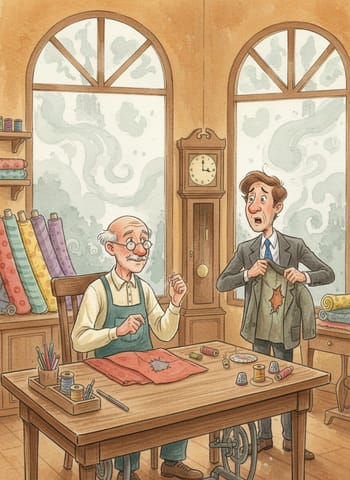
Today Mina and Pavel are already at their places, bent over a pile of trouser hems. The radio plays a slow song from a station that is mostly static. Steam rises from the iron at the back of the room. It drifts across the narrow fitting corner, where the tall mirror turns white in seconds.
Hari ini Mina dan Pavel sudah di tempat mereka, membungkuk di atas setumpuk kelim celana. Radio memutar lagu pelan dari stasiun yang sebagian besar hanya berisi desisan. Uap naik dari setrika di bagian belakang ruangan. Uap itu melayang melintasi sudut ruang pas yang sempit, tempat cermin tinggi berubah putih dalam hitungan detik.
That is the one flaw in the shop. The mirror fogs up whenever the iron is on, and the iron is nearly always on. Customers learn to wipe it with a sleeve before they look. Zahra has been meaning to move the mirror for six years.
Itulah satu-satunya cela di toko itu. Cermin itu berembun setiap kali setrika menyala, dan setrikanya hampir selalu menyala. Para pelanggan belajar menyekanya dengan lengan baju sebelum bercermin. Sudah enam tahun Zahra berniat memindahkan cermin itu.
"Fog again," says Mina, without looking up.
"Berembun lagi," kata Mina tanpa mengangkat wajah.
"It builds character," says Zahra.
"Itu membentuk karakter," kata Zahra.
"It builds fingerprints."
"Itu membentuk sidik jari."
The morning follows its usual pattern. A woman brings a coat with a torn lining. A teenager wants his school trousers taken in, and he pretends not to enjoy being measured. A bank clerk collects a jacket and tells everyone, unprompted, how well it fits. By ten o'clock the pile of finished work is growing on the rail, and the shop smells pleasantly of hot cotton.
Pagi itu berjalan dengan pola biasanya. Seorang perempuan membawa mantel dengan lapisan dalam yang robek. Seorang remaja ingin celana sekolahnya dikecilkan, dan ia pura-pura tidak menikmati diukur. Seorang pegawai bank mengambil jasnya dan memberi tahu semua orang, tanpa diminta, betapa pas jas itu. Menjelang pukul sepuluh tumpukan pekerjaan selesai di rel gantungan makin tinggi, dan toko itu berbau menyenangkan seperti katun yang hangat.
At twenty past ten the door bangs open.
Pukul sepuluh lewat dua puluh, pintu terbanting terbuka.
A man comes in so quickly that the bell above the door gives only half a ring. He is perhaps thirty-five, with dark hair that has been combed in a hurry and a face the colour of paper. Over one arm he carries a black suit in a clear plastic cover. In his other hand is a phone that keeps lighting up and buzzing against his palm.
Seorang pria masuk begitu cepat sehingga lonceng di atas pintu hanya berdering setengah. Usianya mungkin tiga puluh lima, dengan rambut gelap yang disisir terburu-buru dan wajah sepucat kertas. Di satu lengannya ia membawa setelan hitam dalam penutup plastik bening. Di tangan lainnya ada ponsel yang terus menyala dan bergetar di telapak tangannya.
"Please tell me you can fix a seam," he says. "I'm so sorry. I know I should have called."
"Tolong bilang Anda bisa memperbaiki jahitan," katanya. "Saya benar-benar minta maaf. Saya tahu seharusnya saya menelepon dulu."
Zahra puts down her scissors. "Take a breath first. Then show me."
Zahra meletakkan guntingnya. "Tarik napas dulu. Lalu tunjukkan kepada saya."
He lays the suit on the counter. The trousers are fine, but the jacket has a long tear running down one side seam. It runs from the armpit to the hem, as if a knife had opened it.
Ia membentangkan setelan itu di atas meja. Celananya baik-baik saja, tetapi jasnya sobek panjang di sepanjang jahitan sisi. Sobekan itu membentang dari ketiak sampai ke tepi bawah, seakan dibuka dengan pisau.
"Last night I was packing," he says. "The hanger caught on a hook and I pulled too hard, and then I stood there looking at it. I'm Koji. I'm presenting an award at a ceremony this evening. Live, on television. They have my face on the posters."
"Semalam saya sedang berkemas," katanya. "Gantungannya tersangkut di sebuah kait dan saya menariknya terlalu keras, lalu saya berdiri di sana memandanginya. Saya Koji. Malam ini saya akan menyerahkan penghargaan di sebuah upacara. Siaran langsung, di televisi. Wajah saya ada di poster-poster."
Mina has stopped sewing. Even the radio seems quieter.
Mina sudah berhenti menjahit. Bahkan radio terdengar lebih pelan.
"What time?" Zahra asks.
"Jam berapa?" tanya Zahra.
"I leave here at four. The car is booked. I don't have another suit that fits, and the shops in the centre wanted two days." He swallows. "I can pay anything."
"Saya berangkat dari sini pukul empat. Mobilnya sudah dipesan. Saya tidak punya setelan lain yang pas, dan toko-toko di pusat kota minta dua hari." Ia menelan ludah. "Saya bisa bayar berapa pun."
Zahra studies the tear. It is clean, which helps, but the fabric is a fine wool that will punish every mistake. She looks at the clock, then at the rail of waiting orders, then at her two assistants.
Zahra memeriksa sobekan itu. Sobekannya bersih, dan itu membantu, tetapi kainnya wol halus yang akan menghukum setiap kesalahan. Ia melihat jam, lalu rel pesanan yang menunggu, lalu kedua asistennya.
"Mina, put aside the hems. Pavel, finish the coat lining in the next hour and nothing else." She turns back to Koji. "I can do it, but you will wait here. It is a delicate job, and I will need to measure you again as I go. If you walk out and come back, we lose time."
"Mina, singkirkan dulu kelim-kelim itu. Pavel, selesaikan lapisan mantel itu dalam satu jam ke depan dan jangan kerjakan yang lain." Ia berbalik kepada Koji. "Saya bisa mengerjakannya, tapi Anda harus menunggu di sini. Ini pekerjaan yang halus, dan saya perlu mengukur Anda lagi selama mengerjakannya. Kalau Anda pergi lalu kembali, kita kehilangan waktu."
"I'll wait. I'll wait wherever you want."
"Saya akan menunggu. Saya akan menunggu di mana pun Anda minta."
"Good. Take off the jacket you are wearing and go to the mirror."
"Bagus. Lepas jas yang Anda pakai dan pergilah ke cermin."
He goes to the fitting corner and stands there, tall and rigid. The white fog creeps up his reflection until only a pale outline is left. He wipes a small patch with his hand and stares at it, then lets his hand drop.
Ia pergi ke sudut ruang pas dan berdiri di sana, jangkung dan kaku. Embun putih merayap naik pada bayangannya sampai hanya tersisa garis samar yang pucat. Ia menyeka sepetak kecil dengan tangannya dan menatapnya, lalu membiarkan tangannya jatuh.
"Does it always do that?" he asks.
"Selalu begini?" tanyanya.
"Every day. It is part of the shop."
"Setiap hari. Itu bagian dari toko ini."
"Then how does anybody know what they look like?"
"Lalu bagaimana orang tahu seperti apa rupa mereka?"
Zahra thinks that this is a more interesting question than he realises. "They learn to trust the tailor," she says.
Zahra berpikir bahwa itu pertanyaan yang lebih menarik daripada yang ia sadari. "Mereka belajar memercayai penjahitnya," katanya.
She works through the morning with total attention. She undoes the damaged seam stitch by stitch, matches the wool with a scrap from the inner pocket, and steams the edges so they relax. Her hands move with the quiet certainty of an old routine, and Koji watches her from a chair by the window. His phone keeps buzzing. After a while he turns it off.
Ia bekerja sepanjang pagi dengan perhatian penuh. Ia membuka jahitan yang rusak tusuk demi tusuk, mencocokkan wol itu dengan sisa kain dari saku dalam, dan mengukus tepinya agar melemas. Tangannya bergerak dengan keyakinan tenang dari rutinitas lama, dan Koji memperhatikannya dari kursi di dekat jendela. Ponselnya terus bergetar. Setelah beberapa saat ia mematikannya.
By midday the shop has found a new rhythm. Mina brings him a sandwich. Pavel, who is normally shy, asks him about the television studio and is told that it is much smaller than it looks and always freezing. The radio plays the same slow song again, and nobody changes it.
Menjelang tengah hari toko itu menemukan irama baru. Mina membawakan sandwich untuknya. Pavel, yang biasanya pemalu, bertanya kepadanya tentang studio televisi dan diberi tahu bahwa studio itu jauh lebih kecil daripada tampaknya dan selalu dingin. Radio memutar lagu pelan yang sama lagi, dan tak ada yang menggantinya.
At two o'clock Zahra begins the final seam on the fastest machine. The needle chatters. Koji stands up without thinking and comes to stand behind her shoulder.
Pukul dua Zahra memulai jahitan terakhir dengan mesin tercepat. Jarumnya berkeletak. Koji berdiri tanpa berpikir dan datang berdiri di belakang bahunya.
"Can I ask something?" he says. "Why does your work look so calm? I've been so frightened all day that I can't feel my fingers."
"Boleh saya bertanya sesuatu?" katanya. "Kenapa pekerjaan Anda tampak begitu tenang? Saya begitu ketakutan seharian sampai tidak bisa merasakan jari-jari saya."
"I am frightened as well," says Zahra, not looking up. "I am always frightened for the first minute. After that there is only the seam."
"Saya juga takut," kata Zahra tanpa menoleh. "Saya selalu takut pada menit pertama. Setelah itu hanya ada jahitan."
"The first minute of what?"
"Menit pertama apa?"
"Of anything that matters."
"Dari apa pun yang penting."
He laughs under his breath and says nothing more.
Ia tertawa kecil dan tidak berkata apa-apa lagi.
At a quarter to four she cuts the last thread. She holds the jacket up, turns it slowly under the light, and runs her thumb down the repaired line. From the inside you can still see it; from the outside, the black wool lies flat and quiet, and there is nothing to find.
Pukul empat kurang lima belas menit ia memotong benang terakhir. Ia mengangkat jas itu, memutarnya perlahan di bawah lampu, dan menyusurkan ibu jarinya sepanjang garis yang telah diperbaiki. Dari sisi dalam jahitan itu masih terlihat; dari sisi luar, wol hitam itu terbentang rata dan tenang, dan tak ada yang bisa ditemukan.
Koji puts it on. He walks to the mirror, and for the first time that day it is almost clear, because the iron has been off for twenty minutes. He turns one way, then the other. His reflection straightens, as if the jacket has pulled him up by the shoulders.
Koji memakainya. Ia berjalan ke cermin, dan untuk pertama kalinya hari itu cermin itu hampir jernih, karena setrikanya sudah mati dua puluh menit. Ia berbalik ke satu sisi, lalu sisi lainnya. Bayangannya menegak, seakan jas itu menariknya naik pada bahu.
"It is perfect," he says. "I cannot see anything."
"Sempurna," katanya. "Saya tidak bisa melihat apa-apa."
"You are not supposed to." Zahra brushes a thread from his collar. "That is the whole job."
"Memang seharusnya begitu." Zahra membersihkan sehelai benang dari kerahnya. "Itulah seluruh pekerjaannya."
He pays her, and then pays her again until she pushes the extra notes back across the counter. Mina and Pavel clap, rather shyly, and Koji bows to them in the doorway with his hand on his heart. The car is waiting at the kerb with its engine running.
Ia membayar, lalu membayar lagi sampai Zahra mendorong kembali uang kelebihannya melintasi meja. Mina dan Pavel bertepuk tangan, agak malu-malu, dan Koji membungkuk kepada mereka di ambang pintu dengan tangan di dada. Mobil sudah menunggu di tepi jalan dengan mesin menyala.
At the last moment he looks back at the mirror. Behind him, the iron clicks on, and a pale mist starts to creep across the glass again.
Pada saat terakhir ia menoleh ke cermin. Di belakangnya, setrika berbunyi klik menyala, dan kabut pucat mulai merayap lagi di atas kaca.
"You should never fix that mirror," he says. "I looked better in the fog."
"Jangan pernah memperbaiki cermin itu," katanya. "Saya tampak lebih bagus dalam kabut."