The Flooded Archive
Cerita bahasa Inggris gratis level B2 untuk pelajar, bisa dibaca online dalam 5 bahasa, dengan pilihan untuk mendengarkannya di aplikasi Storyteller gratis.
When a burst pipe floods the town archive at night, Alessia has to choose which treasures to carry to safety first.
Itu cuplikannya! Dengarkan cerita lengkapnya di aplikasi Storyteller gratis. Unduh aplikasi
Audio belum tersedia saat ini.
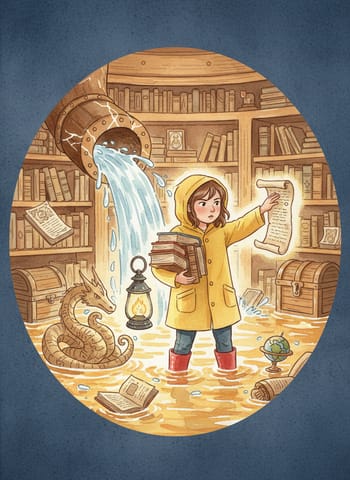
The call came at ten past midnight. A neighbor had seen water running out from under the door of the town archive. By the time Alessia arrived, it was already pooling on the front steps.
Telepon itu datang pukul sepuluh lewat tengah malam. Seorang tetangga melihat air mengalir keluar dari bawah pintu arsip kota. Ketika Alessia tiba, air sudah menggenang di tangga depan.
A pipe had burst in the old market hall above. Down in the basement, the water stood ankle-deep and was rising by an inch every ten minutes. The water company had promised to send someone within the hour, but nobody knew how much the basement would hold by then.
Sebuah pipa pecah di balai pasar tua di atasnya. Di ruang bawah tanah, air sudah setinggi mata kaki dan naik satu inci setiap sepuluh menit. Perusahaan air berjanji mengirim seseorang dalam satu jam, tetapi tidak ada yang tahu seberapa banyak air yang akan tertampung di ruang bawah tanah itu pada saat itu.
Three volunteers had answered her phone calls. One was a retired surveyor in a dressing gown. One was a teenager who did the Saturday filing. The third was a baker who should have been starting his night shift. Alessia handed out boots from the cupboard and looked at the shelves.
Tiga relawan menjawab telepon darinya. Satu adalah juru ukur pensiunan yang masih memakai jubah tidur. Satu adalah remaja yang mengerjakan pengarsipan pada hari Sabtu. Yang ketiga adalah seorang tukang roti yang seharusnya sedang memulai shift malamnya. Alessia membagikan sepatu bot dari lemari dan menatap rak-raknya.
The bottom drawers held the estate maps. They were hand-colored, more than two hundred years old, and they were the pride of the collection. The registers of births stood on a shelf just above them, plain and ugly, in gray cloth bindings.
Laci-laci paling bawah berisi peta-peta perkebunan. Peta-peta itu diwarnai dengan tangan, berusia lebih dari dua ratus tahun, dan menjadi kebanggaan koleksi. Daftar kelahiran berdiri di rak tepat di atasnya, polos dan jelek, dengan sampul kain abu-abu.
"The maps," the surveyor said immediately. "People come from other countries to see those."
"Peta-peta itu," kata si juru ukur segera. "Orang datang dari negara lain untuk melihatnya."
"The registers," the teenager said. "People come every single week."
"Daftar kelahiran," kata si remaja. "Orang datang setiap minggu."
Alessia thought about it for the length of one breath. The maps had been photographed ten years earlier, and the photographs were safe in another building. Nobody had ever scanned the registers. If a register were ruined, a person's proof of being born would simply vanish.
Alessia memikirkannya selama satu tarikan napas. Peta-peta itu sudah difoto sepuluh tahun sebelumnya, dan foto-fotonya aman di gedung lain. Tidak seorang pun pernah memindai daftar kelahiran itu. Kalau sebuah daftar rusak, bukti kelahiran seseorang akan lenyap begitu saja.
"Registers first," she said. "Then the maps, drawer by drawer, for as long as we can."
"Daftar kelahiran dulu," katanya. "Lalu peta-petanya, laci demi laci, selama kita bisa."
They formed a chain up the stairs. The baker, who was the strongest, lifted the heavy volumes from the shelf. The others passed them upward, hand to hand, until the corridor above looked like a crowded station. Meanwhile the water climbed past the second drawer.
Mereka membentuk rantai di sepanjang tangga. Si tukang roti, yang paling kuat, mengangkat jilid-jilid berat itu dari rak. Yang lain mengoperkannya ke atas, dari tangan ke tangan, sampai koridor di atas tampak seperti stasiun yang ramai. Sementara itu, air naik melewati laci kedua.
By the time the water company's van arrived, all forty-one registers were safe, and so were nine of the fourteen map drawers. The last five had been soaked.
Ketika mobil van perusahaan air tiba, keempat puluh satu daftar sudah aman, begitu pula sembilan dari empat belas laci peta. Lima yang terakhir sudah basah kuyup.
In the morning, a conservator told Alessia to freeze the wet maps at once, because the cold would stop the mold. The baker offered his walk-in freezer, and the maps spent that week between sacks of flour and trays of dough.
Pagi harinya, seorang konservator menyuruh Alessia membekukan peta-peta basah itu segera, karena dingin akan menghentikan jamur. Si tukang roti menawarkan lemari bekunya yang besar, dan peta-peta itu menghabiskan minggu itu di antara karung tepung dan nampan adonan.
If they had started with the maps, Alessia thought afterward, they might have saved all fourteen. They would also have lost the registers, and she knew she would have regretted that choice.
Kalau mereka mulai dari peta-peta itu, pikir Alessia kemudian, mungkin mereka bisa menyelamatkan keempat belasnya. Namun, mereka juga akan kehilangan daftar kelahiran, dan ia tahu ia akan menyesali pilihan itu.
On the day the archive reopened, a woman was already waiting at eight o'clock outside the door with a form in her hand. She needed her mother's birth record for a pension application.
Pada hari arsip dibuka kembali, seorang perempuan sudah menunggu pukul delapan di luar pintu dengan selembar formulir di tangannya. Ia membutuhkan catatan kelahiran ibunya untuk pengajuan pensiun.
Alessia went upstairs in her borrowed boots and found the right volume. Its corners were damp, but the page was whole. "It's a little wet at the edges," she said, handing it over. "Everything on it is still there."
Alessia naik ke atas dengan sepatu bot pinjamannya dan menemukan jilid yang tepat. Sudut-sudutnya lembap, tetapi halamannya utuh. "Agak basah di bagian tepinya," katanya sambil menyerahkannya. "Semua yang tertulis di dalamnya masih ada."