The Flooded Archive
A free B2-level English story for language learners, readable online in 4 languages, with an option to listen via the free Storyteller app.
When a burst pipe floods the town archive at night, Alessia has to choose which treasures to carry to safety first.
That was the preview! Hear the full story in the free Storyteller app. Get the app
Audio isn't available right now.
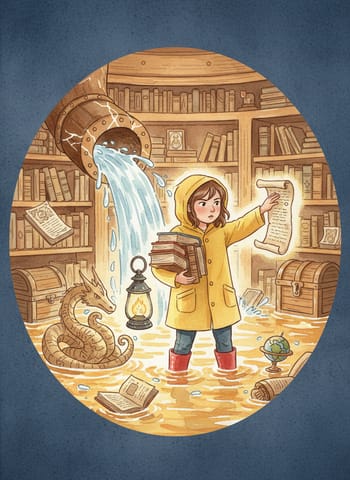
The call came at ten past midnight. A neighbor had seen water running out from under the door of the town archive. By the time Alessia arrived, it was already pooling on the front steps.
A pipe had burst in the old market hall above. Down in the basement, the water stood ankle-deep and was rising by an inch every ten minutes. The water company had promised to send someone within the hour, but nobody knew how much the basement would hold by then.
Three volunteers had answered her phone calls. One was a retired surveyor in a dressing gown. One was a teenager who did the Saturday filing. The third was a baker who should have been starting his night shift. Alessia handed out boots from the cupboard and looked at the shelves.
The bottom drawers held the estate maps. They were hand-colored, more than two hundred years old, and they were the pride of the collection. The registers of births stood on a shelf just above them, plain and ugly, in gray cloth bindings.
"The maps," the surveyor said immediately. "People come from other countries to see those."
"The registers," the teenager said. "People come every single week."
Alessia thought about it for the length of one breath. The maps had been photographed ten years earlier, and the photographs were safe in another building. Nobody had ever scanned the registers. If a register were ruined, a person's proof of being born would simply vanish.
"Registers first," she said. "Then the maps, drawer by drawer, for as long as we can."
They formed a chain up the stairs. The baker, who was the strongest, lifted the heavy volumes from the shelf. The others passed them upward, hand to hand, until the corridor above looked like a crowded station. Meanwhile the water climbed past the second drawer.
By the time the water company's van arrived, all forty-one registers were safe, and so were nine of the fourteen map drawers. The last five had been soaked.
In the morning, a conservator told Alessia to freeze the wet maps at once, because the cold would stop the mold. The baker offered his walk-in freezer, and the maps spent that week between sacks of flour and trays of dough.
If they had started with the maps, Alessia thought afterward, they might have saved all fourteen. They would also have lost the registers, and she knew she would have regretted that choice.
On the day the archive reopened, a woman was already waiting at eight o'clock outside the door with a form in her hand. She needed her mother's birth record for a pension application.
Alessia went upstairs in her borrowed boots and found the right volume. Its corners were damp, but the page was whole. "It's a little wet at the edges," she said, handing it over. "Everything on it is still there."