The Midnight Snowplow
A free B2-level English story for language learners, readable online in 4 languages, with an option to listen via the free Storyteller app.
During a blizzard, snowplow driver Calla finds a stranded family in a drift and leads them to safety behind her plow.
That was the preview! Hear the full story in the free Storyteller app. Get the app
Audio isn't available right now.
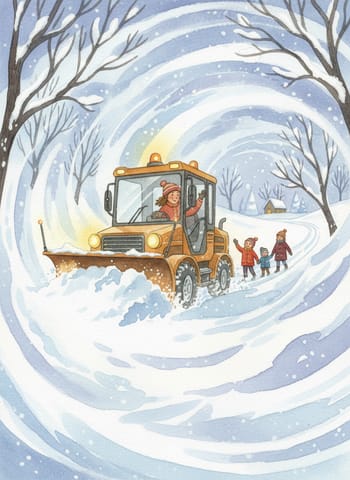
By midnight, it has been snowing for nine hours, and the highway has been closed since eight. Calla keeps her plow moving anyway. The blade throws a white wave across the verge, and an amber light turns on the cab roof. Every twenty minutes, the dispatcher's voice comes through the radio to ask whether she is still alive. "Still here," she answers each time.
The cab smells of diesel and of the ginger tea in her flask. She has driven this stretch for eleven winters and knows every curve by feel, which is lucky, because tonight she can see about thirty meters.
At twenty to one, she notices a dark shape in a drift on the far side of the road. It is a car roof under a mound of snow, with a thin thread of exhaust hanging above it. She stops the plow. "Dispatch, there's a car buried at the quarry turning," she says. "Checking for people."
She pulls on her gloves and wades through knee-deep snow. The car's windows are fogged, and in the fog someone has drawn a smiley face with a finger. She knocks. A man opens the door a crack. Behind him, a woman sits with a sleeping child across her lap. A second child stares at Calla's reflective jacket as if she were an astronaut.
"We took the wrong turn at the junction," the man says. "We should have turned back when we saw the closed sign. We've been running the engine ten minutes every hour to save fuel."
"That was smart," Calla says. "Stay inside. I'll be quick."
She returns to the plow, angles the blade and clears the snow around the car in three slow passes. A black strip of road shows underneath. Then she fetches her flask. The lid becomes a cup, and it goes around the car: the older child first, then the mother, then the father.
"It tastes of ginger and a little bit of diesel," the mother says, almost laughing.
"That's the cup," Calla says. "Not the tea."
The radio crackles. The dispatcher says that the nearest lit building is the motel in Carrow, eleven kilometers away, and that it is still open. Calla explains the plan to the father. "Follow my taillights. Stay close, don't overtake, and if I stop, you stop."
"If you went any faster, we would lose you," he says.
"Exactly."
The drive takes fifty minutes. The plow crawls at twelve kilometers an hour. The little car follows so closely that Calla keeps checking her mirror, where two headlights swim in a cloud of white. Twice, the wind fills the road again, and she backs up to clear it. Once, the headlights disappear, and her stomach drops, until they reappear from behind a drift.
At half past two, the lights of Carrow come into view. There is a gas station, one traffic light blinking yellow and a motel sign that buzzes in the dark. The mother climbs out and tries to speak, but Calla waves it off. "Stay off the highway until morning," she says. "The road will be cleared by seven."
The older child runs back across the snow and holds something up to the window. It is the flask lid. He says nothing, and neither does she.
Calla screws it back on. In her mirror, the family disappears through a lit doorway. She lowers the blade, turns the plow around and lifts the radio. "Dispatch, it's Calla. The road is open as far as Carrow. I'm going back for the rest of it."
Behind her, the snow is already filling her tracks.