The Marathon in the Heat
A free B2-level English story for language learners, readable online in 4 languages, with an option to listen via the free Storyteller app.
A race director shortens a city marathon to a half because of a heat warning, then watches the temperature climb on race day.
That was the preview! Hear the full story in the free Storyteller app. Get the app
Audio isn't available right now.
The forecast arrives on a Wednesday: thirty-six degrees on Sunday, with almost no wind. Frida, who has directed the city marathon for six years, reads it three times. Then she closes her laptop and goes for a walk.
She knows what those numbers mean. She has seen what happens to runners at thirty-two degrees. Thirty-six is far beyond what a medical tent can handle with six thousand people on the course.
On Thursday morning, she announces that the full marathon will become a half, with a start one hour earlier. By lunchtime, the comments are arriving by the hundreds. "Months of training wasted." "You have robbed us." One runner writes that she should resign. Another claims everything would have been fine if the organizers were not so cautious.
She reads them standing in the kitchen with a cold coffee. A sponsor calls to say that his company is "disappointed." The volunteer coordinator calls to say that three people have quit.
"If I'm wrong, I will apologize in public," Frida tells the coordinator. "I can do that. I could not do the other thing."
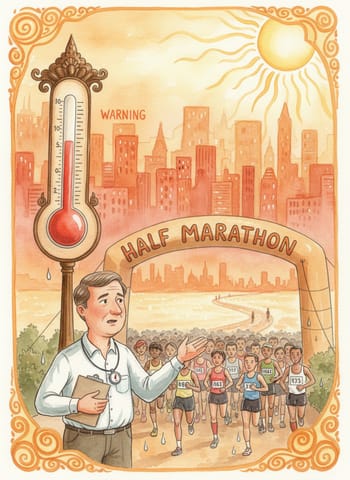
On Sunday, the starting gun fires at seven, while the air is still pleasant. Frida stands at the finish line with a radio, a thermometer clipped to her vest and six hundred sponges soaking in ice water. Volunteers have built a misting arch from garden hoses at the ten-kilometer mark.
By nine, it is thirty-one degrees, and the first finishers are crossing the line, red-faced but upright. They laugh when they reach the sponges. The medical tent is busy but calm, mostly cramps and dizziness. The doctors send most people to the shade with water and a stern look.
Frida watches the thermometer climb while the last runners come in. Thirty-three. Thirty-four. She does the arithmetic she has been doing since Wednesday. At this hour, the full-marathon runners would have been near kilometer thirty, with twelve more kilometers of unshaded road ahead of them.
A man in a yellow vest walks toward the finish tent, a wet sponge on his neck and a medal in his hand. She recognizes him from the comment thread. He is the one who wrote that she should resign.
"I wanted to say something," he says. "I was furious on Thursday." He looks back down the road. "At the twelve-kilometer mark I passed three people sitting on the curb. And that was only the half."
He does not finish the sentence. Frida says only that she is glad he made it to the end. He nods, wipes his face and walks away.
Meanwhile, the thermometer on her vest reads thirty-six. She lifts the radio to her mouth.
"All water points," she says. "Double the ice. The last runners are on their way in."