The Fogged Mirror
Uma história gratuita em inglês de nível B2 para estudantes, para ler online em 7 idiomas, com opção de ouvir no app gratuito Storyteller.
A tailor's quiet routine changes when a nervous television host arrives with a torn jacket and only a few hours left.
Essa foi a prévia! Ouça a história completa no app gratuito Storyteller. Baixar o app
O áudio não está disponível no momento.
Every morning at eight, Zahra turns on the three sewing machines in her shop, one after another, like a conductor waking an orchestra. The first is a heavy black machine that sews through leather. The second is quick and light and loves silk. The third rattles, and nobody remembers why she keeps it.
Toda manhã às oito, Zahra liga as três máquinas de costura da sua loja, uma depois da outra, como um maestro acordando uma orquestra. A primeira é uma máquina preta e pesada que costura couro. A segunda é rápida e leve e adora seda. A terceira chacoalha, e ninguém se lembra de por que ela a mantém.
Today Mina and Pavel are already at their places, bent over a pile of trouser hems. The radio plays a slow song from a station that is mostly static. Steam rises from the iron at the back of the room. It drifts across the narrow fitting corner, where the tall mirror turns white in seconds.
Hoje Mina e Pavel já estão em seus lugares, debruçados sobre uma pilha de barras de calça. O rádio toca uma música lenta de uma estação que é quase só chiado. O vapor sobe do ferro de passar, nos fundos da sala. Ele paira sobre o estreito canto de provas, onde o espelho alto fica branco em segundos.
That is the one flaw in the shop. The mirror fogs up whenever the iron is on, and the iron is nearly always on. Customers learn to wipe it with a sleeve before they look. Zahra has been meaning to move the mirror for six years.
Esse é o único defeito da loja. O espelho embaça sempre que o ferro está ligado, e o ferro está quase sempre ligado. Os clientes aprendem a limpar com a manga antes de se olhar. Zahra pensa em mudar o espelho de lugar há seis anos.
"Fog again," says Mina, without looking up.
"Embaçou de novo", diz Mina, sem erguer os olhos.
"It builds character," says Zahra.
"Isso forma o caráter", diz Zahra.
"It builds fingerprints."
"Forma digitais."
The morning follows its usual pattern. A woman brings a coat with a torn lining. A teenager wants his school trousers taken in, and he pretends not to enjoy being measured. A bank clerk collects a jacket and tells everyone, unprompted, how well it fits. By ten o'clock the pile of finished work is growing on the rail, and the shop smells pleasantly of hot cotton.
A manhã segue o padrão de sempre. Uma mulher traz um casaco com o forro rasgado. Um adolescente quer que apertem a calça do uniforme, e finge não gostar de ser medido. Um bancário retira um paletó e conta a todo mundo, sem ninguém pedir, como ele ficou bem. Às dez horas a pilha de trabalhos prontos cresce no cabideiro, e a loja cheira agradavelmente a algodão quente.
At twenty past ten the door bangs open.
Às dez e vinte a porta se abre com um estrondo.
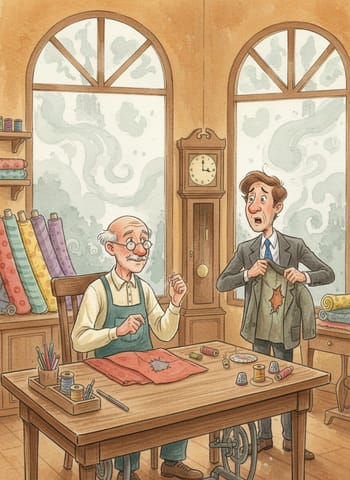
A man comes in so quickly that the bell above the door gives only half a ring. He is perhaps thirty-five, with dark hair that has been combed in a hurry and a face the colour of paper. Over one arm he carries a black suit in a clear plastic cover. In his other hand is a phone that keeps lighting up and buzzing against his palm.
Um homem entra tão depressa que a sineta sobre a porta toca só pela metade. Tem uns trinta e cinco anos, cabelo escuro penteado às pressas e o rosto da cor de papel. Num braço leva um terno preto numa capa de plástico transparente. Na outra mão, um celular que não para de acender e vibrar na palma.
"Please tell me you can fix a seam," he says. "I'm so sorry. I know I should have called."
"Por favor, diga que você consegue consertar uma costura", diz ele. "Sinto muito. Sei que devia ter ligado."
Zahra puts down her scissors. "Take a breath first. Then show me."
Zahra pousa a tesoura. "Respire primeiro. Depois me mostre."
He lays the suit on the counter. The trousers are fine, but the jacket has a long tear running down one side seam. It runs from the armpit to the hem, as if a knife had opened it.
Ele estende o terno sobre o balcão. A calça está boa, mas o paletó tem um rasgo comprido ao longo de uma costura lateral. Vai da axila até a barra, como se uma faca o tivesse aberto.
"Last night I was packing," he says. "The hanger caught on a hook and I pulled too hard, and then I stood there looking at it. I'm Koji. I'm presenting an award at a ceremony this evening. Live, on television. They have my face on the posters."
"Ontem à noite eu estava arrumando as malas", diz ele. "O cabide enganchou num gancho e eu puxei forte demais, e aí fiquei parado olhando. Meu nome é Koji. Vou entregar um prêmio numa cerimônia hoje à noite. Ao vivo, na televisão. Meu rosto está nos cartazes."
Mina has stopped sewing. Even the radio seems quieter.
Mina parou de costurar. Até o rádio parece mais baixo.
"What time?" Zahra asks.
"A que horas?", pergunta Zahra.
"I leave here at four. The car is booked. I don't have another suit that fits, and the shops in the centre wanted two days." He swallows. "I can pay anything."
"Saio daqui às quatro. O carro já está reservado. Não tenho outro terno que sirva, e as lojas do centro pediram dois dias." Ele engole em seco. "Pago o que for."
Zahra studies the tear. It is clean, which helps, but the fabric is a fine wool that will punish every mistake. She looks at the clock, then at the rail of waiting orders, then at her two assistants.
Zahra examina o rasgo. É limpo, o que ajuda, mas o tecido é uma lã fina que vai punir qualquer erro. Ela olha o relógio, depois o cabideiro de encomendas à espera, depois as duas assistentes.
"Mina, put aside the hems. Pavel, finish the coat lining in the next hour and nothing else." She turns back to Koji. "I can do it, but you will wait here. It is a delicate job, and I will need to measure you again as I go. If you walk out and come back, we lose time."
"Mina, deixe as barras de lado. Pavel, termine o forro do casaco na próxima hora e mais nada." Volta-se para Koji. "Eu consigo, mas você vai esperar aqui. É um trabalho delicado, e vou precisar tirar suas medidas de novo ao longo do caminho. Se você sair e voltar, perdemos tempo."
"I'll wait. I'll wait wherever you want."
"Eu espero. Espero onde você quiser."
"Good. Take off the jacket you are wearing and go to the mirror."
"Ótimo. Tire o paletó que está usando e vá até o espelho."
He goes to the fitting corner and stands there, tall and rigid. The white fog creeps up his reflection until only a pale outline is left. He wipes a small patch with his hand and stares at it, then lets his hand drop.
Ele vai ao canto de provas e fica ali, alto e rígido. A névoa branca sobe pelo reflexo dele até restar só um contorno pálido. Ele limpa um pedacinho com a mão e fica olhando para ele, depois deixa a mão cair.
"Does it always do that?" he asks.
"Ele sempre faz isso?", pergunta.
"Every day. It is part of the shop."
"Todo dia. Faz parte da loja."
"Then how does anybody know what they look like?"
"Então como é que alguém sabe como está?"
Zahra thinks that this is a more interesting question than he realises. "They learn to trust the tailor," she says.
Zahra acha que essa pergunta é mais interessante do que ele imagina. "Aprende a confiar na costureira", diz.
She works through the morning with total attention. She undoes the damaged seam stitch by stitch, matches the wool with a scrap from the inner pocket, and steams the edges so they relax. Her hands move with the quiet certainty of an old routine, and Koji watches her from a chair by the window. His phone keeps buzzing. After a while he turns it off.
Ela trabalha a manhã toda com atenção total. Desfaz a costura danificada ponto por ponto, combina a lã com um retalho do bolso interno e passa o vapor nas bordas para que relaxem. Suas mãos se movem com a tranquila certeza de uma velha rotina, e Koji a observa de uma cadeira junto à janela. O celular continua vibrando. Depois de um tempo, ele o desliga.
By midday the shop has found a new rhythm. Mina brings him a sandwich. Pavel, who is normally shy, asks him about the television studio and is told that it is much smaller than it looks and always freezing. The radio plays the same slow song again, and nobody changes it.
Ao meio-dia a loja encontrou um novo ritmo. Mina lhe traz um sanduíche. Pavel, que normalmente é tímido, pergunta sobre o estúdio de televisão e fica sabendo que é muito menor do que parece e sempre congelante. O rádio toca de novo a mesma música lenta, e ninguém a troca.
At two o'clock Zahra begins the final seam on the fastest machine. The needle chatters. Koji stands up without thinking and comes to stand behind her shoulder.
Às duas horas Zahra começa a última costura na máquina mais rápida. A agulha tagarela. Koji se levanta sem pensar e vem ficar atrás do ombro dela.
"Can I ask something?" he says. "Why does your work look so calm? I've been so frightened all day that I can't feel my fingers."
"Posso perguntar uma coisa?", diz. "Por que o seu trabalho parece tão calmo? Estou com tanto medo o dia todo que não sinto os dedos."
"I am frightened as well," says Zahra, not looking up. "I am always frightened for the first minute. After that there is only the seam."
"Eu também estou com medo", diz Zahra, sem olhar para cima. "Sempre tenho medo no primeiro minuto. Depois disso, só existe a costura."
"The first minute of what?"
"O primeiro minuto de quê?"
"Of anything that matters."
"De qualquer coisa que importa."
He laughs under his breath and says nothing more.
Ele ri baixinho e não diz mais nada.
At a quarter to four she cuts the last thread. She holds the jacket up, turns it slowly under the light, and runs her thumb down the repaired line. From the inside you can still see it; from the outside, the black wool lies flat and quiet, and there is nothing to find.
Às quatro menos um quarto, ela corta a última linha. Ergue o paletó, gira-o devagar sob a luz e passa o polegar pela linha consertada. Por dentro ainda dá para ver; por fora, a lã preta fica lisa e quieta, e não há nada para encontrar.
Koji puts it on. He walks to the mirror, and for the first time that day it is almost clear, because the iron has been off for twenty minutes. He turns one way, then the other. His reflection straightens, as if the jacket has pulled him up by the shoulders.
Koji o veste. Caminha até o espelho, e pela primeira vez no dia ele está quase limpo, porque o ferro está desligado há vinte minutos. Vira para um lado, depois para o outro. O reflexo dele se endireita, como se o paletó o tivesse puxado pelos ombros.
"It is perfect," he says. "I cannot see anything."
"Está perfeito", diz. "Não vejo nada."
"You are not supposed to." Zahra brushes a thread from his collar. "That is the whole job."
"Não é para ver." Zahra tira uma linha do colarinho dele. "Esse é o trabalho todo."
He pays her, and then pays her again until she pushes the extra notes back across the counter. Mina and Pavel clap, rather shyly, and Koji bows to them in the doorway with his hand on his heart. The car is waiting at the kerb with its engine running.
Ele paga, e depois paga de novo, até ela empurrar as notas extras de volta pelo balcão. Mina e Pavel batem palmas, meio tímidos, e Koji faz uma reverência para eles na porta, com a mão no peito. O carro o espera no meio-fio, com o motor ligado.
At the last moment he looks back at the mirror. Behind him, the iron clicks on, and a pale mist starts to creep across the glass again.
No último instante, ele olha de novo para o espelho. Atrás dele, o ferro estala ao ligar, e uma névoa pálida começa a se espalhar de novo pelo vidro.
"You should never fix that mirror," he says. "I looked better in the fog."
"Nunca conserte esse espelho", diz ele. "Eu ficava melhor na névoa."