The Thursday Draw
Una historia gratuita en inglés de nivel A1 para estudiantes, para leer en línea en 7 idiomas, con opción de escucharla en la app gratuita Storyteller.
Vesna and Umar always draw at the park chess club, and one Thursday they learn why.
¡Ese fue el avance! Escucha la historia completa en la app gratuita Storyteller. Descargar la app
El audio no está disponible en este momento.
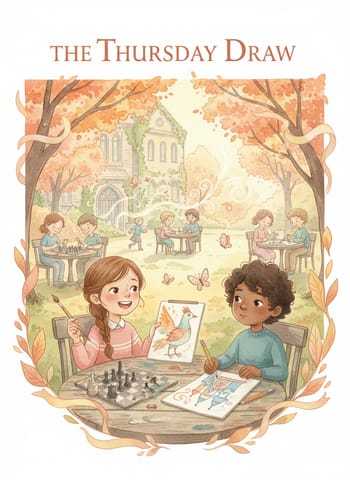
The chess club meets in the park every Thursday. It is a small group. Six tables stand under a big oak tree. Old men bring tea. Children bring snacks.
El club de ajedrez se reúne en el parque todos los jueves. Es un grupo pequeño. Seis mesas se alzan bajo un gran roble. Los señores mayores traen té. Los niños traen bocadillos.
The old men like to watch the two players. They say Vesna and Umar are slow but kind. Vesna brings a small cake each week. Umar brings hot tea for both of them.
A los señores mayores les gusta mirar a los dos jugadores. Dicen que Vesna y Umar son lentos pero amables. Vesna trae un pastelito cada semana. Umar trae té caliente para los dos.
Vesna always sits at the table near the water. Umar always sits across from her. They sit together every week. They have a funny record. All fourteen games end in a draw.
Vesna siempre se sienta en la mesa junto al agua. Umar siempre se sienta frente a ella. Se sientan juntos cada semana. Tienen un récord curioso. Las catorce partidas terminaron en tablas.
"Fourteen draws," says an old man at the next table. "That is a record for our club."
«Catorce tablas», dice un señor de la mesa de al lado. «Es un récord para nuestro club».
Vesna smiles. "I never lose," she says.
Vesna sonríe. «Yo nunca pierdo», dice.
"And I never win," says Umar. "But I never lose too."
«Y yo nunca gano», dice Umar. «Pero tampoco pierdo».
Today, the sky is blue. The leaves are yellow and red. Vesna moves her white pawn. Umar moves his black one. They play fast at first. Then they slow down. The old men stop talking. The children come close.
Hoy el cielo está azul. Las hojas son amarillas y rojas. Vesna mueve su peón blanco. Umar mueve el negro. Al principio juegan rápido. Luego van más despacio. Los señores dejan de hablar. Los niños se acercan.
Soon only a few pieces stay on the board. Vesna has a king and a rook. Umar has a king and a rook too. Vesna thinks for a long time. She sees a way to win. It is a good plan. But it takes five moves.
Pronto solo quedan unas pocas piezas en el tablero. Vesna tiene un rey y una torre. Umar también tiene un rey y una torre. Vesna piensa durante mucho tiempo. Ve una forma de ganar. Es un buen plan. Pero requiere cinco movimientos.
She looks at Umar. He looks at the board. His tea is cold. He taps his finger on the table. He does not look worried. He looks happy.
Mira a Umar. Él mira el tablero. Su té está frío. Golpetea la mesa con el dedo. No parece preocupado. Parece feliz.
Vesna stops. She thinks, "If I win, the game ends. Then he goes home. I go home. We wait a week."
Vesna se detiene. Piensa: «Si gano, la partida termina. Entonces él se va a casa. Yo me voy a casa. Esperamos una semana».
She puts her rook back on the same square.
Vuelve a poner su torre en la misma casilla.
Umar looks up. "Why did you do that?" he asks. "You had a better move."
Umar levanta la vista. «¿Por qué hiciste eso?», pregunta. «Tenías una mejor jugada».
"I did not see it," says Vesna.
«No la vi», dice Vesna.
"You saw it," he says. "I know your face when you see a good move."
«Sí la viste», dice él. «Conozco tu cara cuando ves una buena jugada».
She says nothing. Her cheeks are warm.
Ella no dice nada. Tiene las mejillas calientes.
Umar looks at the board again. Slowly, he says, "I also have a good move. It wins in three steps. I saw it ten minutes ago."
Umar vuelve a mirar el tablero. Despacio, dice: «Yo también tengo una buena jugada. Gana en tres pasos. La vi hace diez minutos».
Vesna opens her mouth. "Ten minutes? Then why…"
Vesna abre la boca. «¿Diez minutos? Entonces, ¿por qué…?»
"I did not want the game to end," says Umar.
«No quería que la partida terminara», dice Umar.
For a moment, the park is very quiet. One of the old men coughs. A child laughs. Then Vesna starts to laugh too. Umar joins her.
Por un momento, el parque queda muy callado. Uno de los señores tose. Un niño se ríe. Entonces Vesna también empieza a reír. Umar se une a ella.
"Fourteen draws," she says. "And we both play them on purpose."
«Catorce tablas», dice ella. «Y las dos jugadas a propósito».
"I think yes," says Umar.
«Creo que sí», dice Umar.
They shake hands over the board. The old men clap. "A draw again!" one of them shouts. "Another record!"
Se dan la mano sobre el tablero. Los señores aplauden. «¡Otra vez tablas!», grita uno de ellos. «¡Otro récord!»
Vesna puts the white king on its side. Umar puts the black king next to it. The two kings lie together on the board. Both of them look at the kings and smile.
Vesna acuesta el rey blanco de lado. Umar pone el rey negro junto a él. Los dos reyes quedan juntos en el tablero. Ambos miran los reyes y sonríen.
Then Umar clears his throat. "Would you like to have dinner next week?" he asks. "A real dinner, I mean. With a table and a candle."
Entonces Umar se aclara la garganta. «¿Quieres cenar conmigo la próxima semana?», pregunta. «Una cena de verdad, digo. Con una mesa y una vela».
"After the game?" says Vesna.
«¿Después de la partida?», dice Vesna.
"Instead of the game," says Umar. "Or after. You choose."
«En lugar de la partida», dice Umar. «O después. Tú eliges».
Vesna looks at the chess board. Then she looks at him.
Vesna mira el tablero de ajedrez. Luego lo mira a él.
"After," she says. "I always want one more game. And next Thursday, I play black."
«Después», dice. «Siempre quiero una partida más. Y el próximo jueves, juego con negras».