The Stage at the Wrong End
Una historia gratuita en inglés de nivel B1 para estudiantes, para leer en línea en 7 idiomas, con opción de escucharla en la app gratuita Storyteller.
A street of shopkeepers builds a party stage at the wrong end, and only a pocket compass can say where north really is.
¡Ese fue el avance! Escucha la historia completa en la app gratuita Storyteller. Descargar la app
El audio no está disponible en este momento.
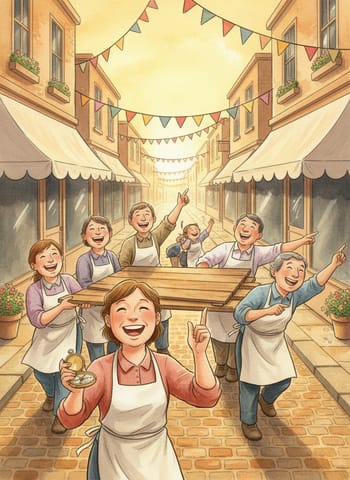
By seven o'clock on Saturday morning, Wick Street already looks like a circus that has lost its map. Ladders lean against shop fronts, and flags lie in tangled heaps on the pavement. A van stands in the middle of the road. Its back is open, full of wooden boards and tables.
A las siete de la mañana del sábado, la calle Wick ya parece un circo que ha perdido su mapa. Hay escaleras apoyadas contra las fachadas de las tiendas y banderas enredadas en montones sobre la acera. Una camioneta está parada en medio de la calle. Su parte trasera está abierta, llena de tablones y mesas de madera.
Aarav stands next to the van with a clipboard. He owns the hardware shop. Tonight is the first street party the neighbourhood has held in ten years. The council sent a letter with a plan. Aarav has read it six times and still feels worried.
Aarav está junto a la camioneta con una tablilla de notas. Es el dueño de la ferretería. Esta noche es la primera fiesta callejera que hace el vecindario en diez años. El ayuntamiento mandó una carta con un plano. Aarav la ha leído seis veces y sigue preocupado.
"Okay, everyone," he calls. "Please listen. The plan says the stage goes at the north end of the street, next to the power box. The tables run down the middle. The party lights go from the clock shop to the cheese shop."
«Muy bien, todos», llama. «Por favor, escuchen. El plano dice que el escenario va en el extremo norte de la calle, junto a la caja de electricidad. Las mesas van por el medio. Las luces de la fiesta van de la relojería a la quesería».
"Perfect," says the flower seller, Calla, who is carrying a bucket of ribbons. "Where is north?"
«Perfecto», dice la florista, Calla, que lleva un balde de listones. «¿Dónde queda el norte?».
Nobody answers. Eleven shopkeepers look at each other.
Nadie responde. Once comerciantes se miran entre sí.
"Easy," says the clock mender. "North is uphill, and uphill is that way." He points confidently towards the shoe shop.
«Fácil», dice el relojero. «El norte está cuesta arriba, y cuesta arriba es por allá». Señala con seguridad hacia la zapatería.
"No, no," says the cheese seller. "North is where the post office is. The post office is always north."
«No, no», dice el quesero. «El norte es donde está el correo. El correo siempre está al norte».
"The post office is on the corner," says Calla. "Everything is on a corner."
«El correo está en la esquina», dice Calla. «Todo está en una esquina».
Aarav rubs his forehead. He had hoped that someone would simply know. He takes out his phone and opens the map. The little arrow spins like a puppy chasing its tail. Between the tall buildings, the phone cannot make up its mind.
Aarav se frota la frente. Esperaba que alguien simplemente lo supiera. Saca su teléfono y abre el mapa. La flechita gira como un cachorro persiguiéndose la cola. Entre los edificios altos, el teléfono no logra decidirse.
"I'll vote," says the shoe seller. "All in favour of the uphill end, raise your hands."
«Votaré yo», dice el zapatero. «Todos los que estén a favor del extremo cuesta arriba, levanten la mano».
Eight hands go up. Three people look at their shoes. It is not exactly science, but it is enough for a hurry.
Ocho manos se levantan. Tres personas miran sus zapatos. No es exactamente ciencia, pero basta para andar con prisa.
"Fine," Aarav says. "Uphill it is. Let's build."
«Está bien», dice Aarav. «Cuesta arriba será. Construyamos».
For the next two hours, the street fills with noise. Shopkeepers carry boards and hammer nails. The stage grows slowly at the uphill end. It has a bright orange curtain and a banner that says WICK STREET LIVES. The tables stretch down the road in a long line. Calla ties ribbons around every chair, and the cheese seller hangs paper lanterns on a rope.
Durante las dos horas siguientes, la calle se llena de ruido. Los comerciantes cargan tablones y clavan clavos. El escenario va creciendo despacio en el extremo cuesta arriba. Tiene una cortina naranja brillante y una pancarta que dice LA CALLE WICK VIVE. Las mesas se extienden por la calle en una larga fila. Calla ata listones alrededor de cada silla y el quesero cuelga faroles de papel en una cuerda.
At half past nine, the electrician arrives, a quiet woman in a yellow jacket. She looks at the stage, then at the power box, then at the stage again.
A las nueve y media llega la electricista, una mujer callada con una chaqueta amarilla. Mira el escenario, luego la caja de electricidad, luego otra vez el escenario.
"Good morning," she says. "Why is the stage so far from the power?"
«Buenos días», dice. «¿Por qué está el escenario tan lejos de la corriente?».
"It isn't," Aarav says. "The power box is at the north end, and that's where we are."
«No lo está», dice Aarav. «La caja de electricidad está en el extremo norte, y ahí estamos nosotros».
"The power box is over there," the electrician says, and points down the street. It stands next to the clock shop, forty metres away from the new stage.
«La caja de electricidad está allá», dice la electricista, y señala calle abajo. Está junto a la relojería, a cuarenta metros del nuevo escenario.
Aarav stares at the box. Then he looks at the stage and at the plan in his hand. "That cannot be right," he says.
Aarav mira fijamente la caja. Luego mira el escenario y el plano que tiene en la mano. «Eso no puede ser», dice.
"I only have a twenty-metre cable," she says. "And the council plan says the stage goes by the box. So either the box has moved, or your stage is at the wrong end."
«Solo tengo un cable de veinte metros», dice ella. «Y el plano del ayuntamiento dice que el escenario va junto a la caja. Así que o la caja se ha movido, o su escenario está en el extremo equivocado».
A long silence settles over the street. Even the flags seem to droop. The clock mender takes off his cap and looks inside it, as if the answer might be there.
Un largo silencio se instala sobre la calle. Hasta las banderas parecen caerse. El relojero se quita la gorra y mira dentro, como si la respuesta pudiera estar ahí.
"My phone says north is both directions," says the shoe seller.
«Mi teléfono dice que el norte está en las dos direcciones», dice el zapatero.
"Mine says it's lunchtime," says the cheese seller.
«El mío dice que es hora de almorzar», dice el quesero.
Calla puts down her bucket. She looks at Aarav, and then at the pocket of his apron. Something small and round makes a bump there. "Aarav," she says. "Don't you have a compass?"
Calla deja su balde. Mira a Aarav y luego al bolsillo de su delantal. Algo pequeño y redondo hace un bulto ahí. «Aarav», dice. «¿No tienes una brújula?».
Aarav freezes. Everybody in the shop knows about the compass. It is brass, as big as a biscuit, and he carries it everywhere. People tease him about it all the time. He once used it to find the stairs in a department store.
Aarav se queda helado. Todos en la tienda saben de la brújula. Es de latón, grande como una galleta, y la lleva a todas partes. La gente se burla de él por eso todo el tiempo. Una vez la usó para encontrar las escaleras en unos grandes almacenes.
"I do," he says slowly. "But you all said it was silly."
«Sí», dice despacio. «Pero todos dijeron que era una tontería».
"It is silly," says the clock mender. "Also, it might be useful today."
«Es una tontería», dice el relojero. «Pero también podría servir hoy».
Aarav takes out the compass and opens the lid. He holds it flat on his palm, in the middle of the road, and the needle swings. It wobbles to the left, then to the right, then to the left again. It will not settle.
Aarav saca la brújula y abre la tapa. La sostiene plana en la palma, en medio de la calle, y la aguja se mueve. Se tambalea hacia la izquierda, luego hacia la derecha, luego otra vez hacia la izquierda. No se asienta.
"It is broken," says the cheese seller.
«Está rota», dice el quesero.
"It isn't broken," Aarav says. "It's confused." He frowns at the heavy steel frame of the stage, then at the van parked next to him. "Metal makes it nervous. I need to stand somewhere clear."
«No está rota», dice Aarav. «Está confundida». Frunce el ceño ante el pesado armazón de acero del escenario, luego ante la camioneta estacionada a su lado. «El metal la pone nerviosa. Necesito pararme en algún lugar despejado».
He walks to the middle of the street, far from the van and the lamp posts. He crouches and sets the compass on the road. Everybody follows him and forms a circle, as if they are about to watch a magic trick.
Camina hasta el medio de la calle, lejos de la camioneta y de los postes de luz. Se agacha y pone la brújula sobre el pavimento. Todos lo siguen y forman un círculo, como si estuvieran a punto de ver un truco de magia.
The needle trembles. It slows down, and it stops. It points firmly and calmly to the end of the street where the clock shop stands.
La aguja tiembla. Se va frenando y se detiene. Apunta firme y tranquila al extremo de la calle donde está la relojería.
"North," Aarav says. "North is the clock shop. The cheese shop is south, and we have built the stage in the wrong place."
«Norte», dice Aarav. «El norte es la relojería. La quesería está al sur, y hemos construido el escenario en el lugar equivocado».
"The wrong place," repeats the clock mender in a small voice. "I voted for uphill."
«El lugar equivocado», repite el relojero con voz pequeña. «Yo voté por cuesta arriba».
"The hill is east," Calla says kindly. "It was a nice guess."
«La colina está al este», dice Calla con amabilidad. «Fue una buena suposición».
For a moment, the whole street is quiet. Eleven people look at a stage that weighs more than a small car. Aarav feels a cold wave of regret. The stage took three hours to build, and the party begins in nine.
Por un momento, toda la calle está en silencio. Once personas miran un escenario que pesa más que un auto pequeño. Aarav siente una fría ola de arrepentimiento. El escenario tardó tres horas en construirse y la fiesta empieza en nueve.
Then the electrician says, "You have wheels on the bottom of that stage, don't you?"
Entonces la electricista dice: «Ese escenario tiene ruedas debajo, ¿no es cierto?».
Aarav blinks. He walks to the side of the stage and kneels. Under the wooden skirt, he sees four small black wheels, still locked with metal brakes. The builders borrowed them from the council last week for exactly this kind of thing.
Aarav parpadea. Camina hasta el costado del escenario y se arrodilla. Bajo el faldón de madera ve cuatro pequeñas ruedas negras, todavía bloqueadas con frenos de metal. Los constructores las pidieron prestadas al ayuntamiento la semana pasada justo para algo así.
"We could roll it," he says.
«Podríamos hacerlo rodar», dice.
"We could roll it," says Calla. She is already holding the corner of the orange curtain.
«Podríamos hacerlo rodar», dice Calla. Ya está sujetando la esquina de la cortina naranja.
It takes eight people to push the stage down Wick Street. Calla stands at the front and shouts directions. The clock mender walks backwards to watch the wheels. The cheese seller pushes with both shoulders and sings a marching song that no one else knows. The helpers slide the tables to the side, and the stage squeaks along the road.
Hacen falta ocho personas para empujar el escenario calle Wick abajo. Calla va al frente y grita indicaciones. El relojero camina de espaldas para vigilar las ruedas. El quesero empuja con los dos hombros y canta una marcha que nadie más conoce. Los ayudantes apartan las mesas a un lado y el escenario va chirriando por la calle.
After twenty minutes, the stage stops beside the power box. The electrician plugs in her cable and tests it with a small meter. She nods once.
Después de veinte minutos, el escenario se detiene junto a la caja de electricidad. La electricista enchufa su cable y lo prueba con un pequeño medidor. Asiente una vez.
"It reaches," she says.
«Llega», dice.
The shopkeepers cheer. The clock mender sits down on a step and fans his face with his cap. Calla laughs so hard that she has to lean on a lamp post.
Los comerciantes aplauden. El relojero se sienta en un escalón y se abanica la cara con la gorra. Calla se ríe tanto que tiene que apoyarse en un poste de luz.
By evening, the street is full of music. The lights stretch from the clock shop to the cheese shop, and the tables shine with ribbons. Children run between the legs of the grown-ups, and the smell of hot food floats everywhere. Aarav stands near the stage with his compass in his hand. He looks at it for a second, then puts it back in his pocket, proudly.
Para la noche, la calle está llena de música. Las luces se extienden de la relojería a la quesería y las mesas brillan con listones. Los niños corren entre las piernas de los adultos y el olor a comida caliente flota por todas partes. Aarav está cerca del escenario con su brújula en la mano. La mira un segundo y luego la vuelve a guardar en el bolsillo, orgulloso.
"Ready?" Calla asks, holding the switch.
«¿Listo?», pregunta Calla, sosteniendo el interruptor.
"Ready," Aarav says.
«Listo», dice Aarav.
She presses it.
Ella lo presiona.
Click.
Clic.