The Stage at the Wrong End
Cerita bahasa Inggris gratis level B1 untuk pelajar, bisa dibaca online dalam 7 bahasa, dengan pilihan untuk mendengarkannya di aplikasi Storyteller gratis.
A street of shopkeepers builds a party stage at the wrong end, and only a pocket compass can say where north really is.
Itu cuplikannya! Dengarkan cerita lengkapnya di aplikasi Storyteller gratis. Unduh aplikasi
Audio belum tersedia saat ini.
By seven o'clock on Saturday morning, Wick Street already looks like a circus that has lost its map. Ladders lean against shop fronts, and flags lie in tangled heaps on the pavement. A van stands in the middle of the road. Its back is open, full of wooden boards and tables.
Pukul tujuh pagi hari Sabtu, Jalan Wick sudah tampak seperti sirkus yang kehilangan petanya. Tangga-tangga bersandar pada etalase toko, dan bendera-bendera tergeletak dalam tumpukan kusut di trotoar. Sebuah van berdiri di tengah jalan. Bagian belakangnya terbuka, penuh papan kayu dan meja.
Aarav stands next to the van with a clipboard. He owns the hardware shop. Tonight is the first street party the neighbourhood has held in ten years. The council sent a letter with a plan. Aarav has read it six times and still feels worried.
Aarav berdiri di samping van dengan papan jepit. Ia pemilik toko perkakas. Malam ini adalah pesta jalanan pertama yang diadakan lingkungan itu dalam sepuluh tahun. Dewan kota mengirim surat berisi denah. Aarav sudah membacanya enam kali dan masih merasa cemas.
"Okay, everyone," he calls. "Please listen. The plan says the stage goes at the north end of the street, next to the power box. The tables run down the middle. The party lights go from the clock shop to the cheese shop."
"Baiklah, semuanya," serunya. "Tolong dengarkan. Denahnya bilang panggung ditaruh di ujung utara jalan, di sebelah kotak listrik. Meja-meja memanjang di tengah. Lampu pesta dipasang dari toko jam sampai toko keju."
"Perfect," says the flower seller, Calla, who is carrying a bucket of ribbons. "Where is north?"
"Sempurna," kata si penjual bunga, Calla, yang membawa seember pita. "Di mana utara?"
Nobody answers. Eleven shopkeepers look at each other.
Tidak ada yang menjawab. Sebelas pemilik toko saling berpandangan.
"Easy," says the clock mender. "North is uphill, and uphill is that way." He points confidently towards the shoe shop.
"Mudah," kata si tukang reparasi jam. "Utara itu arah tanjakan, dan tanjakan ada di sebelah sana." Ia menunjuk dengan yakin ke arah toko sepatu.
"No, no," says the cheese seller. "North is where the post office is. The post office is always north."
"Bukan, bukan," kata si penjual keju. "Utara itu tempat kantor pos berada. Kantor pos selalu di utara."
"The post office is on the corner," says Calla. "Everything is on a corner."
"Kantor pos ada di sudut jalan," kata Calla. "Semuanya ada di sudut jalan."
Aarav rubs his forehead. He had hoped that someone would simply know. He takes out his phone and opens the map. The little arrow spins like a puppy chasing its tail. Between the tall buildings, the phone cannot make up its mind.
Aarav mengusap dahinya. Ia sudah berharap seseorang akan tahu begitu saja. Ia mengeluarkan ponselnya dan membuka peta. Anak panah kecil itu berputar seperti anak anjing mengejar ekornya sendiri. Di antara gedung-gedung tinggi, ponsel itu tidak bisa memutuskan.
"I'll vote," says the shoe seller. "All in favour of the uphill end, raise your hands."
"Aku akan mengadakan pemungutan suara," kata si penjual sepatu. "Yang setuju ujung tanjakan, angkat tangan."
Eight hands go up. Three people look at their shoes. It is not exactly science, but it is enough for a hurry.
Delapan tangan terangkat. Tiga orang menatap sepatu mereka. Itu tidak persis ilmiah, tetapi cukup untuk situasi terburu-buru.
"Fine," Aarav says. "Uphill it is. Let's build."
"Baik," kata Aarav. "Ujung tanjakan. Ayo kita bangun."
For the next two hours, the street fills with noise. Shopkeepers carry boards and hammer nails. The stage grows slowly at the uphill end. It has a bright orange curtain and a banner that says WICK STREET LIVES. The tables stretch down the road in a long line. Calla ties ribbons around every chair, and the cheese seller hangs paper lanterns on a rope.
Selama dua jam berikutnya, jalan itu dipenuhi kebisingan. Para pemilik toko mengangkut papan dan memalu paku. Panggung tumbuh perlahan di ujung tanjakan. Panggung itu punya tirai oranye cerah dan spanduk bertuliskan JALAN WICK HIDUP. Meja-meja membentang di sepanjang jalan dalam satu barisan panjang. Calla mengikatkan pita pada setiap kursi, dan si penjual keju menggantung lampion kertas pada seutas tali.
At half past nine, the electrician arrives, a quiet woman in a yellow jacket. She looks at the stage, then at the power box, then at the stage again.
Pukul setengah sepuluh, tukang listrik tiba, seorang perempuan pendiam berjaket kuning. Ia memandang panggung, lalu kotak listrik, lalu panggung lagi.
"Good morning," she says. "Why is the stage so far from the power?"
"Selamat pagi," katanya. "Kenapa panggungnya jauh dari sumber listrik?"
"It isn't," Aarav says. "The power box is at the north end, and that's where we are."
"Tidak jauh," kata Aarav. "Kotak listriknya di ujung utara, dan di situlah kita berada."
"The power box is over there," the electrician says, and points down the street. It stands next to the clock shop, forty metres away from the new stage.
"Kotak listriknya di sana," kata tukang listrik itu, sambil menunjuk ke arah jalan. Kotak itu berdiri di sebelah toko jam, empat puluh meter dari panggung baru.
Aarav stares at the box. Then he looks at the stage and at the plan in his hand. "That cannot be right," he says.
Aarav menatap kotak itu. Lalu ia memandang panggung dan denah di tangannya. "Itu tidak mungkin benar," katanya.
"I only have a twenty-metre cable," she says. "And the council plan says the stage goes by the box. So either the box has moved, or your stage is at the wrong end."
"Saya hanya punya kabel dua puluh meter," katanya. "Dan denah dewan kota bilang panggung ditaruh di dekat kotak itu. Jadi entah kotaknya yang pindah, atau panggung Anda di ujung yang salah."
A long silence settles over the street. Even the flags seem to droop. The clock mender takes off his cap and looks inside it, as if the answer might be there.
Keheningan panjang menyelimuti jalan itu. Bahkan bendera-bendera tampak terkulai. Si tukang reparasi jam melepas topinya dan melihat ke dalamnya, seolah jawabannya mungkin ada di sana.
"My phone says north is both directions," says the shoe seller.
"Ponselku bilang utara itu dua-duanya," kata si penjual sepatu.
"Mine says it's lunchtime," says the cheese seller.
"Punyaku bilang sekarang waktunya makan siang," kata si penjual keju.
Calla puts down her bucket. She looks at Aarav, and then at the pocket of his apron. Something small and round makes a bump there. "Aarav," she says. "Don't you have a compass?"
Calla meletakkan embernya. Ia memandang Aarav, lalu saku celemeknya. Sesuatu yang kecil dan bundar membuat tonjolan di sana. "Aarav," katanya. "Bukankah kamu punya kompas?"
Aarav freezes. Everybody in the shop knows about the compass. It is brass, as big as a biscuit, and he carries it everywhere. People tease him about it all the time. He once used it to find the stairs in a department store.
Aarav membeku. Semua orang di toko itu tahu soal kompas itu. Terbuat dari kuningan, sebesar biskuit, dan ia membawanya ke mana-mana. Orang-orang selalu menggodanya soal itu. Ia pernah memakainya untuk mencari tangga di sebuah pusat perbelanjaan.
"I do," he says slowly. "But you all said it was silly."
"Ada," katanya perlahan. "Tapi kalian semua bilang itu konyol."
"It is silly," says the clock mender. "Also, it might be useful today."
"Memang konyol," kata si tukang reparasi jam. "Tapi hari ini mungkin berguna."
Aarav takes out the compass and opens the lid. He holds it flat on his palm, in the middle of the road, and the needle swings. It wobbles to the left, then to the right, then to the left again. It will not settle.
Aarav mengeluarkan kompas itu dan membuka tutupnya. Ia memegangnya datar di telapak tangan, di tengah jalan, dan jarumnya berayun. Jarum itu bergoyang ke kiri, lalu ke kanan, lalu ke kiri lagi. Ia tidak mau tenang.
"It is broken," says the cheese seller.
"Rusak," kata si penjual keju.
"It isn't broken," Aarav says. "It's confused." He frowns at the heavy steel frame of the stage, then at the van parked next to him. "Metal makes it nervous. I need to stand somewhere clear."
"Tidak rusak," kata Aarav. "Dia bingung." Ia mengernyit melihat rangka baja panggung yang berat, lalu van yang diparkir di sebelahnya. "Logam membuatnya gugup. Aku harus berdiri di tempat yang bebas."
He walks to the middle of the street, far from the van and the lamp posts. He crouches and sets the compass on the road. Everybody follows him and forms a circle, as if they are about to watch a magic trick.
Ia berjalan ke tengah jalan, jauh dari van dan tiang lampu. Ia berjongkok dan meletakkan kompas di jalan. Semua orang mengikutinya dan membentuk lingkaran, seolah akan menonton pertunjukan sulap.
The needle trembles. It slows down, and it stops. It points firmly and calmly to the end of the street where the clock shop stands.
Jarum itu bergetar. Ia melambat, lalu berhenti. Jarum itu menunjuk tegas dan tenang ke ujung jalan tempat toko jam berdiri.
"North," Aarav says. "North is the clock shop. The cheese shop is south, and we have built the stage in the wrong place."
"Utara," kata Aarav. "Utara itu toko jam. Toko keju ada di selatan, dan kita sudah membangun panggung di tempat yang salah."
"The wrong place," repeats the clock mender in a small voice. "I voted for uphill."
"Tempat yang salah," ulang si tukang reparasi jam dengan suara kecil. "Aku memilih tanjakan."
"The hill is east," Calla says kindly. "It was a nice guess."
"Bukit itu timur," kata Calla ramah. "Tebakan yang bagus."
For a moment, the whole street is quiet. Eleven people look at a stage that weighs more than a small car. Aarav feels a cold wave of regret. The stage took three hours to build, and the party begins in nine.
Sesaat seluruh jalan itu sunyi. Sebelas orang memandang panggung yang lebih berat daripada mobil kecil. Aarav merasakan gelombang penyesalan yang dingin. Panggung itu butuh tiga jam untuk dibangun, dan pesta dimulai sembilan jam lagi.
Then the electrician says, "You have wheels on the bottom of that stage, don't you?"
Lalu si tukang listrik berkata, "Panggung itu punya roda di bawahnya, bukan?"
Aarav blinks. He walks to the side of the stage and kneels. Under the wooden skirt, he sees four small black wheels, still locked with metal brakes. The builders borrowed them from the council last week for exactly this kind of thing.
Aarav berkedip. Ia berjalan ke sisi panggung dan berlutut. Di bawah rok kayunya, ia melihat empat roda hitam kecil, masih terkunci dengan rem logam. Para pembangun meminjamnya dari dewan kota minggu lalu justru untuk keperluan seperti ini.
"We could roll it," he says.
"Kita bisa mendorongnya," katanya.
"We could roll it," says Calla. She is already holding the corner of the orange curtain.
"Kita bisa mendorongnya," kata Calla. Ia sudah memegang sudut tirai oranye.
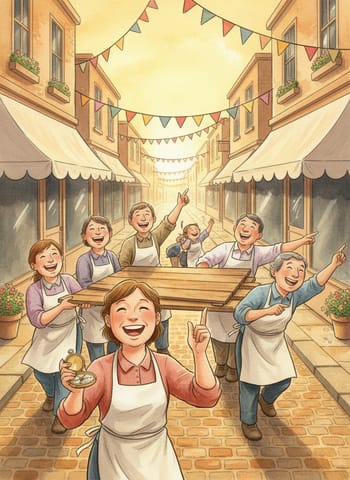
It takes eight people to push the stage down Wick Street. Calla stands at the front and shouts directions. The clock mender walks backwards to watch the wheels. The cheese seller pushes with both shoulders and sings a marching song that no one else knows. The helpers slide the tables to the side, and the stage squeaks along the road.
Dibutuhkan delapan orang untuk mendorong panggung itu menyusuri Jalan Wick. Calla berdiri di depan dan meneriakkan arahan. Si tukang reparasi jam berjalan mundur untuk mengawasi roda-rodanya. Si penjual keju mendorong dengan kedua bahunya dan menyanyikan lagu baris-berbaris yang tidak dikenal siapa pun. Para penolong menggeser meja-meja ke samping, dan panggung itu berdecit di sepanjang jalan.
After twenty minutes, the stage stops beside the power box. The electrician plugs in her cable and tests it with a small meter. She nods once.
Setelah dua puluh menit, panggung berhenti di samping kotak listrik. Si tukang listrik mencolokkan kabelnya dan mengujinya dengan alat ukur kecil. Ia mengangguk sekali.
"It reaches," she says.
"Sampai," katanya.
The shopkeepers cheer. The clock mender sits down on a step and fans his face with his cap. Calla laughs so hard that she has to lean on a lamp post.
Para pemilik toko bersorak. Si tukang reparasi jam duduk di sebuah anak tangga dan mengipasi wajahnya dengan topinya. Calla tertawa begitu keras sampai harus bersandar pada tiang lampu.
By evening, the street is full of music. The lights stretch from the clock shop to the cheese shop, and the tables shine with ribbons. Children run between the legs of the grown-ups, and the smell of hot food floats everywhere. Aarav stands near the stage with his compass in his hand. He looks at it for a second, then puts it back in his pocket, proudly.
Menjelang malam, jalan itu penuh dengan musik. Lampu-lampu membentang dari toko jam sampai toko keju, dan meja-meja berkilau dengan pita. Anak-anak berlarian di antara kaki orang dewasa, dan aroma makanan panas melayang ke mana-mana. Aarav berdiri di dekat panggung dengan kompas di tangannya. Ia memandangnya sebentar, lalu memasukkannya kembali ke saku dengan bangga.
"Ready?" Calla asks, holding the switch.
"Siap?" tanya Calla sambil memegang sakelar.
"Ready," Aarav says.
"Siap," kata Aarav.
She presses it.
Ia menekannya.
Click.
Klik.