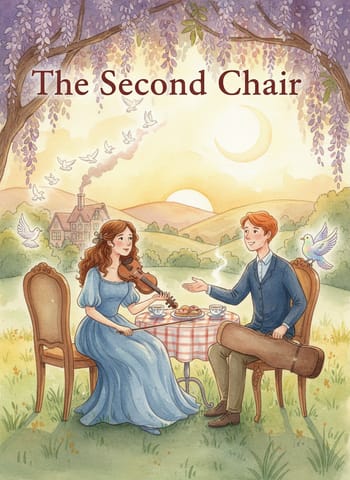
The Second Chair
Una historia gratuita en inglés de nivel C1 para estudiantes, para leer en línea en 3 idiomas, con opción de escucharla en la app gratuita Storyteller.
Two years after her husband's death, a widowed violinist has to decide whether accepting her new stand partner's invitation to dinner means betraying eleven years of marriage or simply making room for something else.
¡Ese fue el avance! Escucha la historia completa en la app gratuita Storyteller. Descargar la app
El audio no está disponible en este momento.
Ilse had played second chair violin in the community orchestra for eleven years, by choice rather than lack of skill. Bram had come to every rehearsal he could manage, sitting in the third row with a paperback he rarely opened. He seemed content simply to be present while she played a part she'd never once tried to trade up from. After he died, she kept the seat. She told herself this was about the music, not about him, though she was never entirely convinced by her own explanation.
Ilse había tocado el segundo violín en la orquesta comunitaria durante once años, por elección y no por falta de talento. Bram había asistido a todos los ensayos que pudo, sentado en la tercera fila con una novela de bolsillo que rara vez abría. Parecía conforme con solo estar presente mientras ella interpretaba una parte que nunca había intentado cambiar por otra más destacada. Después de que él murió, ella conservó el puesto. Se decía a sí misma que se trataba de la música, no de él, aunque nunca estuvo del todo convencida de su propia explicación.
Cyrus took the empty first-chair seat beside her in the spring, two years after Bram's funeral. He was new to the city and, at first, unaware that he'd been placed next to a woman whose husband's absence occupied the third row more thoroughly than any of the audience members did. He was a decent player, better than decent, and he had the specific, undemanding kindness of someone who noticed things without commenting on them. There were the flowers she sometimes left, unexplained, near a particular seat after rehearsal. There was the way she avoided a certain Brahms passage that came up more often than either of them found convenient.
Cyrus ocupó el puesto vacante de primer violín, a su lado, en la primavera, dos años después del funeral de Bram. Era nuevo en la ciudad y, al principio, no sabía que lo habían colocado junto a una mujer cuyo esposo ausente ocupaba la tercera fila con más presencia que cualquiera de los espectadores. Era un buen músico, mejor que bueno, y tenía la amabilidad discreta y poco exigente de alguien que se fija en las cosas sin comentarlas. Estaban las flores que ella a veces dejaba, sin explicación, cerca de un asiento en particular después del ensayo. Estaba la manera en que evitaba cierto pasaje de Brahms que surgía más a menudo de lo que a cualquiera de los dos le resultaba conveniente.
Their friendship built itself slowly, out of shared stands and shared jokes about the conductor's tempo. Then, one evening in autumn, walking her to her car the way he had for several weeks without either of them naming it, he finally said the thing he'd clearly been rehearsing. "I'd like to take you to dinner. Not as colleagues."
Su amistad se construyó lentamente, a partir de atriles compartidos y bromas compartidas sobre el tempo del director. Luego, una tarde de otoño, mientras la acompañaba a su auto como lo había hecho durante varias semanas sin que ninguno de los dos le pusiera nombre a eso, finalmente dijo lo que claramente había estado ensayando. «Me gustaría invitarte a cenar. No como colegas».
Had she answered immediately, she suspects she would have said no, out of a reflex closer to loyalty than to honesty. She didn't answer immediately. "I don't know if I'm allowed to want that," she said instead, which surprised her more than it seemed to surprise him.
Si hubiera respondido de inmediato, sospecha que habría dicho que no, por un reflejo más cercano a la lealtad que a la honestidad. No respondió de inmediato. «No sé si tengo permitido querer eso», dijo en cambio, lo cual la sorprendió más de lo que pareció sorprenderlo a él.
"Allowed by whom?"
«¿Permitido por quién?».
"I don't actually know. Bram, maybe. Or some version of myself that thinks wanting this means the eleven years before it mattered less."
«En realidad no lo sé. Bram, tal vez. O alguna versión de mí misma que piensa que querer esto significa que los once años anteriores importaron menos».
What Cyrus said next was not, she would think later, the reassurance she'd braced for. "I'm not asking you to stop being his. I'm asking whether there's room for something that isn't instead of him — just additional." He paused. "I'll still be second chair to whatever you decide about that. I'm used to the seat."
Lo que Cyrus dijo después no fue, pensaría ella más tarde, el consuelo para el que se había preparado. «No te estoy pidiendo que dejes de ser suya. Te estoy preguntando si hay lugar para algo que no lo reemplace, sino que se añada». Se detuvo un momento. «Seguiré siendo el segundo violín frente a lo que decidas sobre eso. Ya estoy acostumbrado al puesto».
She laughed despite herself, the first unguarded laugh she'd managed in the third row's general direction in longer than she could easily count. Rarely had a joke about orchestra seating landed quite so precisely on the actual question underneath it.
Ella se rio a pesar de sí misma, la primera risa sin reservas que había logrado en dirección a la tercera fila en más tiempo del que podía contar fácilmente. Pocas veces una broma sobre los puestos de la orquesta había dado tan exactamente en la verdadera pregunta que había debajo.
She didn't answer him that night, not fully. But the following Tuesday, she brought two coffees to rehearsal instead of one and set the second down on the stand beside her own. She let that stand as the answer neither of them needed spelled out any further.
No le respondió esa noche, no del todo. Pero el martes siguiente, llevó dos cafés al ensayo en lugar de uno y puso el segundo sobre el atril junto al suyo. Dejó que eso quedara como la respuesta que ninguno de los dos necesitaba que se dijera con más palabras.