The Skylight Room
A free C1-level English story for language learners, readable online in 7 languages, with an option to listen via the free Storyteller app.
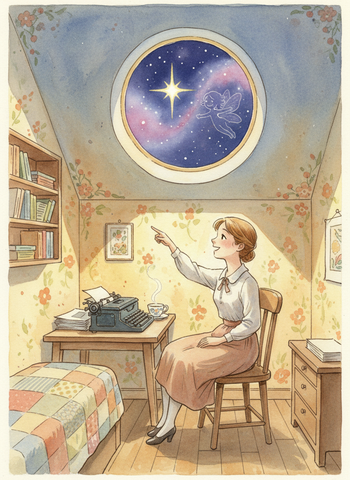
A cheerful young typist takes the cheapest, tiniest room in a boarding house and names a distant star after an imaginary friend to keep herself company.
First Mrs. Parker would show you the double parlours. You would not dare to interrupt her description of their advantages and of the merits of the gentleman who had occupied them for eight years. Then you would manage to stammer forth the confession that you were neither a doctor nor a dentist. Mrs. Parker’s manner of receiving the admission was such that you could never afterward entertain the same feeling toward your parents, who had neglected to train you up in one of the professions that fitted Mrs. Parker’s parlours.
Primero la señora Parker le mostraría a usted el doble salón. No se atrevería a interrumpir su descripción de las ventajas del lugar ni de los méritos del caballero que lo había ocupado durante ocho años. Luego usted lograría balbucear la confesión de que no era ni médico ni dentista. La manera en que la señora Parker recibía esa admisión era tal que nunca más podría sentir lo mismo por sus padres, que habían descuidado educarlo a usted en alguna de las profesiones que convenían a los salones de la señora Parker.
Next you ascended one flight of stairs and looked at the second-floor-back at $8. Convinced by her second-floor manner that it was worth the $12 that Mr. Toosenberry always paid for it until he left to take charge of his brother’s orange plantation in Florida near Palm Beach, where Mrs. McIntyre always spent the winters that had the double front room with private bath, you managed to babble that you wanted something still cheaper.
Después subía usted un tramo de escaleras y miraba la habitación trasera del segundo piso, a ocho dólares. Convencido por los modales de segundo piso de la señora Parker de que valía los doce dólares que siempre pagaba el señor Toosenberry, hasta que se fue a hacerse cargo de la plantación de naranjos de su hermano en Florida, cerca de Palm Beach, donde la señora McIntyre siempre pasaba los inviernos que tenía la habitación doble del frente con baño privado, usted lograba balbucir que quería algo aún más barato.
If you survived Mrs. Parker’s scorn, you were taken to look at Mr. Skidder’s large hall room on the third floor. Mr. Skidder’s room was not vacant. He wrote plays and smoked cigarettes in it all day long. But every room-hunter was made to visit his room to admire the lambrequins. After each visit, Mr. Skidder, from the fright caused by possible eviction, would pay something on his rent.
Si sobrevivía usted al desdén de la señora Parker, lo llevaban a ver la gran habitación de pasillo del señor Skidder, en el tercer piso. La habitación del señor Skidder no estaba libre. Él escribía obras de teatro y fumaba cigarrillos allí todo el día. Pero a todo cazador de habitaciones lo hacían visitar su cuarto para admirar los cenefas. Después de cada visita, el señor Skidder, por el susto que le causaba la posible expulsión, pagaba algo de su renta.
Then—oh, then—if you still stood on one foot, with your hot hand clutching the three moist dollars in your pocket, and hoarsely proclaimed your hideous and culpable poverty, nevermore would Mrs. Parker be cicerone of yours. She would honk loudly the word “Clara,” she would show you her back, and march downstairs. Then Clara, the coloured maid, would escort you up the carpeted ladder that served for the fourth flight, and show you the Skylight Room. It occupied 7×8 feet of floor space at the middle of the hall. On each side of it was a dark lumber closet or storeroom.
Entonces —ah, entonces—, si usted seguía parado sobre un pie, con la mano caliente aferrando los tres dólares húmedos en el bolsillo, y proclamaba con voz ronca su horrible y culpable pobreza, nunca más la señora Parker sería su cicerone. Graznaría en voz alta la palabra "¡Clara!", le mostraría la espalda y bajaría marchando las escaleras. Entonces Clara, la sirvienta de color, lo acompañaría a subir por la escalera alfombrada que servía de cuarto tramo, y le mostraría la Habitación del Tragaluz. Ocupaba dos metros por dos y medio de espacio en el centro del pasillo. A cada lado había un oscuro trastero o cuarto de depósito.
In it was an iron cot, a washstand and a chair. A shelf was the dresser. Its four bare walls seemed to close in upon you like the sides of a coffin. Your hand crept to your throat, you gasped, you looked up as from a well—and breathed once more. Through the glass of the little skylight you saw a square of blue infinity.
Dentro había un catre de hierro, un lavamanos y una silla. Un estante hacía de cómoda. Sus cuatro paredes desnudas parecían cerrarse sobre usted como los costados de un ataúd. La mano le subía a la garganta, jadeaba, miraba hacia arriba como desde el fondo de un pozo, y volvía a respirar. A través del cristal del pequeño tragaluz se veía un cuadrado de infinito azul.
“Two dollars, suh,” Clara would say in her half-contemptuous, half-Tuskegeenial tones.
—Dos dólares, señor —decía Clara con su tono medio despectivo, medio de escuela de Tuskegee.
One day Miss Leeson came hunting for a room. She carried a typewriter made to be lugged around by a much larger lady. She was a very little girl, with eyes and hair that had kept on growing after she had stopped and that always looked as if they were saying: “Goodness me! Why didn’t you keep up with us?”
Un día llegó la señorita Leeson buscando habitación. Cargaba una máquina de escribir hecha para ser cargada por una señora mucho más grande. Era una muchacha muy pequeña, con ojos y cabello que habían seguido creciendo después de que ella dejara de hacerlo, y que siempre parecían decir: "¡Válgame Dios! ¿Por qué no te mantuviste a nuestra altura?".
Mrs. Parker showed her the double parlours. “In this closet,” she said, “one could keep a skeleton or anaesthetic or coal—”
La señora Parker le mostró el doble salón. —En este armario —dijo— se podría guardar un esqueleto, o anestésicos, o carbón…
“But I am neither a doctor nor a dentist,” said Miss Leeson, with a shiver.
—Pero yo no soy ni médica ni dentista —dijo la señorita Leeson, con un escalofrío.
Mrs. Parker gave her the incredulous, pitying, sneering, icy stare that she kept for those who failed to qualify as doctors or dentists, and led the way to the second floor back.
La señora Parker le dedicó la mirada incrédula, compasiva, burlona y helada que reservaba para quienes no calificaban como médicos o dentistas, y la condujo hacia la trasera del segundo piso.
“Eight dollars?” said Miss Leeson. “Dear me! I’m not Hetty if I do look green. I’m just a poor little working girl. Show me something higher and lower.”
—¿Ocho dólares? —dijo la señorita Leeson—. ¡Válgame! No soy ninguna Hetty aunque parezca verdosa. Solo soy una pobre muchacha trabajadora. Muéstreme algo más arriba y más barato.
Mr. Skidder jumped and strewed the floor with cigarette stubs at the rap on his door.
El señor Skidder dio un salto y esparció el suelo de colillas de cigarrillo al oír el golpe en su puerta.
“Excuse me, Mr. Skidder,” said Mrs. Parker, with her demon’s smile at his pale looks. “I didn’t know you were in. I asked the lady to have a look at your lambrequins.”
—Disculpe, señor Skidder —dijo la señora Parker, con su sonrisa de demonio ante la palidez de él—. No sabía que estaba usted. Le pedí a la señorita que echara un vistazo a sus cenefas.
“They’re too lovely for anything,” said Miss Leeson, smiling in exactly the way the angels do.
—Son preciosas, no hay nada como ellas —dijo la señorita Leeson, sonriendo exactamente como sonríen los ángeles.
After they had gone Mr. Skidder got very busy erasing the tall, black-haired heroine from his latest (unproduced) play and inserting a small, roguish one with heavy, bright hair and vivacious features.
Después de que se fueron, el señor Skidder se puso muy ocupado borrando a la heroína alta y de cabello negro de su última obra (no producida) e insertando una pequeña y traviesa, de cabello abundante y brillante y rasgos vivaces.
“Anna Held’ll jump at it,” said Mr. Skidder to himself, putting his feet up against the lambrequins and disappearing in a cloud of smoke like an aerial cuttlefish.
—Anna Held se lanzará sobre esto —se dijo el señor Skidder a sí mismo, apoyando los pies contra las cenefas y desapareciendo en una nube de humo como un calamar aéreo.
Presently the tocsin call of “Clara!” sounded to the world the state of Miss Leeson’s purse. A dark goblin seized her, mounted a Stygian stairway, thrust her into a vault with a glimmer of light in its top and muttered the menacing and cabalistic words “Two dollars!”
Poco después, el toque de alarma de "¡Clara!" anunció al mundo el estado del monedero de la señorita Leeson. Un duende oscuro la agarró, subió por una escalera estigia, la empujó a una cripta con un destello de luz en lo alto y masculló las amenazantes y cabalísticas palabras: "¡Dos dólares!".
“I’ll take it!” sighed Miss Leeson, sinking down upon the squeaky iron bed.
—¡Me la quedo! —suspiró la señorita Leeson, dejándose caer sobre la cama de hierro chirriante.
Every day Miss Leeson went out to work. At night she brought home papers with handwriting on them and made copies with her typewriter. Sometimes she had no work at night, and then she would sit on the steps of the high stoop with the other roomers. Miss Leeson was not intended for a sky-light room when the plans were drawn for her creation. She was gay-hearted and full of tender, whimsical fancies. Once she let Mr. Skidder read to her three acts of his great (unpublished) comedy, “It’s No Kid; or, The Heir of the Subway.”
Todos los días la señorita Leeson salía a trabajar. Por la noche traía a casa papeles con escritura a mano y hacía copias con su máquina de escribir. A veces no tenía trabajo por la noche, y entonces se sentaba en los escalones de la alta entrada con los demás inquilinos. La señorita Leeson no estaba hecha para una habitación de tragaluz cuando se trazaron los planos de su creación. Era alegre de corazón y estaba llena de fantasías tiernas y caprichosas. Una vez dejó que el señor Skidder le leyera tres actos de su gran comedia (inédita), "No es ningún chiste; o, El heredero del metro".
There was rejoicing among the gentlemen roomers whenever Miss Leeson had time to sit on the steps for an hour or two. But Miss Longnecker, the tall blonde who taught in a public school and said, “Well, really!” to everything you said, sat on the top step and sniffed. And Miss Dorn, who shot at the moving ducks at Coney every Sunday and worked in a department store, sat on the bottom step and sniffed. Miss Leeson sat on the middle step and the men would quickly group around her.
Había regocijo entre los inquilinos caballeros cada vez que la señorita Leeson tenía tiempo de sentarse en los escalones una hora o dos. Pero la señorita Longnecker, la rubia alta que enseñaba en una escuela pública y decía "¡Vaya, la verdad!" a todo lo que le decían, se sentaba en el escalón más alto y resoplaba con desdén. Y la señorita Dorn, que disparaba a los patos móviles en Coney cada domingo y trabajaba en unos grandes almacenes, se sentaba en el escalón más bajo y resoplaba también. La señorita Leeson se sentaba en el escalón del medio, y los hombres se agrupaban rápidamente a su alrededor.
Especially Mr. Skidder, who had cast her in his mind for the star part in a private, romantic (unspoken) drama in real life. And especially Mr. Hoover, who was forty-five, fat, flush and foolish. And especially very young Mr. Evans, who set up a hollow cough to induce her to ask him to leave off cigarettes. The men voted her “the funniest and jolliest ever,” but the sniffs on the top step and the lower step were implacable.
Especialmente el señor Skidder, que ya la había elegido en su mente para el papel estelar de un drama privado, romántico (y no declarado) de la vida real. Y especialmente el señor Hoover, que tenía cuarenta y cinco años, era gordo, adinerado y necio. Y especialmente el muy joven señor Evans, que fingía una tos hueca para inducirla a pedirle que dejara los cigarrillos. Los hombres la votaron como "la más graciosa y alegre de todas", pero los resoplidos del escalón de arriba y del de abajo eran implacables.
I pray you let the drama halt while Chorus stalks to the footlights and drops an epicedian tear upon the fatness of Mr. Hoover. Tune the pipes to the tragedy of tallow, the bane of bulk, the calamity of corpulence. Tried out, Falstaff might have rendered more romance to the ton than would have Romeo’s rickety ribs to the ounce. A lover may sigh, but he must not puff. To the train of Momus are the fat men remanded. In vain beats the faithfullest heart above a 52-inch belt. Avaunt, Hoover! Hoover, forty-five, flush and foolish, might carry off Helen herself; Hoover, forty-five, flush, foolish and fat is meat for perdition. There was never a chance for you, Hoover.
Les ruego que dejen la trama detenerse un momento mientras el Coro se adelanta hasta las candilejas y deja caer una lágrima fúnebre sobre la gordura del señor Hoover. Afinen las flautas para la tragedia del sebo, la maldición del bulto, la calamidad de la corpulencia. Puesto a prueba, Falstaff quizás habría rendido más romance por tonelada de lo que las endebles costillas de Romeo habrían rendido por onza. Un enamorado puede suspirar, pero no debe resoplar. Al séquito de Momo son remitidos los hombres gordos. En vano late el corazón más fiel por encima de un cinturón de talla cincuenta y dos. ¡Fuera, Hoover! Hoover, de cuarenta y cinco años, adinerado y necio, podría llevarse a la mismísima Helena; Hoover, de cuarenta y cinco años, adinerado, necio y gordo, es carne de perdición. Jamás hubo oportunidad para ti, Hoover.
As Mrs. Parker’s roomers sat thus one summer’s evening, Miss Leeson looked up into the firmament and cried with her little gay laugh:
Mientras los inquilinos de la señora Parker estaban así sentados una tarde de verano, la señorita Leeson alzó la vista hacia el firmamento y exclamó con su risita alegre:
“Why, there’s Billy Jackson! I can see him from down here, too.”
—¡Vaya, ahí está Billy Jackson! Puedo verlo desde aquí abajo también.
All looked up—some at the windows of skyscrapers, some casting about for an airship, Jackson-guided.
Todos alzaron la vista, algunos hacia las ventanas de los rascacielos, otros buscando alguna aeronave guiada por algún Jackson.
“It’s that star,” explained Miss Leeson, pointing with a tiny finger. “Not the big one that twinkles—the steady blue one near it. I can see it every night through my skylight. I named it Billy Jackson.”
—Es esa estrella —explicó la señorita Leeson, señalando con un dedito—. No la grande que titila, sino la azul y fija de al lado. La veo todas las noches por mi tragaluz. La bauticé Billy Jackson.
“Well, really!” said Miss Longnecker. “I didn’t know you were an astronomer, Miss Leeson.”
—¡Vaya, la verdad! —dijo la señorita Longnecker—. No sabía que fuera usted astrónoma, señorita Leeson.
“Oh, yes,” said the small star gazer, “I know as much as any of them about the style of sleeves they’re going to wear next fall in Mars.”
—Ah, sí —dijo la pequeña observadora de estrellas—, sé tanto como cualquiera de ellos sobre el estilo de mangas que se usarán el próximo otoño en Marte.
“Well, really!” said Miss Longnecker. “The star you refer to is Gamma, of the constellation Cassiopeia. It is nearly of the second magnitude, and its meridian passage is—”
—¡Vaya, la verdad! —dijo la señorita Longnecker—. La estrella a la que se refiere es Gamma, de la constelación de Casiopea. Es casi de segunda magnitud, y su paso meridiano es…
“Oh,” said the very young Mr. Evans, “I think Billy Jackson is a much better name for it.”
—Ah —dijo el muy joven señor Evans—, creo que Billy Jackson es un nombre mucho mejor para ella.
“Same here,” said Mr. Hoover, loudly breathing defiance to Miss Longnecker. “I think Miss Leeson has just as much right to name stars as any of those old astrologers had.”
—Lo mismo digo —dijo el señor Hoover, respirando ruidosamente en desafío a la señorita Longnecker—. Creo que la señorita Leeson tiene tanto derecho a poner nombre a las estrellas como cualquiera de esos viejos astrólogos.
“Well, really!” said Miss Longnecker.
—¡Vaya, la verdad! —dijo la señorita Longnecker.
“I wonder whether it’s a shooting star,” remarked Miss Dorn. “I hit nine ducks and a rabbit out of ten in the gallery at Coney Sunday.”
—Me pregunto si será una estrella fugaz —comentó la señorita Dorn—. Le di a nueve patos y un conejo de diez en la galería de Coney el domingo.
“He doesn’t show up very well from down here,” said Miss Leeson. “You ought to see him from my room. You know you can see stars even in the daytime from the bottom of a well. At night my room is like the shaft of a coal mine, and it makes Billy Jackson look like the big diamond pin that Night fastens her kimono with.”
—No se ve muy bien desde aquí abajo —dijo la señorita Leeson—. Deberían verlo desde mi habitación. Ya saben que se pueden ver las estrellas incluso de día desde el fondo de un pozo. De noche mi habitación es como el pozo de una mina de carbón, y eso hace que Billy Jackson parezca el gran broche de diamante con que la Noche se sujeta la bata.
There came a time after that when Miss Leeson brought no formidable papers home to copy. And when she went out in the morning, instead of working, she went from office to office and let her heart melt away in the drip of cold refusals transmitted through insolent office boys. This went on.
Llegó después un tiempo en que la señorita Leeson ya no traía a casa papeles formidables para copiar. Y cuando salía por la mañana, en lugar de trabajar, iba de oficina en oficina y dejaba que su corazón se derritiera bajo el goteo de fríos rechazos transmitidos por insolentes muchachos de oficina. Y esto siguió así.
There came an evening when she wearily climbed Mrs. Parker’s stoop at the hour when she always returned from her dinner at the restaurant. But she had had no dinner.
Llegó una tarde en que subió con fatiga los escalones de la señora Parker a la hora en que siempre volvía de cenar en el restaurante. Pero no había cenado.
As she stepped into the hall Mr. Hoover met her and seized his chance. He asked her to marry him, and his fatness hovered above her like an avalanche. She dodged, and caught the balustrade. He tried for her hand, and she raised it and smote him weakly in the face. Step by step she went up, dragging herself by the railing. She passed Mr. Skidder’s door as he was red-inking a stage direction for Myrtle Delorme (Miss Leeson) in his (unaccepted) comedy, to “pirouette across stage from L to the side of the Count.” Up the carpeted ladder she crawled at last and opened the door of the skylight room.
Al entrar al vestíbulo, el señor Hoover salió a su encuentro y aprovechó su oportunidad. Le pidió que se casara con él, y su gordura se cernió sobre ella como un alud. Ella lo esquivó, y se aferró a la baranda. Él intentó tomarle la mano, y ella la alzó y lo golpeó débilmente en la cara. Escalón por escalón fue subiendo, arrastrándose por la barandilla. Pasó frente a la puerta del señor Skidder mientras este marcaba en tinta roja una acotación escénica para Myrtle Delorme (la señorita Leeson) en su comedia (rechazada), para que "cruce el escenario girando desde la izquierda hasta el lado del Conde". Por la escalera alfombrada trepó por fin, y abrió la puerta de la habitación del tragaluz.
She was too weak to light the lamp or to undress. She fell upon the iron cot, her fragile body scarcely hollowing the worn springs. And in that Erebus of the skylight room, she slowly raised her heavy eyelids, and smiled.
Estaba demasiado débil para encender la lámpara o para desvestirse. Cayó sobre el catre de hierro, su cuerpo frágil apenas hundiendo los resortes gastados. Y en aquel Érebo de la habitación del tragaluz, alzó despacio los pesados párpados, y sonrió.
For Billy Jackson was shining down on her, calm and bright and constant through the skylight. There was no world about her. She was sunk in a pit of blackness, with but that small square of pallid light framing the star that she had so whimsically and oh, so ineffectually named. Miss Longnecker must be right; it was Gamma, of the constellation Cassiopeia, and not Billy Jackson. And yet she could not let it be Gamma.
Pues Billy Jackson brillaba sobre ella, sereno y luminoso y constante a través del tragaluz. No había mundo alrededor de ella. Estaba hundida en un pozo de negrura, con solo ese pequeño cuadrado de luz pálida enmarcando la estrella que ella había bautizado con tanto capricho y, ay, con tan poca eficacia. La señorita Longnecker debía tener razón; era Gamma, de la constelación de Casiopea, y no Billy Jackson. Y sin embargo, ella no podía permitir que fuera Gamma.
As she lay on her back she tried twice to raise her arm. The third time she got two thin fingers to her lips and blew a kiss out of the black pit to Billy Jackson. Her arm fell back limply.
Tendida boca arriba, intentó dos veces alzar el brazo. La tercera vez logró llevarse dos dedos delgados a los labios y soplar un beso desde el pozo negro hacia Billy Jackson. El brazo le cayó de nuevo, sin fuerzas.
“Good-bye, Billy,” she murmured faintly. “You’re millions of miles away and you won’t even twinkle once. But you kept where I could see you most of the time up there when there wasn’t anything else but darkness to look at, didn’t you? … Millions of miles … Good-bye, Billy Jackson.”
—Adiós, Billy —murmuró débilmente—. Estás a millones de kilómetros y ni siquiera titilarás una vez. Pero te quedaste donde yo pudiera verte casi todo el tiempo, allá arriba, cuando no había nada más que oscuridad para mirar, ¿verdad? … Millones de kilómetros … Adiós, Billy Jackson.
Clara, the coloured maid, found the door locked at 10 the next day, and they forced it open. Vinegar, and the slapping of wrists and burnt feathers proving of no avail, some one ran to ‘phone for an ambulance.
Clara, la sirvienta de color, encontró la puerta cerrada con llave a las diez del día siguiente, y la forzaron para abrirla. El vinagre, las palmaditas en las muñecas y las plumas quemadas no sirvieron de nada, y alguien corrió a telefonear pidiendo una ambulancia.
In due time it backed up to the door with much gong-clanging, and the capable young medico, in his white linen coat, ready, active, confident, with his smooth face half debonair, half grim, danced up the steps.
A su debido tiempo, esta retrocedió hasta la puerta con mucho clamor de campana, y el capaz joven médico, con su bata de lino blanco, listo, activo, seguro de sí, con el rostro afeitado mitad desenfadado y mitad grave, subió los escalones de un salto.
“Ambulance call to 49,” he said briefly. “What’s the trouble?”
—Llamada de ambulancia al 49 —dijo brevemente—. ¿Cuál es el problema?
“Oh, yes, doctor,” sniffed Mrs. Parker, as though her trouble that there should be trouble in the house was the greater. “I can’t think what can be the matter with her. Nothing we could do would bring her to. It’s a young woman, a Miss Elsie—yes, a Miss Elsie Leeson. Never before in my house—”
—Ah, sí, doctor —resopló la señora Parker, como si su propia contrariedad de que hubiera problemas en la casa fuera la mayor de todas—. No logro imaginar qué puede tener. Nada de lo que hicimos logró hacerla reaccionar. Es una jovencita, una señorita Elsie, sí, una señorita Elsie Leeson. Nunca antes en mi casa…
“What room?” cried the doctor in a terrible voice, to which Mrs. Parker was a stranger.
—¿Qué habitación? —gritó el doctor con una voz terrible, a la que la señora Parker no estaba acostumbrada.
“The skylight room. It—”
—La habitación del tragaluz. Es…
Evidently the ambulance doctor was familiar with the location of skylight rooms. He was gone up the stairs, four at a time. Mrs. Parker followed slowly, as her dignity demanded.
Evidentemente el médico de la ambulancia estaba familiarizado con la ubicación de las habitaciones de tragaluz. Subió las escaleras de cuatro en cuatro. La señora Parker lo siguió despacio, como exigía su dignidad.
On the first landing she met him coming back bearing the astronomer in his arms. He stopped and let loose the practised scalpel of his tongue, not loudly. Gradually Mrs. Parker crumpled as a stiff garment that slips down from a nail. Ever afterward there remained crumples in her mind and body. Sometimes her curious roomers would ask her what the doctor said to her.
En el primer rellano se encontró con él que volvía cargando en brazos a la astrónoma. Él se detuvo y soltó el bisturí ejercitado de su lengua, no en voz alta. Poco a poco la señora Parker se desplomó como una prenda tiesa que resbala de un clavo. Para siempre después quedaron arrugas en su mente y en su cuerpo. A veces sus curiosos inquilinos le preguntaban qué le había dicho el doctor.
“Let that be,” she would answer. “If I can get forgiveness for having heard it I will be satisfied.”
—Dejen eso —respondía ella—. Si logro que me perdonen por haberlo oído, me daré por satisfecha.
The ambulance physician strode with his burden through the pack of hounds that follow the curiosity chase, and even they fell back along the sidewalk abashed, for his face was that of one who bears his own dead.
El médico de la ambulancia avanzó con su carga a través de la jauría que sigue la persecución de la curiosidad, y hasta ellos retrocedieron por la acera, avergonzados, pues su rostro era el de alguien que carga a su propio muerto.
They noticed that he did not lay down upon the bed prepared for it in the ambulance the form that he carried, and all that he said was: “Drive like h––––l, Wilson,” to the driver.
Notaron que no depositó sobre la camilla preparada en la ambulancia la figura que llevaba, y que todo lo que dijo fue: "Maneje como el demonio, Wilson", al conductor.
That is all. Is it a story? In the next morning’s paper I saw a little news item, and the last sentence of it may help you (as it helped me) to weld the incidents together.
Eso es todo. ¿Es esto un relato? En el periódico de la mañana siguiente vi una pequeña nota, y su última frase quizás lo ayude a usted (como me ayudó a mí) a unir los incidentes.
It recounted the reception into Bellevue Hospital of a young woman who had been removed from No. 49 East –––– street, suffering from debility induced by starvation. It concluded with these words:
Relataba el ingreso en el Hospital Bellevue de una jovencita que había sido trasladada desde el número 49 de la calle Este, sufriendo de debilidad inducida por inanición. Concluía con estas palabras:
“Dr. William Jackson, the ambulance physician who attended the case, says the patient will recover.”
"El doctor William Jackson, el médico de la ambulancia que atendió el caso, dice que la paciente se recuperará".
