The Night Ferry Musician
Una historia gratuita en inglés de nivel C1 para estudiantes, para leer en línea en 4 idiomas, con opción de escucharla en la app gratuita Storyteller.
On a night ferry, a woman who cannot sleep finds a man playing the violin to an empty deck, and they talk until the harbour appears.
¡Ese fue el avance! Escucha la historia completa en la app gratuita Storyteller. Descargar la app
El audio no está disponible en este momento.
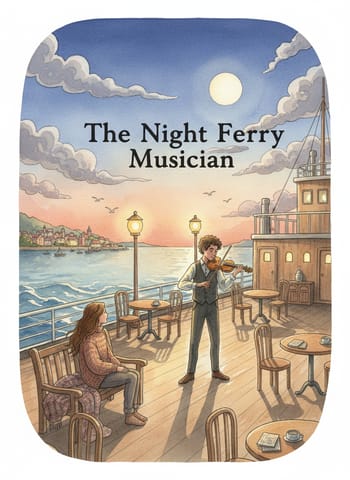
The night ferry leaves at eleven, half empty, and by midnight everyone who is going to sleep has found a bench in the saloon and turned a shoulder to the room. Sonja cannot sleep. She goes out on deck for the cold, which she expects to have to herself, and finds instead, in the lee of a lifeboat, a man playing the violin to the dark.
El transbordador nocturno sale a las once, medio vacío, y a medianoche todos los que van a dormir han encontrado un banco en el salón y le han dado la espalda a la sala. Sonja no puede dormir. Sale a cubierta por el frío, que espera tener para ella sola, y encuentra en cambio, al abrigo de un bote salvavidas, a un hombre que toca el violín para la oscuridad.
He is not busking. There is no case open at his feet, and nobody else is out here. He plays with his eyes shut, in short pieces that begin and then stop, like someone trying a door and finding it locked, and the wind takes half of every phrase. She stands thirty feet away holding her collar closed, a stranger at a rehearsal, and when he lowers the bow she hears herself say, "Don't stop on my account."
No está tocando por monedas. No hay ningún estuche abierto a sus pies, y no hay nadie más aquí afuera. Toca con los ojos cerrados, piezas breves que empiezan y se detienen, como alguien que prueba una puerta y la encuentra cerrada con llave, y el viento se lleva la mitad de cada frase. Ella se queda a diez metros, sujetándose el cuello del abrigo, una extraña en un ensayo, y cuando él baja el arco se oye decir: «No pare por mí».
"There is no account," he says. He looks pleased, but not surprised. "It's the only time I get to play badly and nobody holds it against me."
«No hay ningún “por mí”», dice él. Parece complacido, pero no sorprendido. «Es el único momento en que puedo tocar mal sin que nadie me lo reproche».
They talk, in the end, because sitting is warmer than standing. He is making the crossing for the last time this year, after a season of weddings, the kind of music people have stopped hearing by the second hour. She tells him, without quite meaning to, that she is on her way to look at a flat in a city where she knows no one. She has not decided whether she is moving or only visiting. He does not tell her which she should do. He asks what she will do if she stands in the flat for an hour and hates it.
Acaban conversando, porque sentados se está más caliente que de pie. Él hace la travesía por última vez este año, tras una temporada de bodas, el tipo de música que la gente ha dejado de oír a la segunda hora. Ella le cuenta, sin proponérselo del todo, que va camino de ver un piso en una ciudad donde no conoce a nadie. No ha decidido si se muda o solo va de visita. Él no le dice qué debería hacer. Le pregunta qué hará si se queda una hora en el piso y lo detesta.
"Take the first ferry back," she says.
«Tomar el primer transbordador de vuelta», dice ella.
"Then you know something already." He considers this, and then, because it sounds too certain, adds, "Or you know nothing, which is also useful."
«Entonces ya sabe algo». Lo considera y luego, porque suena demasiado seguro, añade: «O no sabe nada, que también es útil».
Around three the sea goes flat and black, and the far coast appears as a thin, unsteady line of lights. He plays her the piece he has been circling all night: eight bars that never end properly, because, he says, he has never found the ninth. She hums what she thinks it should be, a rising line, nothing more. He tries it and shakes his head, tries it again a tone lower, and for the length of a bar the whole deck is silent except for the engine.
Hacia las tres el mar se queda liso y negro, y la costa de enfrente aparece como una línea delgada e inestable de luces. Él le toca la pieza que ha estado rondando toda la noche: ocho compases que nunca terminan bien, porque, dice, nunca ha encontrado el noveno. Ella tararea lo que cree que debería ser, una línea ascendente, nada más. Él lo prueba y niega con la cabeza, lo prueba otra vez un tono más abajo, y durante un compás toda la cubierta queda en silencio salvo por el motor.
What strikes her, afterwards, is how easy it was. Not until the sky begins to pale does she realise that they have said nothing about where either of them lives, whom they love, or what they are called. If they had traded names at midnight, she thinks, they would have spent the night being the people those names belonged to.
Lo que le llama la atención después es lo fácil que resultó. No es hasta que el cielo empieza a palidecer que se da cuenta de que no han dicho nada de dónde vive ninguno de los dos, a quién quieren ni cómo se llaman. Si hubieran intercambiado nombres a medianoche, piensa, se habrían pasado la noche siendo las personas a las que esos nombres pertenecían.
The harbour comes up out of the grey: cranes, a gull on a bollard, a town not yet awake. Passengers shuffle toward the ramp with their bags and their creased faces. He packs the violin into its case without hurry and stands beside her at the rail while the ropes go across.
El puerto emerge del gris: grúas, una gaviota sobre un noray, un pueblo aún dormido. Los pasajeros arrastran los pies hacia la rampa con sus bolsos y sus caras arrugadas. Él guarda el violín en su estuche sin prisa y se queda a su lado junto a la barandilla mientras pasan las amarras.
"Good luck with the flat," he says.
«Que le vaya bien con el piso», dice.
"Good luck with the ninth bar."
«Que le vaya bien con el noveno compás».
They go down the ramp a few people apart, and at the bottom he turns left along the quay and she turns right. At the end of the quay, behind her, a violin starts up: eight bars, and then a ninth, a tone lower than the one she sang. Sonja keeps walking. She does not turn round, and she does not stop humming.
Bajan por la rampa a pocas personas de distancia, y al pie él gira a la izquierda por el muelle y ella a la derecha. Al final del muelle, a su espalda, arranca un violín: ocho compases, y luego un noveno, un tono más bajo que el que ella tarareó. Sonja sigue andando. No se da la vuelta, y no deja de tararear.