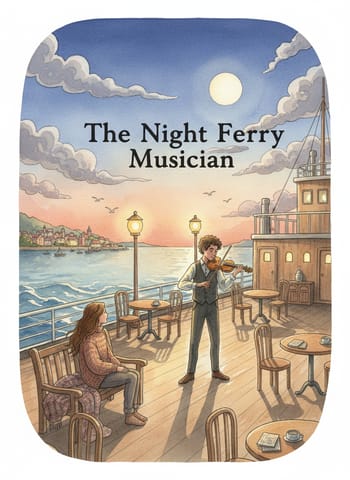
The Night Ferry Musician
Uma história gratuita em inglês de nível C1 para estudantes, para ler online em 4 idiomas, com opção de ouvir no app gratuito Storyteller.
On a night ferry, a woman who cannot sleep finds a man playing the violin to an empty deck, and they talk until the harbour appears.
Essa foi a prévia! Ouça a história completa no app gratuito Storyteller. Baixar o app
O áudio não está disponível no momento.
The night ferry leaves at eleven, half empty, and by midnight everyone who is going to sleep has found a bench in the saloon and turned a shoulder to the room. Sonja cannot sleep. She goes out on deck for the cold, which she expects to have to herself, and finds instead, in the lee of a lifeboat, a man playing the violin to the dark.
A balsa noturna parte às onze, meio vazia, e à meia-noite todos os que vão dormir já acharam um banco no salão e viraram o ombro para o resto da sala. Sonja não consegue dormir. Sai ao convés atrás do frio, que espera ter só para si, e encontra, ao abrigo de um bote salva-vidas, um homem tocando violino para a escuridão.
He is not busking. There is no case open at his feet, and nobody else is out here. He plays with his eyes shut, in short pieces that begin and then stop, like someone trying a door and finding it locked, and the wind takes half of every phrase. She stands thirty feet away holding her collar closed, a stranger at a rehearsal, and when he lowers the bow she hears herself say, "Don't stop on my account."
Ele não está tocando por trocados. Não há estojo aberto aos pés dele, e não há mais ninguém lá fora. Toca de olhos fechados, em peças curtas que começam e param, como quem experimenta uma porta e a encontra trancada, e o vento leva metade de cada frase. Ela fica a dez metros, segurando a gola fechada, uma estranha num ensaio, e quando ele baixa o arco ouve a própria voz dizer: "Não pare por minha causa."
"There is no account," he says. He looks pleased, but not surprised. "It's the only time I get to play badly and nobody holds it against me."
"Não há causa nenhuma", diz ele. Parece contente, mas não surpreso. "É a única hora em que posso tocar mal sem que ninguém me cobre por isso."
They talk, in the end, because sitting is warmer than standing. He is making the crossing for the last time this year, after a season of weddings, the kind of music people have stopped hearing by the second hour. She tells him, without quite meaning to, that she is on her way to look at a flat in a city where she knows no one. She has not decided whether she is moving or only visiting. He does not tell her which she should do. He asks what she will do if she stands in the flat for an hour and hates it.
Acabam conversando porque sentar é mais quente do que ficar de pé. Ele faz a travessia pela última vez neste ano, depois de uma temporada de casamentos, o tipo de música que as pessoas já pararam de ouvir na segunda hora. Ela conta, sem muito querer, que está indo ver um apartamento numa cidade onde não conhece ninguém. Não decidiu se vai se mudar ou só visitar. Ele não diz o que ela deveria fazer. Pergunta o que ela fará se ficar uma hora no apartamento e odiá-lo.
"Take the first ferry back," she says.
"Pego a primeira balsa de volta", diz ela.
"Then you know something already." He considers this, and then, because it sounds too certain, adds, "Or you know nothing, which is also useful."
"Então você já sabe alguma coisa." Ele pondera, e então, por soar certo demais, acrescenta: "Ou não sabe nada, o que também é útil."
Around three the sea goes flat and black, and the far coast appears as a thin, unsteady line of lights. He plays her the piece he has been circling all night: eight bars that never end properly, because, he says, he has never found the ninth. She hums what she thinks it should be, a rising line, nothing more. He tries it and shakes his head, tries it again a tone lower, and for the length of a bar the whole deck is silent except for the engine.
Por volta das três, o mar fica liso e negro, e a costa distante aparece como uma linha fina e instável de luzes. Ele toca para ela a peça em torno da qual andou rodando a noite toda: oito compassos que nunca terminam direito, porque, diz ele, nunca achou o nono. Ela cantarola o que acha que deveria ser, uma linha ascendente, nada mais. Ele tenta, balança a cabeça, tenta de novo um tom abaixo, e pelo tempo de um compasso o convés inteiro fica em silêncio, exceto pelo motor.
What strikes her, afterwards, is how easy it was. Not until the sky begins to pale does she realise that they have said nothing about where either of them lives, whom they love, or what they are called. If they had traded names at midnight, she thinks, they would have spent the night being the people those names belonged to.
O que a marca, depois, é como foi fácil. Só quando o céu começa a empalidecer ela percebe que não disseram nada sobre onde um e outro moram, a quem amam ou como se chamam. Se tivessem trocado nomes à meia-noite, pensa, teriam passado a noite sendo as pessoas a quem esses nomes pertenciam.
The harbour comes up out of the grey: cranes, a gull on a bollard, a town not yet awake. Passengers shuffle toward the ramp with their bags and their creased faces. He packs the violin into its case without hurry and stands beside her at the rail while the ropes go across.
O porto emerge do cinza: guindastes, uma gaivota num cabeço, uma cidade que ainda não acordou. Os passageiros se arrastam rumo à rampa com suas malas e seus rostos amassados. Ele guarda o violino no estojo sem pressa e fica ao lado dela na amurada enquanto as cordas atravessam.
"Good luck with the flat," he says.
"Boa sorte com o apartamento", diz ele.
"Good luck with the ninth bar."
"Boa sorte com o nono compasso."
They go down the ramp a few people apart, and at the bottom he turns left along the quay and she turns right. At the end of the quay, behind her, a violin starts up: eight bars, and then a ninth, a tone lower than the one she sang. Sonja keeps walking. She does not turn round, and she does not stop humming.
Descem a rampa com algumas pessoas de distância, e embaixo ele vira à esquerda pelo cais e ela à direita. No fim do cais, atrás dela, um violino começa: oito compassos, e depois um nono, um tom abaixo do que ela cantarolou. Sonja continua andando. Não se vira, e não para de cantarolar.