The Old Tractor and the Doctor
Una historia gratuita en inglés de nivel A1 para estudiantes, para leer en línea en 7 idiomas, con opción de escucharla en la app gratuita Storyteller.
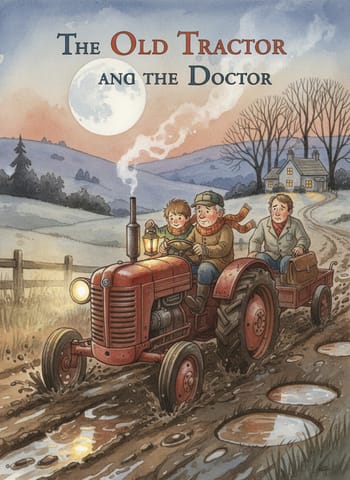
A farmer and a boy drive a slow old tractor through night mud to bring a doctor to a sick grandmother.
¡Ese fue el avance! Escucha la historia completa en la app gratuita Storyteller. Descargar la app
El audio no está disponible en este momento.
Rosalie lived in a small village high in the hills. One night, she had a fever. She felt very hot and very weak.
Rosalie vivía en un pequeño pueblo en lo alto de las colinas. Una noche, le dio fiebre. Se sentía muy acalorada y muy débil.
Her grandson Emil ran to the next house. "Kwame! Please help us!" he said. "My grandmother is ill."
Su nieto Emil corrió a la casa de al lado. —¡Kwame! ¡Por favor, ayúdanos! —dijo—. Mi abuela está enferma.
Kwame opened the door. "Is there a doctor in the village?" he asked.
Kwame abrió la puerta. —¿Hay un médico en el pueblo? —preguntó.
"No," said Emil. "The doctor lives in town. It is far."
—No —dijo Emil—. La doctora vive en la ciudad. Queda lejos.
"Can we call her?" asked Kwame.
—¿Podemos llamarla? —preguntó Kwame.
"The phone does not work in the hills," said Emil.
—El teléfono no funciona en las colinas —dijo Emil.
Kwame thought for a moment. "It rained all day," he said. "The road is mud. A car cannot go there."
Kwame pensó un momento. —Llovió todo el día —dijo—. El camino es puro barro. Un coche no puede pasar.
"What can we do?" asked Emil.
—¿Qué podemos hacer? —preguntó Emil.
"I have my old tractor," said Kwame. "It is slow, but it is strong."
—Tengo mi viejo tractor —dijo Kwame—. Es lento, pero es fuerte.
They ran to the barn. Kwame started the old tractor. It made a loud noise. Emil sat next to him with a big lamp.
Corrieron al granero. Kwame encendió el viejo tractor. Hizo un ruido fuerte. Emil se sentó a su lado con una lámpara grande.
The road was dark and wet. The mud was deep. The tractor went slowly, but it did not stop. After an hour, they came to a bend.
El camino estaba oscuro y mojado. El barro era profundo. El tractor avanzaba despacio, pero no se detenía. Después de una hora, llegaron a una curva.
Some cows stood in the middle of the road. They did not move. Kwame pressed the horn. The cows looked at him and ate more grass.
Unas vacas estaban paradas en medio del camino. No se movían. Kwame tocó la bocina. Las vacas lo miraron y siguieron comiendo pasto.
"They do not like our noise," said Emil. "Wait. I have some bread."
—No les gusta nuestro ruido —dijo Emil—. Espera. Tengo un poco de pan.
Emil got down from the tractor. He held out the bread and walked to the side. The cows followed him one by one. The road was free.
Emil bajó del tractor. Extendió el pan y caminó hacia un lado. Las vacas lo siguieron una por una. El camino quedó libre.
"Good work," said Kwame. Emil smiled and jumped back up.
—Buen trabajo —dijo Kwame. Emil sonrió y volvió a subir de un salto.
Soon the tractor made a strange sound. Then it stopped. Kwame looked at the tank. "No more fuel," he said.
Pronto el tractor hizo un sonido extraño. Luego se detuvo. Kwame miró el tanque. —Se acabó el combustible —dijo.
"Do you have more?" asked Emil.
—¿Tienes más? —preguntó Emil.
"Yes, there is a can in the barn," said Kwame. "But it is far behind us."
—Sí, hay un bidón en el granero —dijo Kwame—. Pero está muy lejos, detrás de nosotros.
Then they heard a car. Its light came around the bend. A woman stood in the road and waved her arms.
Entonces oyeron un coche. Su luz apareció por la curva. Una mujer estaba parada en el camino y agitaba los brazos.
"Hello!" she said. "I am Sunita. I am the doctor. My car is stuck down the road."
—¡Hola! —dijo—. Soy Sunita. Soy la doctora. Mi coche se quedó atascado más abajo.
Kwame and Emil looked at each other. "We need you!" said Emil.
Kwame y Emil se miraron. —¡La necesitamos! —dijo Emil.
"Who is ill?" asked Sunita.
—¿Quién está enfermo? —preguntó Sunita.
"My grandmother," said Emil. "She has a fever."
—Mi abuela —dijo Emil—. Tiene fiebre.
"Then I must go to her now," said Sunita. "Is it far?"
—Entonces debo ir con ella ahora mismo —dijo Sunita—. ¿Queda lejos?
"One hour by tractor," said Kwame. "But we have no fuel."
—Una hora en tractor —dijo Kwame—. Pero no tenemos combustible.
Sunita looked at the tractor. She opened her bag. "I have a small can in my car," she said. "My car does not move, but the fuel is fine."
Sunita miró el tractor. Abrió su bolso. —Tengo un bidón pequeño en mi coche —dijo—. Mi coche no se mueve, pero el combustible está bien.
They walked together to her car. They took the can and went back to the tractor. Kwame poured the fuel into the tank. The old engine started with a loud noise.
Caminaron juntos hasta su coche. Tomaron el bidón y volvieron al tractor. Kwame echó el combustible en el tanque. El viejo motor arrancó con un gran ruido.
"Come, Doctor," said Kwame. "Sit here, next to the boy."
—Venga, doctora —dijo Kwame—. Siéntese aquí, junto al niño.
Sunita held her bag on her knees. Emil held the lamp high. The tractor moved slowly through the mud and the dark.
Sunita puso su bolso sobre las rodillas. Emil sostuvo la lámpara en alto. El tractor avanzó despacio por el barro y la oscuridad.
At last, they saw the lights of the village. Emil jumped down before the tractor stopped. He ran to the house and opened the door.
Por fin vieron las luces del pueblo. Emil saltó antes de que el tractor se detuviera. Corrió a la casa y abrió la puerta.
Rosalie lay in bed. She opened her eyes. "Emil? Who is that?" she asked.
Rosalie estaba acostada en la cama. Abrió los ojos. —¿Emil? ¿Quién es ella? —preguntó.
"Grandmother, this is the doctor," said Emil. "She came on Kwame's tractor."
—Abuela, ella es la doctora —dijo Emil—. Vino en el tractor de Kwame.
Sunita sat down next to the bed. She put her hand on Rosalie's head. "Don't worry," she said. "I have medicine in my bag."
Sunita se sentó junto a la cama. Puso la mano sobre la frente de Rosalie. —No se preocupe —dijo—. Tengo medicina en mi bolso.
Kwame stood at the door with his hat. "Is she very ill?" he asked.
Kwame estaba en la puerta con su sombrero. —¿Está muy enferma? —preguntó.
"She is ill, but she is strong," said Sunita. "You came in time."
—Está enferma, pero es fuerte —dijo Sunita—. Llegaron a tiempo.
Then she looked at the tractor outside. "Next time, I bring my own fuel," she said.
Luego miró el tractor que estaba afuera. —La próxima vez, traigo mi propio combustible —dijo.