The Key With No Label
Una historia gratuita en inglés de nivel B1 para estudiantes, para leer en línea en 7 idiomas, con opción de escucharla en la app gratuita Storyteller.
A young groundskeeper hides the fact that he cannot name one key until a goal builder asks him to open a rusty hatch.
¡Ese fue el avance! Escucha la historia completa en la app gratuita Storyteller. Descargar la app
El audio no está disponible en este momento.
The village of Hollin Ford had one football pitch and one goal. The second goal had been missing for six years, and nobody ever talked about it.
El pueblo de Hollin Ford tenía una cancha de fútbol y un arco. El segundo arco había desaparecido hacía seis años, y nadie hablaba nunca de eso.
Oded took the job of looking after the pitch in March. He was twenty-seven, and he had never kept anything alive for longer than a houseplant. He was quietly sure that he would fail.
Oded aceptó el trabajo de cuidar la cancha en marzo. Tenía veintisiete años y nunca había mantenido vivo nada por más tiempo que una planta de interior. En su fuero interno estaba seguro de que fracasaría.
The man who had done the job before him had moved to the coast. He left Oded a list of tasks, a flask of oil, and a ring of keys.
El hombre que había hecho el trabajo antes que él se había mudado a la costa. Le dejó a Oded una lista de tareas, un frasco de aceite y un llavero con llaves.
The ring held nine keys. Eight of them had paper tags in careful capital letters. They read SHED, GATE, WATER, BOILER, LINES, NETS, CLUBHOUSE and BELL. The ninth key was long and dark. Its tag had fallen off long before Oded arrived. Only a small hole in the metal showed where it had been.
El llavero tenía nueve llaves. Ocho de ellas tenían etiquetas de papel con cuidadas letras mayúsculas. Decían COBERTIZO, PORTÓN, AGUA, CALDERA, LÍNEAS, REDES, CASETA DEL CLUB y CAMPANA. La novena llave era larga y oscura. Su etiqueta se había caído mucho antes de que Oded llegara. Solo un pequeño agujero en el metal mostraba dónde había estado.
Oded never asked what the ninth key opened. Asking meant admitting that he did not know. He had worked hard all spring to look like a man who knew everything.
Oded nunca preguntó qué abría la novena llave. Preguntar significaba admitir que no lo sabía. Se había esforzado toda la primavera por parecer un hombre que lo sabía todo.
His days followed a pattern. He walked to the pitch at six, while the grass was still wet with dew. He unlocked the shed and pulled out the chalk machine. Then he drew the lines again, because the children's boots rubbed them away every evening.
Sus días seguían un patrón. Caminaba hasta la cancha a las seis, mientras el pasto aún estaba húmedo de rocío. Abría el cobertizo y sacaba la máquina de trazar líneas. Luego volvía a dibujar las líneas, porque las botas de los niños las borraban cada tarde.
Then he dragged the single goal to the middle of the field. It was heavy and the wheels were crooked. The job took him ten minutes and two bad words. Every child in the village played at that one goal. They took turns to shoot and took turns to stand in front of it.
Luego arrastraba el único arco hasta el centro del campo. Era pesado y las ruedas estaban torcidas. El trabajo le tomaba diez minutos y dos groserías. Todos los niños del pueblo jugaban en ese único arco. Se turnaban para patear y se turnaban para pararse frente a él.
"Why do we only have one?" a girl asked him once. She was about nine, and she had mud on both knees.
«¿Por qué solo tenemos uno?», le preguntó una vez una niña. Tenía unos nueve años y barro en ambas rodillas.
"We have always managed with one," Oded said. It was not an answer, and she knew it.
«Siempre nos las hemos arreglado con uno», dijo Oded. No era una respuesta, y ella lo sabía.
On the far side of the pitch stood a rusty iron hatch set into the ground. Oded mowed around it every week. He had decided long ago that it was part of the landscape, like a rock or a tree.
Al otro lado de la cancha había una escotilla de hierro oxidada empotrada en el suelo. Oded cortaba el pasto alrededor de ella cada semana. Hacía mucho que había decidido que era parte del paisaje, como una roca o un árbol.
One Tuesday in June, a white van drove through the gate. Oded was kneeling by the touchline with a bucket of chalk, and he stood up too quickly. The man who climbed out was broad and sunburnt, with a pencil behind each ear.
Un martes de junio, una camioneta blanca entró por el portón. Oded estaba arrodillado junto a la línea de banda con un balde de tiza, y se levantó demasiado rápido. El hombre que bajó era corpulento y estaba quemado por el sol, con un lápiz detrás de cada oreja.
"I am looking for the keeper," the man said. "My name is Ozan. I build goals for the county."
«Busco al encargado», dijo el hombre. «Me llamo Ozan. Construyo arcos para el condado».
"I am the keeper," Oded said. He tried to say it like someone who had been the keeper for years.
«Yo soy el encargado», dijo Oded. Trató de decirlo como alguien que lo había sido durante años.
Ozan opened the back of the van. Inside lay a brand-new steel goal, still wrapped in plastic. It was bigger than the old one and painted a clean, bright white.
Ozan abrió la parte trasera de la camioneta. Adentro había un arco de acero nuevecito, todavía envuelto en plástico. Era más grande que el viejo y estaba pintado de un blanco limpio y brillante.
"The village council ordered it in the winter," Ozan said. "The children collected the money themselves. They sold jam and washed cars for months. Nobody told you?"
«El consejo del pueblo lo encargó en invierno», dijo Ozan. «Los niños juntaron el dinero ellos mismos. Vendieron mermelada y lavaron autos durante meses. ¿Nadie te lo dijo?».
Oded shook his head. He remembered a jar of coins in the clubhouse, but he had never asked who it was for.
Oded negó con la cabeza. Recordaba un frasco de monedas en la caseta del club, pero nunca había preguntado para qué era.
"Well, it is here now," Ozan said cheerfully. "The plan says the ground sockets are under a cover at the far end. The key should be on your ring."
«Bueno, ya está aquí», dijo Ozan alegremente. «El plano dice que los casquillos del suelo están bajo una tapa en el extremo opuesto. La llave debería estar en tu llavero».
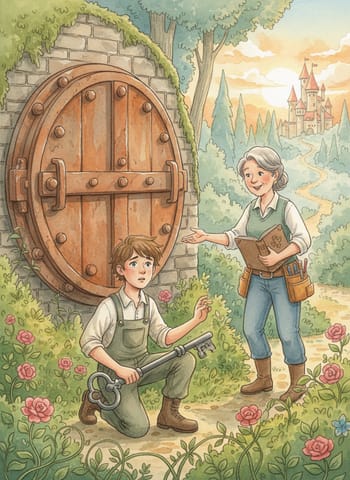
They walked across the field together. The iron hatch looked even more rusty up close. A heavy padlock hung through its handle, and the lock was as old as the hatch.
Cruzaron el campo juntos. La escotilla de hierro se veía aún más oxidada de cerca. Un candado pesado colgaba de su asa, y el candado era tan viejo como la escotilla.
Oded took out his ring and tried the first key. It was the SHED key, and it did not fit. He tried GATE, then WATER, then BOILER. Ozan watched in polite silence, rocking on his heels.
Oded sacó su llavero y probó la primera llave. Era la llave del COBERTIZO, y no encajó. Probó PORTÓN, luego AGUA, luego CALDERA. Ozan lo observaba en cortés silencio, meciéndose sobre los talones.
By the time Oded reached BELL, his hands were sweating. He had run out of labelled keys, and the lock had not moved. Only the ninth key was left, the long dark one with no tag.
Cuando Oded llegó a CAMPANA, le sudaban las manos. Se le habían acabado las llaves con etiqueta, y el candado no se había movido. Solo quedaba la novena llave, la larga y oscura sin etiqueta.
He stood there holding it, and the whole spring came down on him at once. Three months of pretending, of nodding at questions he could not answer. For a moment he almost said that the lock must be broken.
Se quedó ahí sosteniéndola, y toda la primavera le cayó encima de golpe. Tres meses de fingir, de asentir ante preguntas que no podía responder. Por un momento casi dijo que el candado debía de estar roto.
"I have a confession," he said instead. His voice sounded smaller than he wanted. "I do not know what this key opens. I have never known. I was afraid to ask."
«Tengo una confesión», dijo en cambio. Su voz sonó más pequeña de lo que quería. «No sé qué abre esta llave. Nunca lo he sabido. Tuve miedo de preguntar».
Ozan did not laugh. He scratched his chin and looked at the key for a while.
Ozan no se rio. Se rascó la barbilla y miró la llave un rato.
"Do you know how many keys I carry?" he said at last. "Thirty-one. Four of them are a mystery to me. I keep them in case one day a door appears."
«¿Sabes cuántas llaves llevo yo?», dijo al fin. «Treinta y una. Cuatro de ellas son un misterio para mí. Las guardo por si algún día aparece una puerta».
Oded laughed, and the knot in his chest loosened a little.
Oded se rio, y el nudo en el pecho se le aflojó un poco.
"Then let us find out," Ozan said. "If it fits, we will all know something new."
«Entonces averigüémoslo», dijo Ozan. «Si encaja, todos sabremos algo nuevo».
Oded pushed the long key into the padlock. It slid in smoothly, as if it had been waiting. He turned it, and the lock gave a dull clunk and fell open.
Oded metió la llave larga en el candado. Se deslizó con suavidad, como si hubiera estado esperando. La giró, y el candado dio un golpe sordo y se abrió.
Neither of them said anything. The hatch itself was another matter. It had not moved in six years, and it fought them. Ozan poured oil along the hinges, and Oded found a crowbar in the shed. They pulled together, counting aloud, until the iron lid screamed upward and crashed against the grass.
Ninguno de los dos dijo nada. La escotilla en sí era otro asunto. No se había movido en seis años, y se resistió. Ozan vertió aceite a lo largo de las bisagras, y Oded encontró una palanca en el cobertizo. Tiraron juntos, contando en voz alta, hasta que la tapa de hierro chilló hacia arriba y cayó con estrépito sobre el pasto.
Underneath lay a neat concrete hole with a steel sleeve at the bottom. Next to it was a second sleeve, and beside that, a small tin box. Oded wiped the dust away with his sleeve. Inside the box he found a folded paper, yellow at the edges.
Debajo había un hoyo de concreto ordenado con un casquillo de acero en el fondo. Junto a él había un segundo casquillo, y al lado, una pequeña caja de lata. Oded limpió el polvo con la manga. Dentro de la caja encontró un papel doblado, amarillento en los bordes.
It was a drawing in pencil, dated six years earlier. It showed two goals, one at each end of the pitch. A tiny stick figure stood in front of each. Under the drawing the old keeper had written: "For whoever comes next. Ask anyone anything. Nobody here minds."
Era un dibujo a lápiz, fechado seis años atrás. Mostraba dos arcos, uno en cada extremo de la cancha. Un diminuto muñeco de palitos estaba parado frente a cada uno. Debajo del dibujo, el antiguo encargado había escrito: «Para quien venga después. Pregunta lo que sea a quien sea. Aquí a nadie le molesta».
Oded read the note twice. Then he handed it to Ozan, who read it once and smiled.
Oded leyó la nota dos veces. Luego se la pasó a Ozan, que la leyó una vez y sonrió.
"Your friend knew you were coming," Ozan said.
«Tu amigo sabía que vendrías», dijo Ozan.
"He knew somebody was coming," Oded said. "I wish he had put a tag on the key."
«Sabía que vendría alguien», dijo Oded. «Ojalá le hubiera puesto una etiqueta a la llave».
They spent the next two hours carrying the new goal across the field. It was lighter than it looked. Ozan lowered the posts into the sleeves, and Oded tightened the bolts one by one. When the last bolt was tight, the goal stood straight and white at the far end.
Pasaron las dos horas siguientes cargando el arco nuevo por el campo. Era más ligero de lo que parecía. Ozan bajó los postes en los casquillos, y Oded apretó los pernos uno por uno. Cuando se apretó el último perno, el arco quedó erguido y blanco en el extremo opuesto.
Just after four, the children arrived from school. They stopped at the gate and stared. Nobody spoke for a long moment.
Poco después de las cuatro, los niños llegaron de la escuela. Se detuvieron en el portón y se quedaron mirando. Nadie habló durante un largo momento.
Then the girl with the muddy knees began to run. The others followed, shouting and tripping over their bags. Within five minutes there were two teams and two goalkeepers. There was also a loud argument about who would kick off.
Entonces la niña de las rodillas con barro echó a correr. Los demás la siguieron, gritando y tropezando con sus mochilas. En cinco minutos había dos equipos y dos porteros. También había una fuerte discusión sobre quién daría el saque inicial.
"That is the best noise I have heard all year," Ozan said. He leaned against his van and drank water from a bottle.
«Es el mejor ruido que he oído en todo el año», dijo Ozan. Se apoyó en su camioneta y bebió agua de una botella.
"Thank you for coming," Oded said. "And for not laughing at me."
«Gracias por venir», dijo Oded. «Y por no reírte de mí».
"Thank you for the key," Ozan said. "Now I have one mystery fewer."
«Gracias por la llave», dijo Ozan. «Ahora tengo un misterio menos».
When the van had gone, Oded stayed by the shed. The sun was low, and the children's shadows stretched long over the grass. Someone scored at the far end, and a cheer rose from both sides.
Cuando la camioneta se fue, Oded se quedó junto al cobertizo. El sol estaba bajo, y las sombras de los niños se alargaban sobre el pasto. Alguien anotó en el extremo opuesto, y un grito de alegría subió de ambos lados.
He took the ring from his pocket. Then he went into the shed and found a pen and a clean paper tag. He wrote on it in careful capital letters: SECOND GOAL. He punched a hole in the tag and threaded it through the long dark key. Then he tied it on with a double knot.
Sacó el llavero del bolsillo. Luego entró al cobertizo y encontró un bolígrafo y una etiqueta de papel limpia. Escribió en ella con cuidadas letras mayúsculas: SEGUNDO ARCO. Perforó un agujero en la etiqueta y la pasó por la llave larga y oscura. Luego la ató con un nudo doble.