The Key With No Label
A free B1-level English story for language learners, readable online in 7 languages, with an option to listen via the free Storyteller app.
A young groundskeeper hides the fact that he cannot name one key until a goal builder asks him to open a rusty hatch.
That was the preview! Hear the full story in the free Storyteller app. Get the app
Audio isn't available right now.
The village of Hollin Ford had one football pitch and one goal. The second goal had been missing for six years, and nobody ever talked about it.
Oded took the job of looking after the pitch in March. He was twenty-seven, and he had never kept anything alive for longer than a houseplant. He was quietly sure that he would fail.
The man who had done the job before him had moved to the coast. He left Oded a list of tasks, a flask of oil, and a ring of keys.
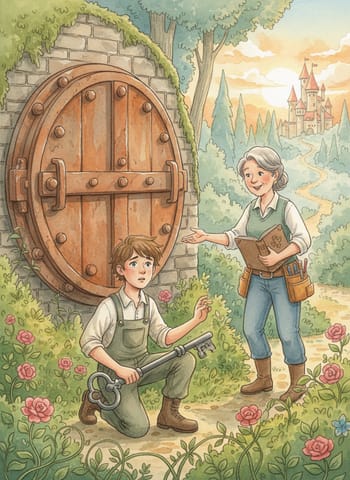
The ring held nine keys. Eight of them had paper tags in careful capital letters. They read SHED, GATE, WATER, BOILER, LINES, NETS, CLUBHOUSE and BELL. The ninth key was long and dark. Its tag had fallen off long before Oded arrived. Only a small hole in the metal showed where it had been.
Oded never asked what the ninth key opened. Asking meant admitting that he did not know. He had worked hard all spring to look like a man who knew everything.
His days followed a pattern. He walked to the pitch at six, while the grass was still wet with dew. He unlocked the shed and pulled out the chalk machine. Then he drew the lines again, because the children's boots rubbed them away every evening.
Then he dragged the single goal to the middle of the field. It was heavy and the wheels were crooked. The job took him ten minutes and two bad words. Every child in the village played at that one goal. They took turns to shoot and took turns to stand in front of it.
"Why do we only have one?" a girl asked him once. She was about nine, and she had mud on both knees.
"We have always managed with one," Oded said. It was not an answer, and she knew it.
On the far side of the pitch stood a rusty iron hatch set into the ground. Oded mowed around it every week. He had decided long ago that it was part of the landscape, like a rock or a tree.
One Tuesday in June, a white van drove through the gate. Oded was kneeling by the touchline with a bucket of chalk, and he stood up too quickly. The man who climbed out was broad and sunburnt, with a pencil behind each ear.
"I am looking for the keeper," the man said. "My name is Ozan. I build goals for the county."
"I am the keeper," Oded said. He tried to say it like someone who had been the keeper for years.
Ozan opened the back of the van. Inside lay a brand-new steel goal, still wrapped in plastic. It was bigger than the old one and painted a clean, bright white.
"The village council ordered it in the winter," Ozan said. "The children collected the money themselves. They sold jam and washed cars for months. Nobody told you?"
Oded shook his head. He remembered a jar of coins in the clubhouse, but he had never asked who it was for.
"Well, it is here now," Ozan said cheerfully. "The plan says the ground sockets are under a cover at the far end. The key should be on your ring."
They walked across the field together. The iron hatch looked even more rusty up close. A heavy padlock hung through its handle, and the lock was as old as the hatch.
Oded took out his ring and tried the first key. It was the SHED key, and it did not fit. He tried GATE, then WATER, then BOILER. Ozan watched in polite silence, rocking on his heels.
By the time Oded reached BELL, his hands were sweating. He had run out of labelled keys, and the lock had not moved. Only the ninth key was left, the long dark one with no tag.
He stood there holding it, and the whole spring came down on him at once. Three months of pretending, of nodding at questions he could not answer. For a moment he almost said that the lock must be broken.
"I have a confession," he said instead. His voice sounded smaller than he wanted. "I do not know what this key opens. I have never known. I was afraid to ask."
Ozan did not laugh. He scratched his chin and looked at the key for a while.
"Do you know how many keys I carry?" he said at last. "Thirty-one. Four of them are a mystery to me. I keep them in case one day a door appears."
Oded laughed, and the knot in his chest loosened a little.
"Then let us find out," Ozan said. "If it fits, we will all know something new."
Oded pushed the long key into the padlock. It slid in smoothly, as if it had been waiting. He turned it, and the lock gave a dull clunk and fell open.
Neither of them said anything. The hatch itself was another matter. It had not moved in six years, and it fought them. Ozan poured oil along the hinges, and Oded found a crowbar in the shed. They pulled together, counting aloud, until the iron lid screamed upward and crashed against the grass.
Underneath lay a neat concrete hole with a steel sleeve at the bottom. Next to it was a second sleeve, and beside that, a small tin box. Oded wiped the dust away with his sleeve. Inside the box he found a folded paper, yellow at the edges.
It was a drawing in pencil, dated six years earlier. It showed two goals, one at each end of the pitch. A tiny stick figure stood in front of each. Under the drawing the old keeper had written: "For whoever comes next. Ask anyone anything. Nobody here minds."
Oded read the note twice. Then he handed it to Ozan, who read it once and smiled.
"Your friend knew you were coming," Ozan said.
"He knew somebody was coming," Oded said. "I wish he had put a tag on the key."
They spent the next two hours carrying the new goal across the field. It was lighter than it looked. Ozan lowered the posts into the sleeves, and Oded tightened the bolts one by one. When the last bolt was tight, the goal stood straight and white at the far end.
Just after four, the children arrived from school. They stopped at the gate and stared. Nobody spoke for a long moment.
Then the girl with the muddy knees began to run. The others followed, shouting and tripping over their bags. Within five minutes there were two teams and two goalkeepers. There was also a loud argument about who would kick off.
"That is the best noise I have heard all year," Ozan said. He leaned against his van and drank water from a bottle.
"Thank you for coming," Oded said. "And for not laughing at me."
"Thank you for the key," Ozan said. "Now I have one mystery fewer."
When the van had gone, Oded stayed by the shed. The sun was low, and the children's shadows stretched long over the grass. Someone scored at the far end, and a cheer rose from both sides.
He took the ring from his pocket. Then he went into the shed and found a pen and a clean paper tag. He wrote on it in careful capital letters: SECOND GOAL. He punched a hole in the tag and threaded it through the long dark key. Then he tied it on with a double knot.