The Fort at the Tram Stop
Una historia gratuita en inglés de nivel B1 para estudiantes, para leer en línea en 7 idiomas, con opción de escucharla en la app gratuita Storyteller.
Leona has a new flat but no bed, and a long night walk home with a friend and twenty-two pillows tests her sense of direction.
¡Ese fue el avance! Escucha la historia completa en la app gratuita Storyteller. Descargar la app
El audio no está disponible en este momento.
Leona signed the lease on Tuesday. By Friday evening she still had no bed.
Leona firmó el contrato de alquiler el martes. Para el viernes por la tarde todavía no tenía cama.
The flat was a bright room on the top floor. It had a tiny kitchen and a window above the street. It had no sofa, no chairs and no curtains. The furniture shop said her bed would arrive in two weeks.
El departamento era una habitación luminosa en el último piso. Tenía una cocina diminuta y una ventana sobre la calle. No tenía sofá, ni sillas, ni cortinas. La mueblería dijo que su cama llegaría en dos semanas.
"Two weeks is a long time to sleep on the floor," Leona said on the phone.
«Dos semanas es mucho tiempo para dormir en el piso», dijo Leona por teléfono.
"So don't sleep on the floor," said Zahra. "Sleep on pillows. I know a man who sells them cheap."
«Pues no duermas en el piso», dijo Zahra. «Duerme sobre almohadas. Conozco a un hombre que las vende baratas».
Zahra lived in the flat below. They had met on the stairs the day before, when Leona was carrying a single lamp. Zahra had looked at the lamp, then at Leona, and decided they were friends. At home, Leona's friendships grew slowly, like trees. Zahra simply walked in and sat down.
Zahra vivía en el departamento de abajo. Se habían conocido en la escalera el día anterior, cuando Leona cargaba una sola lámpara. Zahra había mirado la lámpara, luego a Leona, y había decidido que eran amigas. En su tierra, las amistades de Leona crecían despacio, como árboles. Zahra simplemente entró y se sentó.
The man with the pillows had a stall at the night market across the river. He had forty left, all in odd colours. He sold twenty-two of them for the price of a pizza. He packed them into two enormous plastic bags.
El hombre de las almohadas tenía un puesto en el mercado nocturno al otro lado del río. Le quedaban cuarenta, todas de colores raros. Vendió veintidós por el precio de una pizza. Las metió en dos enormes bolsas de plástico.
"How do we carry these?" Leona asked.
«¿Cómo las llevamos?», preguntó Leona.
"On our heads," Zahra said. "Like queens."
«En la cabeza», dijo Zahra. «Como reinas».
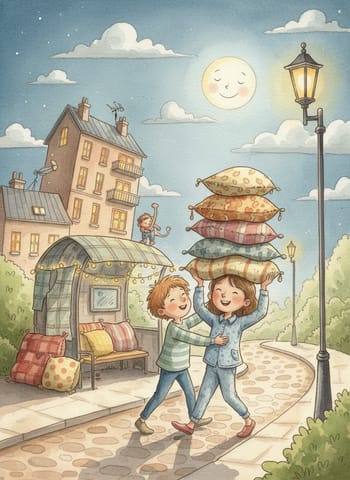
They did not carry them on their heads. They dragged the bags down the market street to the tram stop at the end. It was ten o'clock, and the stop was almost empty. A glass shelter stood beside the rails. Inside it were a bench and a big lit map of the whole city.
No las llevaron en la cabeza. Arrastraron las bolsas por la calle del mercado hasta la parada del tranvía al final. Eran las diez, y la parada estaba casi vacía. Un refugio de vidrio se alzaba junto a los rieles. Adentro había una banca y un gran mapa iluminado de toda la ciudad.
Leona dropped her bag and sat on it. Her arms hurt, and her new shoes hurt more. She had lived in this city for eleven days. She still got lost every time she left the house. She never told anyone that.
Leona soltó su bolsa y se sentó encima. Le dolían los brazos, y los zapatos nuevos le dolían más. Llevaba once días viviendo en esta ciudad. Todavía se perdía cada vez que salía de casa. Nunca se lo decía a nadie.
"The next tram is at ten past," Zahra said. She read the board, and then she stopped smiling. "Or it isn't."
«El próximo tranvía es a las diez y diez», dijo Zahra. Leyó el tablero, y luego dejó de sonreír. «O no».
A paper notice was taped across the timetable. The line was closed for repairs until Monday morning. There was no tram, and there would be no tram all weekend.
Un aviso de papel estaba pegado sobre el horario. La línea estaba cerrada por reparaciones hasta el lunes por la mañana. No había tranvía, y no habría tranvía todo el fin de semana.
Zahra tried to call a taxi. The market had just closed, and every driver in the area was busy.
Zahra intentó llamar un taxi. El mercado acababa de cerrar, y todos los conductores de la zona estaban ocupados.
"One hour," she read. "Maybe more."
«Una hora», leyó. «Quizás más».
"We could walk," Leona said slowly. "It isn't far. It's only two miles."
«Podríamos caminar», dijo Leona despacio. «No está lejos. Son solo tres kilómetros».
"My phone has three percent left," Zahra said. "I used it all on pillow photos."
«A mi teléfono le queda el tres por ciento», dijo Zahra. «Lo gasté todo en fotos de almohadas».
Leona pulled out her own phone. It had two percent. She opened the map, watched the little blue dot turn, and then the screen went black.
Leona sacó su propio teléfono. Tenía el dos por ciento. Abrió el mapa, vio girar el puntito azul, y luego la pantalla se puso negra.
For a moment neither of them spoke. Somewhere behind the market, a late stall pulled down its metal shutters with a long rattle.
Por un momento ninguna de las dos habló. En algún lugar detrás del mercado, un puesto rezagado bajó sus persianas metálicas con un largo traqueteo.
Then Leona looked at the big lit map on the wall of the shelter.
Entonces Leona miró el gran mapa iluminado en la pared del refugio.
She stood up and walked over to it. She found the river, then the market, then the tram line with its thin blue stripe. She put her finger on the dot that said YOU ARE HERE. Then she followed the streets with her finger, slowly, all the way to her own front door.
Se levantó y caminó hacia él. Encontró el río, luego el mercado, luego la línea del tranvía con su fina franja azul. Puso el dedo en el punto que decía USTED ESTÁ AQUÍ. Luego siguió las calles con el dedo, despacio, hasta su propia puerta.
"Left at the fountain," she said. "Then along the canal until the iron bridge. Over the bridge, and the second street on the right. Then straight uphill."
«A la izquierda en la fuente», dijo. «Luego por el canal hasta el puente de hierro. Cruzando el puente, la segunda calle a la derecha. Y luego todo derecho cuesta arriba».
"You know this?" Zahra asked.
«¿Te lo sabes?», preguntó Zahra.
"I don't know it yet," Leona said. "Give me a minute."
«Todavía no me lo sé», dijo Leona. «Dame un minuto».
She said the route aloud four times, first with her eyes open and then with them closed. Zahra waited and did not make a single joke.
Dijo la ruta en voz alta cuatro veces, primero con los ojos abiertos y luego con ellos cerrados. Zahra esperó y no hizo ni una sola broma.
"Okay," Leona said at last. "I think I have it."
«Bueno», dijo Leona por fin. «Creo que lo tengo».
They picked up the bags and set off.
Levantaron las bolsas y se pusieron en marcha.
At the first corner, the bag in Zahra's hand split down one side with a soft, sad sound. Pillows slid out onto the pavement, one after another. A blue one rolled into the road. A yellow one landed face down under a lamp.
En la primera esquina, la bolsa en la mano de Zahra se rajó por un costado con un sonido suave y triste. Las almohadas se deslizaron sobre la acera, una tras otra. Una azul rodó hacia la calle. Una amarilla cayó boca abajo bajo una farola.
"Stop," Zahra said, laughing so hard that she had to hold a wall. "Stop, stop. We have lost the beds."
«Para», dijo Zahra, riéndose tanto que tuvo que apoyarse en una pared. «Para, para. Hemos perdido las camas».
"We have not lost them," said Leona. "They are everywhere."
«No las hemos perdido», dijo Leona. «Están por todas partes».
She did not feel like laughing. If they could not carry the pillows, they would have to leave half of them here.
No tenía ganas de reírse. Si no podían cargar las almohadas, tendrían que dejar la mitad ahí.
Then she remembered the scarf around her neck. She pulled it off.
Entonces se acordó de la bufanda que llevaba al cuello. Se la quitó.
"Give me your scarf," she said. "And your belt."
«Dame tu bufanda», dijo. «Y tu cinturón».
"My belt? Why?"
«¿Mi cinturón? ¿Para qué?».
"Because we are going to wear them."
«Porque nos las vamos a poner».
It took ten minutes. Leona stacked six pillows into a tall bundle and tied them tightly with her scarf. Then she pushed her arms through two loops of Zahra's belt. The bundle sat on her back like a school bag. Zahra copied her. They stuffed four more pillows inside their coats, until both of them looked like round, soft penguins. They carried the last ones under their arms.
Tardaron diez minutos. Leona apiló seis almohadas en un bulto alto y lo ató con fuerza con su bufanda. Luego pasó los brazos por dos lazos del cinturón de Zahra. El bulto quedó en su espalda como una mochila escolar. Zahra la imitó. Metieron cuatro almohadas más dentro de los abrigos, hasta que las dos parecían pingüinos redondos y blandos. Las últimas las llevaron bajo los brazos.
"You look ridiculous," Zahra said happily. "I love it."
«Te ves ridícula», dijo Zahra con alegría. «Me encanta».
Leona led the way. At the fountain she turned left without stopping. She heard Zahra's footsteps behind her, and the whisper of pillows against pillows. The streets were quiet.
Leona abrió el camino. En la fuente giró a la izquierda sin detenerse. Oyó los pasos de Zahra detrás, y el susurro de almohadas contra almohadas. Las calles estaban tranquilas.
The canal came, just as the map had promised. The water was black and still. They walked beside it for a long time, past a boat with a string of tiny lights. Leona's shoulders ached. But her head felt clear and strange, as if someone had opened a window inside it.
El canal apareció, tal como había prometido el mapa. El agua era negra y quieta. Caminaron junto a él durante mucho rato, pasando una barca con una guirnalda de luces diminutas. A Leona le dolían los hombros. Pero su cabeza se sentía despejada y extraña, como si alguien hubiera abierto una ventana dentro de ella.
Then she reached the iron bridge, and her stomach dropped. There were two bridges. One was iron, and one was made of grey stone, and they stood side by side.
Entonces llegó al puente de hierro, y se le encogió el estómago. Había dos puentes. Uno era de hierro, y uno era de piedra gris, y estaban uno al lado del otro.
"Which one?" Zahra asked.
«¿Cuál?», preguntó Zahra.
Leona closed her eyes and saw the map again. The mark across the canal had been a straight line. A straight line meant the flat stone one. She had been about to take the pretty one.
Leona cerró los ojos y volvió a ver el mapa. La marca al otro lado del canal había sido una línea recta. Una línea recta significaba el puente plano de piedra. Había estado a punto de tomar el bonito.
"The stone one," she said. "The iron one goes to the park."
«El de piedra», dijo. «El de hierro lleva al parque».
"Are you sure?"
«¿Estás segura?».
"No," Leona said. "But I think so."
«No», dijo Leona. «Pero creo que sí».
They crossed the stone bridge. On the other side, a sign said Mill Road. It was the second street on the right. Leona nearly laughed out loud.
Cruzaron el puente de piedra. Al otro lado, un letrero decía Calle del Molino. Era la segunda calle a la derecha. Leona casi se rió en voz alta.
Then came the hill. It was steeper than it looked on the map, and the bundles felt heavier with every step. Twice Zahra stopped. Twice Leona said, "Ten more steps," and counted them aloud. By the end, they were counting together.
Entonces llegó la cuesta. Era más empinada de lo que parecía en el mapa, y los bultos pesaban más a cada paso. Dos veces Zahra se detuvo. Dos veces Leona dijo: «Diez pasos más», y los contó en voz alta. Al final, los contaban juntas.
At the top of the hill, a familiar yellow door waited under a lamp. It was her own front door.
En lo alto de la cuesta, una puerta amarilla conocida esperaba bajo una farola. Era su propia puerta de entrada.
"We did it," Zahra said. "You did it."
«Lo logramos», dijo Zahra. «Lo lograste».
Up in the empty flat, they dropped everything in the middle of the floor. Then Zahra pulled a clean sheet out of a box in the corner. She tied two of its corners to the radiator and the window handle.
Arriba, en el departamento vacío, dejaron todo caer en medio del piso. Luego Zahra sacó una sábana limpia de una caja en el rincón. Ató dos de sus esquinas al radiador y a la manija de la ventana.
"What are you doing?" Leona asked.
«¿Qué haces?», preguntó Leona.
"A fort," said Zahra. "Every good flat needs one."
«Un fuerte», dijo Zahra. «Todo buen departamento necesita uno».
They built it together. The big pillows made walls, the small ones made a floor, and the sheet made a roof. They tucked in the edges until the whole thing looked like a round, lopsided nest. Leona crawled in first. It smelled of dust and market and new cotton.
Lo construyeron juntas. Las almohadas grandes hicieron las paredes, las pequeñas hicieron el piso, y la sábana hizo el techo. Metieron los bordes hasta que todo parecía un nido redondo y torcido. Leona entró gateando primero. Olía a polvo y a mercado y a algodón nuevo.
Zahra crawled in after her and pulled a pillow under her head. "Tomorrow I will bring you a blanket," she said. "And a kettle. And one more lamp."
Zahra entró gateando detrás de ella y se puso una almohada bajo la cabeza. «Mañana te traeré una manta», dijo. «Y una tetera. Y una lámpara más».
"You don't have to," Leona said.
«No tienes que hacerlo», dijo Leona.
"I know." Zahra yawned. "That is why I am going to."
«Lo sé». Zahra bostezó. «Por eso lo voy a hacer».
Soon her breathing grew slow and even. Leona lay awake a little longer, looking up at the sheet. A line of yellow light from the street came through a gap in the pillows. It lay across her hand. Far away, down the hill, she could hear one bicycle bell, small and clear, ringing in the dark.
Pronto su respiración se volvió lenta y pareja. Leona se quedó despierta un poco más, mirando hacia arriba la sábana. Una línea de luz amarilla de la calle entraba por un hueco entre las almohadas. Caía sobre su mano. A lo lejos, cuesta abajo, oyó una sola campanilla de bicicleta, pequeña y clara, que sonaba en la oscuridad.
She closed her eyes and let it ring.
Cerró los ojos y dejó que sonara.