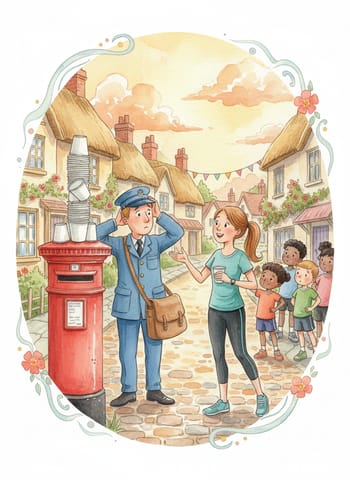
The Cups on the Post Box
Una historia gratuita en inglés de nivel B1 para estudiantes, para leer en línea en 7 idiomas, con opción de escucharla en la app gratuita Storyteller.
A village postman and a young running-club leader misunderstand each other over a stack of paper cups.
¡Ese fue el avance! Escucha la historia completa en la app gratuita Storyteller. Descargar la app
El audio no está disponible en este momento.
Ilan has emptied the village post box every morning for eleven years. He arrives at twenty to seven, when the road is empty and the air smells of cut grass. He opens the little door with his small key and slides the letters into his bag. Then he drives to the next village. It is a quiet job, and he likes it that way.
Ilan vacía el buzón del pueblo todas las mañanas desde hace once años. Llega a las siete menos veinte, cuando el camino está vacío y el aire huele a césped recién cortado. Abre la puertecita con su llave pequeña y desliza las cartas en su bolsa. Luego conduce hasta el siguiente pueblo. Es un trabajo tranquilo, y a él le gusta así.
On a Monday in May, something new sits on top of the box. It is a stack of paper cups, about thirty of them, held down by a flat stone.
Un lunes de mayo, algo nuevo está encima del buzón. Es una pila de vasos de papel, unos treinta, sujetos con una piedra plana.
Ilan frowns. "Somebody's rubbish," he says to the empty road.
Ilan frunce el ceño. «La basura de alguien», le dice al camino vacío.
He picks up the cups and carries them to the bin by the school gate. He puts the stone back in the hedge, where he thinks it belongs. Then he collects the post and drives away.
Recoge los vasos y los lleva al contenedor junto a la puerta de la escuela. Devuelve la piedra al seto, donde cree que pertenece. Luego recoge el correo y se va.
On Tuesday, there is another stack and a different stone. Ilan throws them away too. On Wednesday, the stack is taller, and the stone is bigger. He sighs, and he throws them away again.
El martes hay otra pila y una piedra diferente. Ilan también las tira. El miércoles la pila es más alta y la piedra más grande. Suspira, y las tira otra vez.
Kalani, meanwhile, is having a very bad week.
Kalani, mientras tanto, está teniendo una semana muy mala.
She is nineteen, and she has just come home after her first year at college. She wants to do something useful in the village. So she has started a morning running club for beginners. Twelve people have joined. They meet at seven o'clock by the post box, and they run once round the lake.
Tiene diecinueve años, y acaba de volver a casa después de su primer año en la universidad. Quiere hacer algo útil en el pueblo. Así que ha empezado un club de running matutino para principiantes. Se han unido doce personas. Se reúnen a las siete junto al buzón, y corren una vez alrededor del lago.
Kalani is in charge of everything. She plans the route, she counts the runners, and she worries a lot. Every morning at half past six, she leaves a stack of cups on the box. Later, she comes back with a big jug of water for the runners.
Kalani está a cargo de todo. Planea la ruta, cuenta a los corredores y se preocupa mucho. Todas las mañanas a las seis y media deja una pila de vasos sobre el buzón. Después vuelve con una jarra grande de agua para los corredores.
But every morning, the cups are gone.
Pero todas las mañanas, los vasos han desaparecido.
"Someone is stealing them," she tells her friend on the phone. "Or someone doesn't like us. I don't know which is worse."
«Alguien los está robando», le dice a su amiga por teléfono. «O a alguien no le caemos bien. No sé qué es peor».
"Just ask around," her friend says.
«Solo pregunta por ahí», dice su amiga.
"I can't," Kalani says. "What if I sound silly?"
«No puedo», dice Kalani. «¿Y si sueno tonta?».
On Thursday, she writes a note and puts it under the stone. It says, "Please stop taking our cups. They are for the runners."
El jueves escribe una nota y la pone bajo la piedra. Dice: «Por favor, dejen de llevarse nuestros vasos. Son para los corredores».
When Ilan finds the note, he goes very quiet, as he always does when he is annoyed. He reads it twice. Nobody tells a postman what to do with his own post box, he thinks. He takes a pen from his pocket. Underneath, he writes, "Please stop leaving rubbish on a public post box."
Cuando Ilan encuentra la nota, se queda muy callado, como siempre que está molesto. La lee dos veces. Nadie le dice a un cartero qué hacer con su propio buzón, piensa. Saca un bolígrafo del bolsillo. Debajo escribe: «Por favor, dejen de dejar basura en un buzón público».
He puts the note back under the stone. Then he feels a little pleased with himself, and a little ashamed.
Vuelve a poner la nota bajo la piedra. Luego se siente un poco satisfecho consigo mismo, y un poco avergonzado.
Later that morning, Kalani reads his answer under the stone. She feels her stomach turn over. Rubbish! Those are good cups, and she paid for them with her own money.
Más tarde esa mañana, Kalani lee su respuesta bajo la piedra. Siente que se le revuelve el estómago. ¡Basura! Son buenos vasos, y los pagó con su propio dinero.
She decides that notes are not working. She sets her alarm for five o'clock. At twenty past six, she is sitting on the low wall next to the post box. She has a jug of water and her phone. She is determined to say something to the person who takes her cups, and to say it clearly.
Decide que las notas no funcionan. Pone su alarma a las cinco. A las seis y veinte está sentada en el muro bajo junto al buzón. Tiene una jarra de agua y su teléfono. Está decidida a decirle algo a la persona que se lleva sus vasos, y a decírselo con claridad.
At twenty to seven, the white van comes round the corner. Ilan gets out with his small key and his bag. He sees Kalani on the wall, and he stops.
A las siete menos veinte, la furgoneta blanca dobla la esquina. Ilan baja con su llave pequeña y su bolsa. Ve a Kalani en el muro, y se detiene.
"Good morning," he says carefully.
«Buenos días», dice con cautela.
"Are you the person who throws away my cups?" Kalani asks. Her voice shakes, but she keeps going.
«¿Usted es la persona que tira mis vasos?», pregunta Kalani. Le tiembla la voz, pero sigue adelante.
"Are you the person who leaves rubbish on my post box?" Ilan says.
«¿Usted es la persona que deja basura en mi buzón?», dice Ilan.
For a moment, they look at each other. Then Ilan looks at the jug and at the sports bag beside her. Last, he looks at the stack of cups on the wall.
Por un momento se miran. Luego Ilan mira la jarra y el bolso deportivo junto a ella. Por último, mira la pila de vasos sobre el muro.
"Rubbish?" Kalani says. "They are for the running club. We meet here every morning at seven."
«¿Basura?», dice Kalani. «Son para el club de running. Nos reunimos aquí todas las mañanas a las siete».
"I didn't know about a running club," Ilan says slowly. "I just saw cups. Nobody ever leaves anything on this box. I thought somebody was making a joke."
«No sabía de un club de running», dice Ilan despacio. «Solo vi vasos. Nadie deja nunca nada en este buzón. Pensé que alguien estaba haciendo una broma».
"I thought you were stealing them," Kalani says.
«Yo pensé que usted se los estaba robando», dice Kalani.
"I was," Ilan says. "In a way. I put thirty of them in the bin at the school gate."
«Lo hacía», dice Ilan. «En cierto modo. Puse treinta en el contenedor de la puerta de la escuela».
Kalani laughs suddenly, and the laugh surprises her. Ilan starts to laugh too. It is a rusty sound, because he does not laugh much before breakfast. They stand there for a minute, two people laughing at a post box.
Kalani ríe de pronto, y la risa la sorprende. Ilan también empieza a reír. Es un sonido oxidado, porque no ríe mucho antes del desayuno. Se quedan allí un minuto, dos personas riéndose de un buzón.
"I should have asked someone," Kalani says, when she can speak again. "I wrote a note instead. A rude note."
«Debí preguntarle a alguien», dice Kalani, cuando puede volver a hablar. «En vez de eso escribí una nota. Una nota grosera».
"My note was ruder," Ilan says. "I am sorry. If you had put your name on it, I would have understood."
«La mía fue más grosera», dice Ilan. «Lo siento. Si hubiera puesto su nombre, yo habría entendido».
"I was afraid," Kalani says. "I'm not very good at telling people things."
«Tenía miedo», dice Kalani. «No soy muy buena para decirle cosas a la gente».
Ilan scratches his chin. "At your age, I left my first job because I wouldn't ask one small question," he says. "It took me three years to find another one. Ask early, and ask out loud. That is my only advice."
Ilan se rasca la barbilla. «A su edad, yo dejé mi primer trabajo porque no quise hacer una pequeña pregunta», dice. «Me tomó tres años encontrar otro. Pregunte pronto, y pregunte en voz alta. Ese es mi único consejo».
Kalani nods slowly. For a long time, nobody has given her advice that did not feel like an order. She thinks about it all the way round the lake that morning, with twelve runners puffing behind her.
Kalani asiente lentamente. Hace mucho que nadie le da un consejo que no parezca una orden. Lo piensa todo el camino alrededor del lago esa mañana, con doce corredores resoplando detrás de ella.
On Saturday, Ilan arrives at twenty to seven as usual. This time, he brings something with him. It is a small wooden shelf from his garage. He screws it to the wall beside the post box, a handspan from the ground.
El sábado, Ilan llega a las siete menos veinte como de costumbre. Esta vez trae algo consigo. Es un pequeño estante de madera de su garaje. Lo atornilla a la pared junto al buzón, a un palmo del suelo.
"Cups can go here," he says to nobody in particular. "Out of the way of the letters, and out of the way of my bin."
«Los vasos pueden ir aquí», le dice a nadie en particular. «Fuera del camino de las cartas, y fuera del camino de mi contenedor».
When Kalani comes with her jug, she finds the shelf and the cups already lined up on it. She says nothing for a second. Then she pours the first cup of water and holds it out to him.
Cuando Kalani llega con su jarra, encuentra el estante y los vasos ya alineados en él. No dice nada durante un segundo. Luego sirve el primer vaso de agua y se lo ofrece.
"For the postman," she says.
«Para el cartero», dice.
Ilan takes it, drinks it in one go, and gives the cup back. "Better than coffee," he says. "Don't tell anyone."
Ilan lo toma, lo bebe de un trago y le devuelve el vaso. «Mejor que el café», dice. «No se lo diga a nadie».
By Monday, the runners have a new rule. Every morning, someone brings a stack of cups for the shelf. Every morning, Ilan checks that it is neatly done. If the cups are straight, he gives two short beeps on his horn. If they are crooked, he gives one long one.
Para el lunes, los corredores tienen una regla nueva. Todas las mañanas alguien trae una pila de vasos para el estante. Todas las mañanas, Ilan revisa que esté bien hecho. Si los vasos están derechos, da dos bocinazos cortos. Si están torcidos, da uno largo.
On Friday, Kalani lifts the last stack from the shelf to pour the water. She turns the bottom cup over in her hand and stops. Inside the rim, in thin blue pencil, someone has drawn a tiny bird.
El viernes, Kalani levanta la última pila del estante para servir el agua. Da vuelta al vaso de abajo en su mano y se detiene. Dentro del borde, con lápiz azul tenue, alguien ha dibujado un pajarito.
She did not draw it. She looks at Ilan, who is locking the post box, and he shakes his head.
Ella no lo dibujó. Mira a Ilan, que está cerrando el buzón con llave, y él niega con la cabeza.
"Not mine," he says. "I can't draw a bird to save my life."
«No es mío», dice. «No sé dibujar un pájaro ni aunque mi vida dependiera de ello».
They both look at the empty road. Then, far away, at the other end of the lake, a single runner starts to wave.
Los dos miran el camino vacío. Entonces, a lo lejos, en el otro extremo del lago, un solo corredor empieza a saludar con la mano.