The Bag in the Square Well
Una historia gratuita en inglés de nivel B1 para estudiantes, para leer en línea en 7 idiomas, con opción de escucharla en la app gratuita Storyteller.
A young man hired to clean the village well finds a bag of marbles and angers the woman who hid it.
¡Ese fue el avance! Escucha la historia completa en la app gratuita Storyteller. Descargar la app
El audio no está disponible en este momento.
Bastien got the job on the last day of June. The village council needed someone to clean the old well in the square before the summer fair. Nobody else wanted the work.
Bastien consiguió el trabajo el último día de junio. El consejo del pueblo necesitaba a alguien que limpiara el viejo pozo de la plaza antes de la feria de verano. Nadie más quería el trabajo.
"You are eighteen and strong," the mayor told him. "The job is yours, if you can start tomorrow."
«Tienes dieciocho años y eres fuerte», le dijo el alcalde. «El trabajo es tuyo, si puedes empezar mañana».
"I can start tonight," Bastien said. "I have nothing else to do."
«Puedo empezar esta noche», dijo Bastien. «No tengo nada más que hacer».
The mayor laughed and gave him the key to the tool shed. Bastien had finished school two weeks before. He did not know what to do with his life yet. A month of simple work seemed like a good place to begin.
El alcalde se rio y le dio la llave del cobertizo de herramientas. Bastien había terminado el colegio hacía dos semanas. Todavía no sabía qué hacer con su vida. Un mes de trabajo sencillo parecía un buen lugar para empezar.
The next morning he stood in the square with a ladder, a lamp and a long iron hook. The well sat in the middle of the village, round and grey, under a small stone roof. Children had played around it for hundreds of years. Their shoes had worn the stones smooth.
A la mañana siguiente estaba en la plaza con una escalera, una lámpara y un largo gancho de hierro. El pozo se alzaba en medio del pueblo, redondo y gris, bajo un pequeño tejado de piedra. Los niños habían jugado a su alrededor durante cientos de años. Sus zapatos habían desgastado las piedras hasta dejarlas lisas.
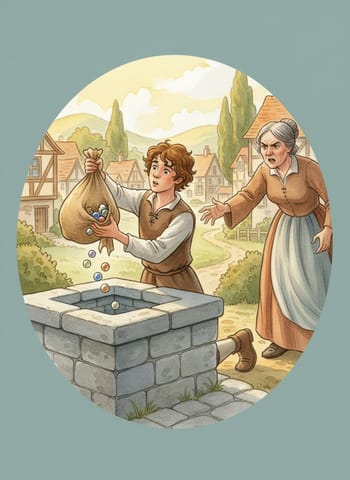
Bastien tied the lamp to a rope and lowered it into the dark. Cold air rose past his face. Far below, the water shone like a coin. Then the lamp swung against the wall, and the light caught something strange. A small leather bag hung from an iron hook, just above the water.
Bastien ató la lámpara a una cuerda y la bajó a la oscuridad. El aire frío subió rozándole la cara. Muy abajo, el agua brillaba como una moneda. Entonces la lámpara osciló contra la pared, y la luz alcanzó algo extraño. Una pequeña bolsa de cuero colgaba de un gancho de hierro, justo encima del agua.
It took him twenty minutes to reach it. He climbed down six rungs, leaned out and caught the cord with the long hook. His arms shook when he pulled the bag up. Then he climbed back into the sun. He sat on the edge of the well to catch his breath.
Tardó veinte minutos en alcanzarla. Bajó seis peldaños, se inclinó hacia afuera y enganchó el cordón con el largo gancho. Le temblaron los brazos al subir la bolsa. Luego trepó de vuelta al sol. Se sentó en el borde del pozo para recobrar el aliento.
The bag was tied with a green cord. Bastien opened it carefully. Inside, there were at least fifty glass marbles. Some were blue, some were yellow, and some had twisted ribbons of colour inside. He had not seen so many marbles since he was seven years old.
La bolsa estaba atada con un cordón verde. Bastien la abrió con cuidado. Adentro había al menos cincuenta canicas de vidrio. Algunas eran azules, algunas amarillas, y algunas tenían cintas de colores retorcidas en su interior. No había visto tantas canicas desde que tenía siete años.
He picked one out and held it up to the light. It was clear green, with a white spiral in the middle. For a moment, he forgot about the job, the fair and the whole long summer.
Sacó una y la levantó a la luz. Era de un verde transparente, con una espiral blanca en el centro. Por un momento, se olvidó del trabajo, de la feria y de todo el largo verano.
"What are you doing?" a voice asked behind him.
«¿Qué haces?», preguntó una voz a su espalda.
A woman stood at the edge of the square with a basket of papers on her arm. She had ink on her fingers and a pencil in her hair. Bastien knew her by sight. Her name was Lorna, and she ran the village library and the Saturday club for children.
Una mujer estaba en el borde de la plaza con una canasta de papeles en el brazo. Tenía tinta en los dedos y un lápiz en el pelo. Bastien la conocía de vista. Se llamaba Lorna, y dirigía la biblioteca del pueblo y el club de los sábados para niños.
"I'm cleaning the well," Bastien said. "Look what I found down there. Somebody lost a whole bag of marbles."
«Estoy limpiando el pozo», dijo Bastien. «Mira lo que encontré allá abajo. Alguien perdió una bolsa entera de canicas».
"Nobody lost them," Lorna said. Her voice was very quiet. "Please put them back in the bag."
«Nadie las perdió», dijo Lorna. Su voz era muy baja. «Por favor, vuelve a ponerlas en la bolsa».
Bastien frowned. "I wanted to give them to the school. The children will love them."
Bastien frunció el ceño. «Quería dárselas a la escuela. A los niños les encantarán».
"You wanted to give them away?" Lorna put her basket on the ground. "Do you know how long I worked on this? Do you know what you have done?"
«¿Querías regalarlas?». Lorna dejó su canasta en el suelo. «¿Sabes cuánto tiempo trabajé en esto? ¿Sabes lo que has hecho?».
"I haven't done anything," Bastien said. "I climbed down and I got them. That's my job."
«No he hecho nada», dijo Bastien. «Bajé y las saqué. Ese es mi trabajo».
"Your job is to clean the well. It is not to take things out of it." Lorna held out her hand. "Give me the bag, please."
«Tu trabajo es limpiar el pozo. No es sacar cosas de él». Lorna extendió la mano. «Dame la bolsa, por favor».
Something hard and angry rose in Bastien's chest. He was not a child, and he did not like to be treated like one. "I am not a thief," he said. "I have never taken anything that was not mine."
Algo duro y furioso le subió a Bastien por el pecho. No era un niño, y no le gustaba que lo trataran como a uno. «No soy un ladrón», dijo. «Nunca he tomado nada que no fuera mío».
"I did not say you were a thief," said Lorna.
«No dije que fueras un ladrón», dijo Lorna.
"You did not have to." He put the bag in her hand, picked up his ladder and carried it to the shed. He did not look back.
«No hacía falta». Puso la bolsa en su mano, recogió su escalera y la llevó al cobertizo. No miró atrás.
He ate an apple and some cheese in the tool shed. Neither of them tasted of anything. On the wall hung a notice board with the programme for the summer fair. Bastien read it to pass the time. Near the bottom, in small letters, he saw one line: "Children's treasure hunt. Six clues. A prize at the end. Organised by Lorna."
Comió una manzana y un poco de queso en el cobertizo de herramientas. Ninguno de los dos sabía a nada. En la pared colgaba un tablón de anuncios con el programa de la feria de verano. Bastien lo leyó para pasar el rato. Cerca del final, en letras pequeñas, vio una línea: «Búsqueda del tesoro infantil. Seis pistas. Un premio al final. Organiza Lorna».
Beside the programme, someone had pinned a sheet of riddles. The third one said: "Where the whole village drinks, look under the roof of stone. Do not go down alone."
Junto al programa, alguien había clavado una hoja de acertijos. El tercero decía: «Donde todo el pueblo bebe, busca bajo el techo de piedra. No bajes solo».
Bastien read it three times. Then he put his apple down. "Oh no," he said to the empty shed.
Bastien lo leyó tres veces. Luego dejó la manzana. «Ay, no», dijo al cobertizo vacío.
He found Lorna in the library, on her knees between two shelves. A box of paper stars stood beside her. She did not look up when he came in.
Encontró a Lorna en la biblioteca, de rodillas entre dos estantes. Una caja de estrellas de papel estaba a su lado. No levantó la vista cuando él entró.
"I'm sorry," he said. "I read the riddles. The bag was the prize, wasn't it?"
«Lo siento», dijo. «Leí los acertijos. La bolsa era el premio, ¿verdad?».
"It was part of the prize." Lorna sat back on her heels. "I'm sorry too. I should not have shouted. It took me three evenings to hang that bag, and I was afraid you had ruined everything."
«Era parte del premio». Lorna se sentó sobre los talones. «Yo también lo siento. No debí gritar. Me llevó tres tardes colgar esa bolsa, y temí que lo hubieras arruinado todo».
"I did not know," Bastien said. "Nobody told me anything."
«No lo sabía», dijo Bastien. «Nadie me dijo nada».
"Nobody told the mayor, either." Lorna almost smiled. "I wanted the treasure hunt to be a surprise. That was probably a mistake."
«Tampoco le dijeron nada al alcalde». Lorna casi sonrió. «Quería que la búsqueda del tesoro fuera una sorpresa. Probablemente fue un error».
Bastien sat down on a low chair made for children. His knees came up almost to his chin. "Can I say something about the hook?"
Bastien se sentó en una silla baja hecha para niños. Las rodillas le llegaban casi a la barbilla. «¿Puedo decir algo sobre el gancho?».
"Go on."
«Adelante».
"It is too dangerous. A child who follows your clue will try to climb down. I nearly slipped this morning, and I am eighteen."
«Es demasiado peligroso. Un niño que siga tu pista intentará bajar. Yo casi resbalé esta mañana, y tengo dieciocho años».
Lorna was quiet for a moment. "I had not thought of that. I only thought of the surprise."
Lorna guardó silencio un momento. «No lo había pensado. Solo pensé en la sorpresa».
"Here is an idea," Bastien said. "If I fix a small wheel under the stone roof, the bag can hang from a rope. Then a child only has to turn the handle. An adult can stand next to them."
«Se me ocurre una idea», dijo Bastien. «Si coloco una pequeña polea bajo el techo de piedra, la bolsa puede colgar de una cuerda. Así el niño solo tiene que girar la manivela. Un adulto puede estar a su lado».
Lorna looked at him as if she saw him for the first time. "Can you build that?"
Lorna lo miró como si lo viera por primera vez. «¿Puedes construir eso?».
"I have a whole month, a tool shed and nothing else to do."
«Tengo un mes entero, un cobertizo de herramientas y nada más que hacer».
They worked together all afternoon. Bastien cut a wheel from an old wooden cart he found behind the shed. He sanded it until it turned without a sound. Lorna sat on the edge of the well and counted the marbles by colour. There were fifty-two. She said that two of them came from her own childhood. She did not want to lose them.
Trabajaron juntos toda la tarde. Bastien cortó una rueda de una vieja carreta de madera que encontró detrás del cobertizo. La lijó hasta que giró sin hacer ruido. Lorna se sentó en el borde del pozo y contó las canicas por colores. Eran cincuenta y dos. Dijo que dos de ellas eran de su propia infancia. No quería perderlas.
Near evening, Bastien climbed up under the stone roof and fixed the wheel to a beam. He threaded a new cord through it and tied the leather bag to the end. Then he turned the handle. The bag rose out of the dark and swung gently into the light. It looked like something from a story.
Hacia el atardecer, Bastien subió bajo el techo de piedra y fijó la rueda a una viga. Pasó por ella una cuerda nueva y ató la bolsa de cuero al extremo. Luego giró la manivela. La bolsa subió desde la oscuridad y osciló suavemente hacia la luz. Parecía algo salido de un cuento.
Lorna clapped her hands once, like a child. "It is perfect. It is much better than before."
Lorna dio una palmada, como una niña. «Es perfecto. Es mucho mejor que antes».
"It is safer," Bastien said. "That is the point."
«Es más seguro», dijo Bastien. «Ese es el punto».
The square was empty now, and the sky over the roofs had turned the colour of honey. Lorna put the bag back in its place and let the cord run slowly down into the well. Then she opened her hand. In her palm lay the green marble with the white spiral.
La plaza estaba vacía ahora, y el cielo sobre los tejados había tomado el color de la miel. Lorna puso la bolsa de vuelta en su lugar y dejó que la cuerda corriera despacio hacia el pozo. Luego abrió la mano. En su palma estaba la canica verde con la espiral blanca.
"This one is for you," she said. "You are the first person who ever found it."
«Esta es para ti», dijo. «Eres la primera persona que la encontró».
Bastien turned the marble in his fingers and held it up to the last of the light. He thought about the month ahead, the ladder and the lamp and the long quiet hours. Then he thought about six clues, and about a crowd of children running across the square.
Bastien hizo girar la canica entre los dedos y la levantó a la última luz. Pensó en el mes que venía, la escalera, la lámpara y las largas horas de silencio. Luego pensó en seis pistas, y en una multitud de niños corriendo por la plaza.
"Lorna," he said, "does the Saturday club need another helper?"
«Lorna», dijo, «¿el club de los sábados necesita otro ayudante?».