The Roll Under the Air Hockey Table
Una historia gratuita en inglés de nivel B1 para estudiantes, para leer en línea en 7 idiomas, con opción de escucharla en la app gratuita Storyteller.
A young arcade technician follows an old roll of film from person to person until he finds its owner.
¡Ese fue el avance! Escucha la historia completa en la app gratuita Storyteller. Descargar la app
El audio no está disponible en este momento.
The Sea Star Arcade never really sleeps. Even at ten in the morning, the doors are still locked. The machines hum and blink to themselves like a room full of tired animals. Dilan loves this hour. He walks along the sticky carpet with a ring of keys, checking coins and switching on screens.
El Sea Star Arcade nunca duerme del todo. Incluso a las diez de la mañana, las puertas siguen cerradas con llave. Las máquinas zumban y parpadean para sí mismas como una sala llena de animales cansados. A Dilan le encanta esta hora. Camina por la alfombra pegajosa con un llavero, revisando monedas y encendiendo pantallas.
He is twenty-three, and he has worked here since he was seventeen. Everybody says he is the best technician the pier ever had. Everybody also asks him the same question, which is when he plans to do something else.
Tiene veintitrés años y trabaja aquí desde los diecisiete. Todos dicen que es el mejor técnico que ha tenido el muelle. Todos le hacen también la misma pregunta, que es cuándo piensa hacer otra cosa.
This morning he has a letter in his back pocket that he has not answered. A company in the city offers him a job fixing game machines. It comes with a proper salary and a desk. The letter has been there for nine days.
Esta mañana lleva en el bolsillo trasero una carta que no ha contestado. Una empresa de la ciudad le ofrece un trabajo arreglando máquinas de juegos. Incluye un sueldo como es debido y un escritorio. La carta lleva allí nueve días.
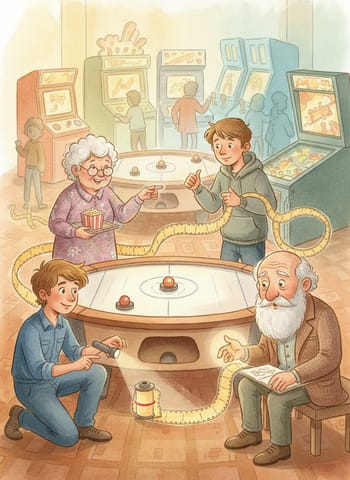
At the far end, the cleaner is pushing the heavy air hockey table away from the wall. She stops and bends down.
Al fondo, la señora de la limpieza empuja la pesada mesa de hockey de aire para separarla de la pared. Se detiene y se agacha.
"Dilan, come and look at this."
«Dilan, ven a ver esto».
Under the table, in a nest of dust and old coins, lies a small black plastic tube. Dilan picks it up and shakes it. Something rattles inside. He pulls off the lid and finds a roll of camera film. It is the old kind that people used before phones.
Debajo de la mesa, en un nido de polvo y monedas viejas, hay un pequeño tubo de plástico negro. Dilan lo recoge y lo sacude. Algo suena adentro. Quita la tapa y encuentra un rollo de película de cámara. Es del tipo antiguo que la gente usaba antes de los teléfonos.
"Somebody's holiday photos," the cleaner says. "Probably twenty years old."
«Fotos de vacaciones de alguien», dice la señora de la limpieza. «Probablemente de hace veinte años».
"Why would anyone leave them here?"
«¿Por qué alguien las dejaría aquí?».
"They were never left. They fell." She wipes her hands on her apron. "Give it to the manager. He decides what we do with lost things."
«No las dejaron. Se cayeron». Se limpia las manos en el delantal. «Dáselo al gerente. Él decide qué hacemos con las cosas perdidas».
The manager is in his office, eating an apple over a pile of invoices. He looks at the tube for about two seconds.
El gerente está en su oficina, comiendo una manzana sobre una pila de facturas. Mira el tubo unos dos segundos.
"Film," he says. "Nobody can use that any more. Throw it away."
«Película», dice. «Ya nadie puede usar eso. Tírala».
"It might have pictures on it."
«Podría tener fotos».
"It might have a lot of things on it. It is also under a table that was last moved before you were born." The manager waves a hand. "We are not a museum, Dilan. Bin it."
«Podría tener muchas cosas. También estaba debajo de una mesa que se movió por última vez antes de que tú nacieras». El gerente agita una mano. «No somos un museo, Dilan. A la basura».
Dilan walks back across the arcade with the tube in his hand. He stops beside the bin and holds the tube over the opening. His fingers will not let go.
Dilan cruza de vuelta la sala de juegos con el tubo en la mano. Se detiene junto al bote de basura y sostiene el tubo sobre la abertura. Sus dedos no lo sueltan.
He is not sure why. He only knows that someone once held this roll. That person thought it was important enough to keep in a small black case. It would be strange to see it end up in a bin next to a paper cup.
No está seguro de por qué. Solo sabe que alguien sostuvo alguna vez este rollo. Esa persona pensó que era lo bastante importante como para guardarlo en un pequeño estuche negro. Sería extraño verlo terminar en un bote junto a un vaso de papel.
He drops the tube into his pocket, next to the letter from the city.
Deja caer el tubo en su bolsillo, junto a la carta de la ciudad.
On his lunch break, he walks to the photo shop at the end of the pier. A man with thick glasses takes the film, turns it over twice and smiles.
En su descanso para almorzar, camina hasta la tienda de fotografía al final del muelle. Un hombre de gafas gruesas toma la película, le da la vuelta dos veces y sonríe.
"I have not seen one of these in a long time," he says. "The roll is old. The pictures may be pale, or they may be nothing. But I will try."
«Hace mucho que no veía una de estas», dice. «El rollo es viejo. Puede que las fotos estén pálidas, o puede que no haya nada. Pero lo intentaré».
"How much?"
«¿Cuánto cuesta?».
"Ten pounds. Come back on Thursday."
«Diez libras. Vuelve el jueves».
Dilan pays and goes back to work. For three days he checks his phone and pretends he is not thinking about it. His workmates tease him about it. On Thursday, he runs to the shop before it opens.
Dilan paga y regresa al trabajo. Durante tres días revisa su teléfono y finge que no está pensando en ello. Sus compañeros lo molestan por eso. El jueves, corre a la tienda antes de que abra.
The man hands him a thin envelope. "Eighteen pictures came out," he says. "The rest is dark. I think you will like them."
El hombre le entrega un sobre delgado. «Salieron dieciocho fotos», dice. «El resto está oscuro. Creo que te van a gustar».
Dilan opens the envelope on the pier railing, with the sea flashing behind him. The first photograph shows the front of the Sea Star Arcade. The sign is newer and brighter, and the paint is fresh. The second shows a row of boys in front of the old racing game. They are about sixteen. They are all laughing, and they are pulling silly faces at the camera.
Dilan abre el sobre en la barandilla del muelle, con el mar destellando detrás. La primera fotografía muestra la fachada del Sea Star Arcade. El letrero es más nuevo y brillante, y la pintura está fresca. La segunda muestra una fila de chicos frente a la vieja máquina de carreras. Tienen unos dieciséis años. Todos se ríen y le hacen muecas tontas a la cámara.
In the fifth photograph, one of the boys stands alone in front of the machine. He holds up one hand. His other hand is on the wheel. On the screen behind him, large yellow letters show the name MAG and a score of 99,990.
En la quinta fotografía, uno de los chicos está solo frente a la máquina. Levanta una mano. Con la otra sujeta el volante. En la pantalla detrás de él, grandes letras amarillas muestran el nombre MAG y un puntaje de 99,990.
Dilan looks up from the photograph. He knows that name. It has been at the top of the old racing machine for as long as he can remember. In all his years at the arcade, no one has ever beaten it.
Dilan levanta la vista de la fotografía. Conoce ese nombre. Ha estado en lo más alto de la vieja máquina de carreras desde que él recuerda. En todos sus años en el arcade, nadie lo ha superado.
"MAG," he says out loud. "Who are you?"
«MAG», dice en voz alta. «¿Quién eres?».
He asks the cleaner. She does not know. He asks the manager, who says the name was there before him. He asks the regular customers, who shrug. A boy who plays the claw machine every afternoon says it must be a ghost.
Le pregunta a la señora de la limpieza. Ella no lo sabe. Le pregunta al gerente, que dice que el nombre estaba allí antes que él. Les pregunta a los clientes habituales, que se encogen de hombros. Un niño que juega a la máquina de la garra todas las tardes dice que debe de ser un fantasma.
Dilan does not give up. He takes the photographs to work every day and shows them to anyone who stands still. On Saturday evening, he is still carrying the envelope when a man walks in through the front doors.
Dilan no se rinde. Lleva las fotografías al trabajo todos los días y se las muestra a cualquiera que se quede quieto. El sábado por la tarde, todavía lleva el sobre cuando un hombre entra por las puertas principales.
The man is about thirty-five. He wears a dark coat and holds the strap of a travel bag. He does not look at the machines in a casual way. He looks at them like someone who is checking whether they remember him. He walks slowly down the aisle, past the air hockey table. Then he stops in front of the old racing game.
El hombre tiene unos treinta y cinco años. Lleva un abrigo oscuro y sujeta la correa de un bolso de viaje. No mira las máquinas de manera casual. Las mira como alguien que comprueba si lo recuerdan. Camina despacio por el pasillo, pasando junto a la mesa de hockey de aire. Luego se detiene frente a la vieja máquina de carreras.
He stands there for a long time.
Se queda allí mucho tiempo.
Dilan watches from behind the counter. Then he sees the man lean forward and read the top of the screen.
Dilan lo observa desde detrás del mostrador. Luego ve que el hombre se inclina hacia adelante y lee la parte superior de la pantalla.
MAG. 99,990.
MAG. 99,990.
Dilan's heart starts to beat faster. He crosses the arcade before he can change his mind.
El corazón de Dilan empieza a latir más rápido. Cruza el arcade antes de poder cambiar de idea.
"Excuse me," he says. "Is that your name?"
«Disculpe», dice. «¿Ese es su nombre?».
The man turns. His eyes are kind and a little surprised. "It was," he says. "For about ten years. My name is Magnus. Why? Does the machine still work?"
El hombre se da vuelta. Tiene ojos amables y un poco sorprendidos. «Lo era», dice. «Durante unos diez años. Me llamo Magnus. ¿Por qué? ¿La máquina todavía funciona?».
"It always works. I fix it." Dilan takes a breath. "Nobody has ever beaten your score."
«Siempre funciona. Yo la arreglo». Dilan respira hondo. «Nadie ha superado nunca su puntaje».
"Really?" Magnus laughs, and the sound is warm. "I was eighteen. It took me a whole summer. I came to the arcade every day, and I spent all my pocket money on coins."
«¿De verdad?». Magnus se ríe, y el sonido es cálido. «Yo tenía dieciocho años. Me tomó todo un verano. Venía al arcade todos los días y gastaba todo mi dinero de bolsillo en monedas».
"Did you take pictures here?"
«¿Tomó fotos aquí?».
The laughter fades slowly. Magnus looks at him carefully. "I took one roll. The night before I left for university. I carried my camera everywhere that summer. But I lost the finished roll somewhere in this room, and I never found it again." He pauses. "I still think about it. My friends and I never took a better picture than those."
La risa se apaga lentamente. Magnus lo mira con atención. «Tomé un rollo. La noche antes de irme a la universidad. Ese verano llevé mi cámara a todas partes. Pero perdí el rollo terminado en algún lugar de esta sala, y nunca lo volví a encontrar». Hace una pausa. «Todavía pienso en eso. Mis amigos y yo nunca nos tomamos una foto mejor que esas».
Dilan reaches into his pocket and holds out the envelope.
Dilan mete la mano en el bolsillo y le extiende el sobre.
For a moment, Magnus does not move. Then he takes it with both hands, as if it might fall apart. He opens it. He looks at the first photograph, and then the second. His face changes, quietly, in many small ways.
Por un momento, Magnus no se mueve. Luego lo toma con las dos manos, como si pudiera deshacerse. Lo abre. Mira la primera fotografía, y luego la segunda. Su rostro cambia, en silencio, de muchas formas pequeñas.
"That is Kofi," he says in a low voice. "And that is Sam. We said we would meet here every summer. And then we never did." He touches the picture of himself, and his voice breaks into a smile. "Look at my hair. Who allowed that?"
«Ese es Kofi», dice en voz baja. «Y ese es Sam. Dijimos que nos encontraríamos aquí todos los veranos. Y luego nunca lo hicimos». Toca la imagen de sí mismo, y su voz se quiebra en una sonrisa. «Mire mi pelo. ¿Quién permitió eso?».
"The roll was under the air hockey table," Dilan says. "The cleaner found it. The manager wanted to bin it. I took it to the photo shop."
«El rollo estaba debajo de la mesa de hockey de aire», dice Dilan. «La señora de la limpieza lo encontró. El gerente quería tirarlo. Yo lo llevé a la tienda de fotografía».
Magnus looks up. "Why?"
Magnus levanta la vista. «¿Por qué?».
Dilan thinks about the letter in his pocket, and about the nine days he spent not answering it. He thinks about all the people who leave and all the people who stay.
Dilan piensa en la carta de su bolsillo, y en los nueve días que pasó sin contestarla. Piensa en todas las personas que se van y en todas las que se quedan.
"I think it wanted to go home," he says.
«Creo que quería volver a casa», dice.
Magnus is silent for a moment. Then he puts the envelope carefully inside his coat. He feels in his other pocket and takes out two coins.
Magnus guarda silencio un momento. Luego guarda el sobre con cuidado dentro de su abrigo. Busca en el otro bolsillo y saca dos monedas.
"Show me whether the machine really still works," he says.
«Muéstreme si la máquina de verdad todavía funciona», dice.
Dilan takes the coins, slides them into the slot and presses the start button.
Dilan toma las monedas, las desliza en la ranura y presiona el botón de inicio.