The Fort at the Tram Stop
Uma história gratuita em inglês de nível B1 para estudantes, para ler online em 7 idiomas, com opção de ouvir no app gratuito Storyteller.
Leona has a new flat but no bed, and a long night walk home with a friend and twenty-two pillows tests her sense of direction.
Essa foi a prévia! Ouça a história completa no app gratuito Storyteller. Baixar o app
O áudio não está disponível no momento.
Leona signed the lease on Tuesday. By Friday evening she still had no bed.
Leona assinou o contrato de aluguel na terça-feira. Na sexta à noite ainda não tinha cama.
The flat was a bright room on the top floor. It had a tiny kitchen and a window above the street. It had no sofa, no chairs and no curtains. The furniture shop said her bed would arrive in two weeks.
O apartamento era um quarto claro no último andar. Tinha uma cozinha minúscula e uma janela sobre a rua. Não tinha sofá, nem cadeiras, nem cortinas. A loja de móveis disse que a cama chegaria em duas semanas.
"Two weeks is a long time to sleep on the floor," Leona said on the phone.
"Duas semanas é muito tempo para dormir no chão", disse Leona ao telefone.
"So don't sleep on the floor," said Zahra. "Sleep on pillows. I know a man who sells them cheap."
"Então não durma no chão", disse Zahra. "Durma em travesseiros. Conheço um homem que vende barato."
Zahra lived in the flat below. They had met on the stairs the day before, when Leona was carrying a single lamp. Zahra had looked at the lamp, then at Leona, and decided they were friends. At home, Leona's friendships grew slowly, like trees. Zahra simply walked in and sat down.
Zahra morava no apartamento de baixo. Tinham se conhecido na escada no dia anterior, quando Leona carregava uma única luminária. Zahra olhou para a luminária, depois para Leona, e decidiu que eram amigas. Na terra de Leona, as amizades cresciam devagar, como árvores. Zahra simplesmente entrou e sentou.
The man with the pillows had a stall at the night market across the river. He had forty left, all in odd colours. He sold twenty-two of them for the price of a pizza. He packed them into two enormous plastic bags.
O homem dos travesseiros tinha uma barraca na feira noturna do outro lado do rio. Restavam quarenta, todos de cores esquisitas. Ele vendeu vinte e dois pelo preço de uma pizza. Embalou-os em dois sacos de plástico enormes.
"How do we carry these?" Leona asked.
"Como é que a gente carrega isso?", perguntou Leona.
"On our heads," Zahra said. "Like queens."
"Na cabeça", disse Zahra. "Como rainhas."
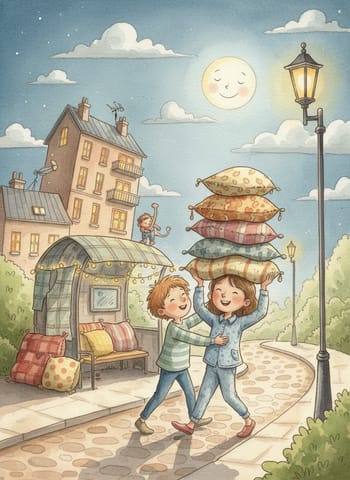
They did not carry them on their heads. They dragged the bags down the market street to the tram stop at the end. It was ten o'clock, and the stop was almost empty. A glass shelter stood beside the rails. Inside it were a bench and a big lit map of the whole city.
Não os carregaram na cabeça. Arrastaram os sacos pela rua da feira até o ponto de bonde no fim. Eram dez horas, e o ponto estava quase vazio. Um abrigo de vidro ficava ao lado dos trilhos. Dentro dele havia um banco e um grande mapa iluminado da cidade inteira.
Leona dropped her bag and sat on it. Her arms hurt, and her new shoes hurt more. She had lived in this city for eleven days. She still got lost every time she left the house. She never told anyone that.
Leona largou o saco e sentou nele. Os braços doíam, e os sapatos novos doíam ainda mais. Ela morava naquela cidade havia onze dias. Ainda se perdia toda vez que saía de casa. Nunca contou isso a ninguém.
"The next tram is at ten past," Zahra said. She read the board, and then she stopped smiling. "Or it isn't."
"O próximo bonde é às dez e dez", disse Zahra. Leu o painel e então parou de sorrir. "Ou não é."
A paper notice was taped across the timetable. The line was closed for repairs until Monday morning. There was no tram, and there would be no tram all weekend.
Um aviso de papel estava colado sobre a tabela de horários. A linha estava fechada para obras até a manhã de segunda. Não havia bonde, e não haveria bonde o fim de semana inteiro.
Zahra tried to call a taxi. The market had just closed, and every driver in the area was busy.
Zahra tentou chamar um táxi. A feira acabara de fechar, e todos os motoristas da região estavam ocupados.
"One hour," she read. "Maybe more."
"Uma hora", leu. "Talvez mais."
"We could walk," Leona said slowly. "It isn't far. It's only two miles."
"A gente podia ir a pé", disse Leona devagar. "Não é longe. São só três quilômetros."
"My phone has three percent left," Zahra said. "I used it all on pillow photos."
"Meu celular tem três por cento", disse Zahra. "Gastei tudo em fotos de travesseiros."
Leona pulled out her own phone. It had two percent. She opened the map, watched the little blue dot turn, and then the screen went black.
Leona tirou o próprio celular. Tinha dois por cento. Abriu o mapa, viu o pontinho azul girar, e então a tela ficou preta.
For a moment neither of them spoke. Somewhere behind the market, a late stall pulled down its metal shutters with a long rattle.
Por um momento, nenhuma das duas falou. Em algum lugar atrás da feira, uma barraca tardia baixou as persianas de metal com um longo chacoalhar.
Then Leona looked at the big lit map on the wall of the shelter.
Então Leona olhou para o grande mapa iluminado na parede do abrigo.
She stood up and walked over to it. She found the river, then the market, then the tram line with its thin blue stripe. She put her finger on the dot that said YOU ARE HERE. Then she followed the streets with her finger, slowly, all the way to her own front door.
Levantou-se e foi até ele. Achou o rio, depois a feira, depois a linha do bonde com sua fina listra azul. Pôs o dedo no ponto que dizia VOCÊ ESTÁ AQUI. Depois seguiu as ruas com o dedo, devagar, até a porta da própria casa.
"Left at the fountain," she said. "Then along the canal until the iron bridge. Over the bridge, and the second street on the right. Then straight uphill."
"À esquerda na fonte", disse. "Depois ao longo do canal até a ponte de ferro. Atravessa a ponte, e a segunda rua à direita. Depois sempre morro acima."
"You know this?" Zahra asked.
"Você sabe isso?", perguntou Zahra.
"I don't know it yet," Leona said. "Give me a minute."
"Ainda não sei", disse Leona. "Me dê um minuto."
She said the route aloud four times, first with her eyes open and then with them closed. Zahra waited and did not make a single joke.
Ela repetiu o caminho em voz alta quatro vezes, primeiro de olhos abertos e depois fechados. Zahra esperou e não fez uma única piada.
"Okay," Leona said at last. "I think I have it."
"Pronto", disse Leona por fim. "Acho que peguei."
They picked up the bags and set off.
Elas pegaram os sacos e partiram.
At the first corner, the bag in Zahra's hand split down one side with a soft, sad sound. Pillows slid out onto the pavement, one after another. A blue one rolled into the road. A yellow one landed face down under a lamp.
Na primeira esquina, o saco na mão de Zahra rasgou de cima a baixo com um som suave e triste. Os travesseiros escorregaram para a calçada, um depois do outro. Um azul rolou para a rua. Um amarelo caiu de cara no chão sob um poste.
"Stop," Zahra said, laughing so hard that she had to hold a wall. "Stop, stop. We have lost the beds."
"Pare", disse Zahra, rindo tanto que precisou se apoiar numa parede. "Pare, pare. Perdemos as camas."
"We have not lost them," said Leona. "They are everywhere."
"Não perdemos", disse Leona. "Elas estão por toda parte."
She did not feel like laughing. If they could not carry the pillows, they would have to leave half of them here.
Não tinha vontade de rir. Se não conseguissem carregar os travesseiros, teriam que deixar metade ali.
Then she remembered the scarf around her neck. She pulled it off.
Então se lembrou do cachecol em volta do pescoço. Tirou-o.
"Give me your scarf," she said. "And your belt."
"Me dê seu cachecol", disse. "E seu cinto."
"My belt? Why?"
"Meu cinto? Por quê?"
"Because we are going to wear them."
"Porque a gente vai vesti-los."
It took ten minutes. Leona stacked six pillows into a tall bundle and tied them tightly with her scarf. Then she pushed her arms through two loops of Zahra's belt. The bundle sat on her back like a school bag. Zahra copied her. They stuffed four more pillows inside their coats, until both of them looked like round, soft penguins. They carried the last ones under their arms.
Levou dez minutos. Leona empilhou seis travesseiros num fardo alto e o amarrou firme com o cachecol. Depois passou os braços por duas alças feitas com o cinto de Zahra. O fardo ficou nas costas dela como uma mochila de escola. Zahra a imitou. Enfiaram mais quatro travesseiros dentro dos casacos, até as duas parecerem pinguins redondos e macios. Os últimos foram levados debaixo do braço.
"You look ridiculous," Zahra said happily. "I love it."
"Você está ridícula", disse Zahra, feliz. "Adorei."
Leona led the way. At the fountain she turned left without stopping. She heard Zahra's footsteps behind her, and the whisper of pillows against pillows. The streets were quiet.
Leona abriu o caminho. Na fonte virou à esquerda sem parar. Ouvia os passos de Zahra atrás dela e o sussurro de travesseiros contra travesseiros. As ruas estavam quietas.
The canal came, just as the map had promised. The water was black and still. They walked beside it for a long time, past a boat with a string of tiny lights. Leona's shoulders ached. But her head felt clear and strange, as if someone had opened a window inside it.
O canal apareceu, exatamente como o mapa prometera. A água era negra e parada. Caminharam ao lado dele por um bom tempo, passando por um barco com um fio de luzinhas. Os ombros de Leona doíam. Mas a cabeça estava clara e estranha, como se alguém tivesse aberto uma janela dentro dela.
Then she reached the iron bridge, and her stomach dropped. There were two bridges. One was iron, and one was made of grey stone, and they stood side by side.
Então chegou à ponte de ferro, e o estômago despencou. Havia duas pontes. Uma era de ferro, a outra de pedra cinza, e ficavam lado a lado.
"Which one?" Zahra asked.
"Qual delas?", perguntou Zahra.
Leona closed her eyes and saw the map again. The mark across the canal had been a straight line. A straight line meant the flat stone one. She had been about to take the pretty one.
Leona fechou os olhos e viu o mapa de novo. A marca atravessando o canal era uma linha reta. Uma linha reta significava a de pedra, a lisa. Ela estava prestes a pegar a bonita.
"The stone one," she said. "The iron one goes to the park."
"A de pedra", disse. "A de ferro vai para o parque."
"Are you sure?"
"Tem certeza?"
"No," Leona said. "But I think so."
"Não", disse Leona. "Mas acho que sim."
They crossed the stone bridge. On the other side, a sign said Mill Road. It was the second street on the right. Leona nearly laughed out loud.
Atravessaram a ponte de pedra. Do outro lado, uma placa dizia Rua do Moinho. Era a segunda rua à direita. Leona quase riu alto.
Then came the hill. It was steeper than it looked on the map, and the bundles felt heavier with every step. Twice Zahra stopped. Twice Leona said, "Ten more steps," and counted them aloud. By the end, they were counting together.
Depois veio o morro. Era mais íngreme do que parecia no mapa, e os fardos pareciam mais pesados a cada passo. Duas vezes Zahra parou. Duas vezes Leona disse: "Mais dez passos", e os contou em voz alta. No final, contavam juntas.
At the top of the hill, a familiar yellow door waited under a lamp. It was her own front door.
No alto do morro, uma porta amarela conhecida esperava sob um poste de luz. Era a porta da casa dela.
"We did it," Zahra said. "You did it."
"Conseguimos", disse Zahra. "Você conseguiu."
Up in the empty flat, they dropped everything in the middle of the floor. Then Zahra pulled a clean sheet out of a box in the corner. She tied two of its corners to the radiator and the window handle.
No apartamento vazio, largaram tudo no meio do chão. Então Zahra tirou um lençol limpo de uma caixa no canto. Amarrou duas pontas dele ao radiador e à maçaneta da janela.
"What are you doing?" Leona asked.
"O que você está fazendo?", perguntou Leona.
"A fort," said Zahra. "Every good flat needs one."
"Um forte", disse Zahra. "Todo bom apartamento precisa de um."
They built it together. The big pillows made walls, the small ones made a floor, and the sheet made a roof. They tucked in the edges until the whole thing looked like a round, lopsided nest. Leona crawled in first. It smelled of dust and market and new cotton.
Construíram juntas. Os travesseiros grandes fizeram as paredes, os pequenos fizeram o chão, e o lençol fez o teto. Ajeitaram as bordas até o conjunto parecer um ninho redondo e torto. Leona engatinhou para dentro primeiro. Cheirava a poeira, a feira e a algodão novo.
Zahra crawled in after her and pulled a pillow under her head. "Tomorrow I will bring you a blanket," she said. "And a kettle. And one more lamp."
Zahra engatinhou depois dela e puxou um travesseiro para debaixo da cabeça. "Amanhã eu trago um cobertor", disse. "E uma chaleira. E mais uma luminária."
"You don't have to," Leona said.
"Você não precisa", disse Leona.
"I know." Zahra yawned. "That is why I am going to."
"Eu sei." Zahra bocejou. "Por isso mesmo vou fazer."
Soon her breathing grew slow and even. Leona lay awake a little longer, looking up at the sheet. A line of yellow light from the street came through a gap in the pillows. It lay across her hand. Far away, down the hill, she could hear one bicycle bell, small and clear, ringing in the dark.
Logo a respiração dela ficou lenta e regular. Leona ficou acordada um pouco mais, olhando para o lençol. Uma faixa de luz amarela da rua entrava por uma fresta entre os travesseiros. Pousava na mão dela. Longe, morro abaixo, ela ouvia uma única campainha de bicicleta, pequena e clara, tocando no escuro.
She closed her eyes and let it ring.
Fechou os olhos e deixou que tocasse.