The Hare and the Partridge
Una historia gratuita en inglés de nivel B1 para estudiantes, para leer en línea en 7 idiomas, con opción de escucharla en la app gratuita Storyteller.
A partridge mocks her companion hare after hounds catch him — but soon meets her own doom when a hawk attacks her.
¡Ese fue el avance! Escucha la historia completa en la app gratuita Storyteller. Descargar la app
El audio no está disponible en este momento.
Never mock at other people's misfortune; for you cannot tell how soon you yourself may be unhappy. Aesop the sage has given us one or two examples of this truth, and I am going to tell you of a similar one now.
Nunca te burles de la desgracia ajena, pues no sabes cuán pronto podrías tú mismo ser infeliz. Esopo, el sabio, nos dejó uno o dos ejemplos de esta verdad, y ahora voy a contarte uno semejante.
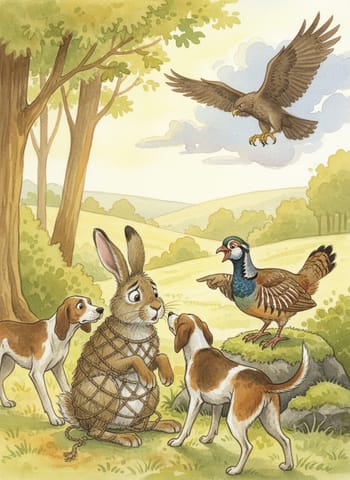
A hare and a partridge were living as fellow-citizens very peacefully in a field, when a pack of hounds making an onset obliged the hare to seek refuge. He rushed into his form and succeeded in putting the hounds at fault. But here the scent from his over-heated body betrayed him. Towler, philosophising, concluded that this scent came from his hare, and with admirable zeal routed him out. Then old Trusty, who never is at fault, proclaimed that the hare was gone away. The poor unfortunate creature at last died in his form.
Una liebre y una perdiz vivían como buenas vecinas, muy tranquilas, en un campo, cuando una jauría, lanzándose al ataque, obligó a la liebre a buscar refugio. Corrió a su madriguera y logró despistar a los perros. Pero allí, el olor de su cuerpo acalorado la delató. Towler, razonando, concluyó que ese olor venía de la liebre y, con admirable empeño, la sacó de su escondite. Entonces el viejo Trusty, que nunca se equivoca, anunció que la liebre había escapado. La pobre e infortunada criatura murió al fin en su madriguera.
The partridge, his companion, thought fit to soothe his last moments with some scoffing remarks upon his fate. "You boasted of being so swift," she said "What has come to your feet, then?"
La perdiz, su compañera, creyó oportuno consolar sus últimos momentos con algunos comentarios burlones sobre su suerte. «Presumías de ser tan veloz», le dijo. «¿Qué les pasó entonces a tus patas?».
But even as she was chuckling her own turn came. Secure in the belief that her wings would save her whatever happened, she did not reckon upon the cruel talons of the hawk.
Pero mientras se reía, le llegó su propio turno. Segura de que sus alas la salvarían pasara lo que pasara, no contó con las crueles garras del halcón.