The Hare and the Partridge
A free B1-level English story for language learners, readable online in 7 languages, with an option to listen via the free Storyteller app.
A partridge mocks her companion hare after hounds catch him — but soon meets her own doom when a hawk attacks her.
That was the preview! Hear the full story in the free Storyteller app. Get the app
Audio isn't available right now.
Never mock at other people's misfortune; for you cannot tell how soon you yourself may be unhappy. Aesop the sage has given us one or two examples of this truth, and I am going to tell you of a similar one now.
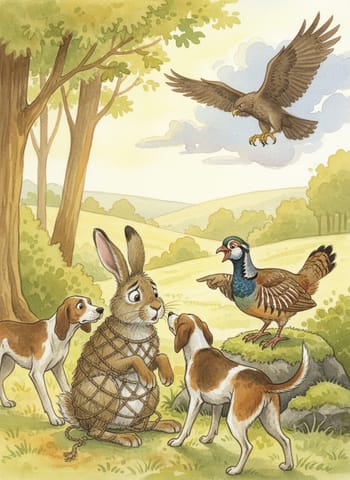
A hare and a partridge were living as fellow-citizens very peacefully in a field, when a pack of hounds making an onset obliged the hare to seek refuge. He rushed into his form and succeeded in putting the hounds at fault. But here the scent from his over-heated body betrayed him. Towler, philosophising, concluded that this scent came from his hare, and with admirable zeal routed him out. Then old Trusty, who never is at fault, proclaimed that the hare was gone away. The poor unfortunate creature at last died in his form.
The partridge, his companion, thought fit to soothe his last moments with some scoffing remarks upon his fate. "You boasted of being so swift," she said "What has come to your feet, then?"
But even as she was chuckling her own turn came. Secure in the belief that her wings would save her whatever happened, she did not reckon upon the cruel talons of the hawk.