The Sagacious Monkey and the Boar
A free B1-level English story for language learners, readable online in 7 languages, with an option to listen via the free Storyteller app.
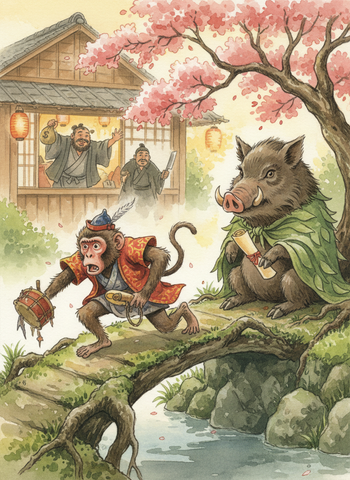
An aging performing monkey overhears his master plotting to sell him to the butcher, so he races to a wise wild boar for a clever plan to save his own life.
Long, long ago, there lived in the province of Shinshin in Japan, a traveling monkey-man, who earned his living by taking round a monkey and showing off the animal’s tricks.
Hace mucho, mucho tiempo, vivía en la provincia de Shinshin, en Japón, un hombre que iba de pueblo en pueblo con un mono, ganándose la vida al exhibir las gracias del animal.
One evening the man came home in a very bad temper and told his wife to send for the butcher the next morning.
Una noche el hombre volvió a casa de muy mal humor y le dijo a su esposa que mandara llamar al carnicero a la mañana siguiente.
The wife was very bewildered and asked her husband:
La esposa quedó muy desconcertada y le preguntó a su marido:
“Why do you wish me to send for the butcher?”
—¿Por qué quieres que mande llamar al carnicero?
“It’s no use taking that monkey round any longer, he’s too old and forgets his tricks. I beat him with my stick all I know how, but he won’t dance properly. I must now sell him to the butcher and make what money out of him I can. There is nothing else to be done.”
—Ya no sirve de nada seguir paseando a ese mono, está demasiado viejo y se olvida de sus trucos. Lo he golpeado con mi vara todo lo que he podido, pero no baila como es debido. Ahora tengo que venderlo al carnicero y sacar de él el dinero que pueda. No hay otra cosa que hacer.
The woman felt very sorry for the poor little animal, and pleaded for her husband to spare the monkey, but her pleading was all in vain, the man was determined to sell him to the butcher.
La mujer sintió una gran lástima por el pobre animalito y suplicó a su marido que perdonara al mono, pero sus ruegos fueron en vano, pues el hombre estaba decidido a venderlo al carnicero.
Now the monkey was in the next room and overheard every word of the conversation. He soon understood that he was to be killed, and he said to himself:
Ahora bien, el mono estaba en el cuarto de al lado y oyó cada palabra de la conversación. Enseguida comprendió que iba a ser sacrificado, y se dijo a sí mismo:
“Barbarous, indeed, is my master! Here I have served him faithfully for years, and instead of allowing me to end my days comfortably and in peace, he is going to let me be cut up by the butcher, and my poor body is to be roasted and stewed and eaten? Woe is me! What am I to do. Ah! a bright thought has struck me! There is, I know, a wild boar living in the forest near by. I have often heard tell of his wisdom. Perhaps if I go to him and tell him the strait I am in he will give me his counsel. I will go and try.”
—¡Qué cruel es en verdad mi amo! Yo lo he servido fielmente durante años, y en vez de dejarme terminar mis días con comodidad y en paz, va a dejar que el carnicero me despedace, y mi pobre cuerpo será asado y guisado y devorado. ¡Ay de mí! ¿Qué voy a hacer? ¡Ah! Se me ha ocurrido una idea brillante. Sé que hay un jabalí salvaje que vive en el bosque cercano. A menudo he oído hablar de su sabiduría. Quizá, si voy a verlo y le cuento el aprieto en que me encuentro, me dé su consejo. Iré a intentarlo.
There was no time to lose. The monkey slipped out of the house and ran as quickly as he could to the forest to find the boar. The boar was at home, and the monkey began his tale of woe at once.
No había tiempo que perder. El mono se escabulló de la casa y corrió tan rápido como pudo hacia el bosque para buscar al jabalí. El jabalí estaba en casa, y el mono comenzó de inmediato su relato de infortunio.
“Good Mr. Boar, I have heard of your excellent wisdom. I am in great trouble, you alone can help me. I have grown old in the service of my master, and because I cannot dance properly now he intends to sell me to the butcher. What do you advise me to do? I know how clever you are!”
—Buen señor Jabalí, he oído hablar de su excelente sabiduría. Estoy en un gran aprieto, y solo usted puede ayudarme. He envejecido al servicio de mi amo, y como ya no puedo bailar bien, él pretende venderme al carnicero. ¿Qué me aconseja hacer? ¡Sé lo listo que es usted!
The boar was pleased at the flattery and determined to help the monkey. He thought for a little while and then said:
El jabalí, halagado, decidió ayudar al mono. Pensó un momento y luego dijo:
“Hasn’t your master a baby?”
—¿No tiene tu amo un bebé?
“Oh, yes,” said the monkey, “he has one infant son.”
—Ah, sí —dijo el mono—, tiene un hijito pequeño.
“Doesn’t it lie by the door in the morning when your mistress begins the work of the day? Well, I will come round early and when I see my opportunity I will seize the child and run off with it.”
—¿No lo dejan junto a la puerta por las mañanas, cuando tu ama empieza las tareas del día? Bien, yo vendré temprano, y en cuanto vea la oportunidad, agarraré al niño y huiré con él.
“What then?” said the monkey.
—¿Y luego qué? —dijo el mono.
“Why the mother will be in a tremendous scare, and before your master and mistress know what to do, you must run after me and rescue the child and take it home safely to its parents, and you will see that when the butcher comes they won’t have the heart to sell you.”
—Pues la madre se llevará un susto tremendo, y antes de que tu amo y tu ama sepan qué hacer, tú tendrás que correr tras de mí, rescatar al niño y llevarlo sano y salvo de vuelta a sus padres, y verás que cuando venga el carnicero no tendrán corazón para venderte.
The monkey thanked the boar many times and then went home. He did not sleep much that night, as you may imagine, for thinking of the morrow. His life depended on whether the boar’s plan succeeded or not. He was the first up, waiting anxiously for what was to happen. It seemed to him a very long time before his master’s wife began to move about and open the shutters to let in the light of day. Then all happened as the boar had planned. The mother placed her child near the porch as usual while she tidied up the house and got her breakfast ready.
El mono le dio las gracias al jabalí muchas veces y luego volvió a casa. Aquella noche apenas durmió, como podrás imaginar, pensando en el día siguiente. Su vida dependía de que el plan del jabalí tuviera éxito o no. Fue el primero en levantarse, esperando ansioso lo que iba a suceder. Le pareció que pasaba muchísimo tiempo antes de que la esposa de su amo empezara a moverse y abriera los postigos para dejar entrar la luz del día. Entonces todo sucedió tal como el jabalí lo había planeado. La madre colocó a su hijo cerca del porche, como de costumbre, mientras ordenaba la casa y preparaba el desayuno.
The child was crooning happily in the morning sunlight, dabbing on the mats at the play of light and shadow. Suddenly there was a noise in the porch and a loud cry from the child. The mother ran out from the kitchen to the spot, only just in time to see the boar disappearing through the gate with her child in its clutch. She flung out her hands with a loud cry of despair and rushed into the inner room where her husband was still sleeping soundly.
El niño canturreaba feliz bajo la luz de la mañana, dando palmaditas sobre las esteras al juego de luces y sombras. De pronto se oyó un ruido en el porche y un fuerte grito del niño. La madre salió corriendo de la cocina hacia el lugar, justo a tiempo para ver al jabalí desaparecer por la puerta con su hijo entre las fauces. Lanzó las manos al aire con un grito desesperado y corrió hacia la habitación interior, donde su marido aún dormía profundamente.
He sat up slowly and rubbed his eyes, and crossly demanded what his wife was making all that noise about. By the time that the man was alive to what had happened, and they both got outside the gate, the boar had got well away, but they saw the monkey running after the thief as hard as his legs would carry him.
Él se incorporó despacio y se frotó los ojos, y preguntó de mal humor a qué venía tanto alboroto. Para cuando el hombre comprendió lo que había ocurrido y ambos salieron por la puerta, el jabalí ya estaba lejos, pero vieron al mono corriendo tras el ladrón con todas sus fuerzas.
Both the man and wife were moved to admiration at the plucky conduct of the sagacious monkey, and their gratitude knew no bounds when the faithful monkey brought the child safely back to their arms.
Tanto el hombre como su esposa se llenaron de admiración ante la valiente conducta del sagaz mono, y su gratitud no tuvo límites cuando el fiel mono trajo al niño sano y salvo de vuelta a sus brazos.
“There!” said the wife. “This is the animal you want to kill—if the monkey hadn’t been here we should have lost our child forever.”
—¡Ahí lo tienes! —dijo la esposa—. Este es el animal que quieres matar; si el mono no hubiera estado aquí, habríamos perdido a nuestro hijo para siempre.
“You are right, wife, for once,” said the man as he carried the child into the house. “You may send the butcher back when he comes, and now give us all a good breakfast and the monkey too.”
—Tienes razón, esposa, por una vez —dijo el hombre mientras llevaba al niño de vuelta a la casa—. Puedes despedir al carnicero cuando venga, y ahora danos a todos un buen desayuno, y al mono también.
When the butcher arrived he was sent away with an order for some boar’s meat for the evening dinner, and the monkey was petted and lived the rest of his days in peace, nor did his master ever strike him again.
Cuando llegó el carnicero, lo despidieron con un encargo de carne de jabalí para la cena de esa noche, y el mono fue mimado y vivió el resto de sus días en paz, sin que su amo volviera a golpearlo jamás. </content>
