The Gate That Would Not Stay Open
Una historia gratuita en inglés de nivel B2 para estudiantes, para leer en línea en 7 idiomas, con opción de escucharla en la app gratuita Storyteller.
Two teenage rowers try every trick they can think of to stop a boathouse gate from slamming on their boat before practice.
¡Ese fue el avance! Escucha la historia completa en la app gratuita Storyteller. Descargar la app
El audio no está disponible en este momento.
The gate between the boathouse and the river had one job, and it did that job badly. It was supposed to stay open while rowers carried their boats to the water. Instead, it swung shut every time, like a very rude guard.
La puerta entre el cobertizo de botes y el río tenía un solo trabajo, y lo hacía mal. Se suponía que debía quedarse abierta mientras los remeros llevaban sus botes al agua. En cambio, se cerraba siempre de golpe, como un guardia muy grosero.
Koji and Gil had been fighting it for three weeks. Both of them were fifteen, and both had joined the rowing club to get fit. Neither had expected to spend the autumn arguing with a piece of metal.
Koji y Gil llevaban tres semanas peleando con ella. Los dos tenían quince años, y los dos se habían unido al club de remo para ponerse en forma. Ninguno esperaba pasar el otoño discutiendo con un pedazo de metal.
"Five-thirty," Gil said, checking his phone on the Tuesday morning. "Coach comes at six-thirty. If we have the eight on the water by then, he'll say nice things about us."
«Cinco y media», dijo Gil, mirando su teléfono el martes por la mañana. «El entrenador llega a las seis y media. Si tenemos el ocho en el agua para entonces, dirá cosas lindas de nosotros».
"He has never said nice things about anybody," said Koji.
«Nunca ha dicho cosas lindas de nadie», dijo Koji.
"Then it will be historic."
«Entonces será histórico».
The two of them had volunteered to take the racing eight out early, because it sounded like a wonderful idea at nine o'clock at night. The boat was seventeen metres long and weighed as much as a heavy man. In theory, four people could carry it. In practice, two tired teenagers could manage it, but only if nothing got in their way.
Los dos se habían ofrecido para sacar temprano el ocho de competencia, porque a las nueve de la noche había sonado como una idea maravillosa. El bote medía diecisiete metros y pesaba tanto como un hombre corpulento. En teoría, cuatro personas podían cargarlo. En la práctica, dos adolescentes cansados podían arreglárselas, pero solo si nada se les ponía en el camino.
The gate got in their way.
La puerta se les puso en el camino.
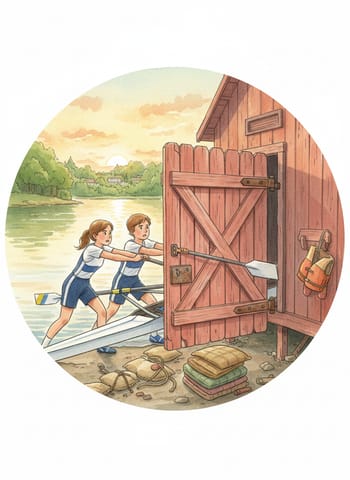
They lifted the boat onto their shoulders and shuffled toward the exit, one step at a time, like two ants carrying a banana. At the doorway, Koji gave the gate a push with his elbow. It swung open with a squeal, and he hurried through. The stern of the boat was halfway out when the gate swung back and slapped it with a loud clang.
Levantaron el bote sobre sus hombros y avanzaron arrastrando los pies hacia la salida, un paso a la vez, como dos hormigas que cargan un plátano. En el umbral, Koji le dio un empujón a la puerta con el codo. Se abrió con un chirrido, y él pasó apurado. La popa del bote estaba a medio salir cuando la puerta se cerró de vuelta y le pegó con un fuerte estruendo.
"Ow!" said Gil, who was holding that end and felt the whole boat shiver.
«¡Ay!», dijo Gil, que sostenía ese extremo y sintió estremecerse todo el bote.
"I'm sorry. It didn't wait."
«Perdón. No esperó».
"It never waits!"
«¡Nunca espera!».
They put the boat down on the grass, rubbed their shoulders, and held a short meeting about the problem. Gil proposed the obvious solution first. He found a brick behind the boathouse and placed it against the bottom of the gate. The gate pushed straight over it, like a bull ignoring a flower.
Dejaron el bote sobre el pasto, se frotaron los hombros y tuvieron una breve reunión sobre el problema. Gil propuso primero la solución obvia. Encontró un ladrillo detrás del cobertizo y lo puso contra la parte baja de la puerta. La puerta lo empujó sin más, como un toro que ignora una flor.
"Right," said Gil. "A bigger brick."
«Bien», dijo Gil. «Un ladrillo más grande».
The next brick was twice the size. The gate dragged it across the concrete with an unpleasant scraping noise, then stopped halfway and thought about its options. A moment later it shut with a small, defeated click.
El siguiente ladrillo era el doble de grande. La puerta lo arrastró por el concreto con un desagradable ruido de raspado, luego se detuvo a medio camino y pensó en sus opciones. Un momento después se cerró con un pequeño clic derrotado.
"It's rolling downhill," Koji said, squinting. "Look. The path slopes toward the water. That's why it always swings in the same direction."
«Rueda cuesta abajo», dijo Koji, entrecerrando los ojos. «Mira. El camino tiene pendiente hacia el agua. Por eso siempre se cierra para el mismo lado».
"So we should tie it."
«Entonces deberíamos atarla».
"To what?"
«¿A qué?».
"To the fence."
«A la cerca».
Gil took the rope from the launch box, a long blue one with a knot at the end. He tied the gate to a post, looping the rope round and round until it looked like the gate was being wrapped as a present. For a moment, it worked beautifully. Then the post leaned, the rope tightened, and the whole fence made a groaning noise that sounded alarmingly like an announcement.
Gil sacó la cuerda de la caja de lanzamiento, una larga azul con un nudo en la punta. Ató la puerta a un poste, enrollando la cuerda vuelta tras vuelta hasta que parecía que la puerta estaba siendo envuelta como un regalo. Por un momento, funcionó de maravilla. Entonces el poste se inclinó, la cuerda se tensó, y toda la cerca soltó un gemido que sonó alarmantemente como un anuncio.
"Let's not do that again," said Koji.
«No volvamos a hacer eso», dijo Koji.
They untied it as quickly as they could. By now it was ten to six. The sky had turned pale, and a few early swans had appeared on the water. The boat lay in the grass like an enormous patient on a hospital bed.
La desataron lo más rápido que pudieron. Para entonces eran las seis menos diez. El cielo se había puesto pálido, y algunos cisnes madrugadores habían aparecido en el agua. El bote yacía en el pasto como un enorme paciente en una cama de hospital.
"New plan," said Gil. "I hold the gate with my foot, and you carry the bow."
«Plan nuevo», dijo Gil. «Yo sostengo la puerta con el pie, y tú cargas la proa».
"And who carries the stern?"
«¿Y quién carga la popa?».
"The boat can walk."
«El bote puede caminar».
The boat did not walk. Instead, Gil balanced on one leg with his other foot pressed against the gate, while Koji lifted the bow alone and staggered forward. For about two metres the plan went well. Then the stern dropped, Gil hopped, and the gate escaped. The boat landed on the grass with a gentle thump. Gil landed beside it with a not-so-gentle one.
El bote no caminó. En cambio, Gil se equilibró en una pierna con el otro pie apoyado contra la puerta, mientras Koji levantaba la proa solo y avanzaba tambaleándose. Durante unos dos metros el plan salió bien. Entonces la popa cayó, Gil dio un salto, y la puerta se escapó. El bote aterrizó en el pasto con un golpe suave. Gil aterrizó a su lado con uno no tan suave.
"I think," he said, lying on his back, "that the gate is winning."
«Creo», dijo, tendido de espaldas, «que la puerta está ganando».
"It's not winning. It's just persistent."
«No está ganando. Es solo persistente».
"That's what winning is."
«Eso es lo que es ganar».
Koji sat down on the grass next to him and looked at the gate for a long moment. It stood there, innocent and a little smug, its paint peeling in the early light. He noticed something he had missed on all the other mornings. The top hinge was fixed to the post with a long bolt. The bottom one sat slightly crooked, a few millimetres lower than it should have been.
Koji se sentó en el pasto junto a él y miró la puerta un largo momento. Estaba ahí, inocente y algo engreída, con la pintura descascarada bajo la luz temprana. Notó algo que se le había pasado todas las demás mañanas. La bisagra de arriba estaba fija al poste con un perno largo. La de abajo estaba un poco torcida, unos milímetros más baja de lo que debería.
"Gil," he said. "How many of those flat washers do we have in the oar box?"
«Gil», dijo. «¿Cuántas de esas arandelas planas tenemos en la caja de los remos?».
"Hundreds. Why?"
«Cientos. ¿Por qué?».
"Because the gate isn't swinging because of the slope. It's swinging because the post leans a bit. If the bottom hinge sat higher, the gate would tilt the other way." Koji drew a quick sketch in the dirt with a stick. "Like a door that wants to open instead of close."
«Porque la puerta no se cierra por la pendiente. Se cierra porque el poste está un poco inclinado. Si la bisagra de abajo estuviera más alta, la puerta se inclinaría hacia el otro lado». Koji hizo un rápido dibujo en la tierra con un palo. «Como una puerta que quiere abrirse en vez de cerrarse».
Gil sat up. For the first time that morning, he looked at the gate with respect.
Gil se incorporó. Por primera vez esa mañana, miró la puerta con respeto.
"That's either genius," he said, "or the stupidest thing you've ever said."
«Eso es o genial», dijo, «o lo más estúpido que has dicho».
"Let's find out."
«Averigüémoslo».
They worked in silence for ten minutes. Gil lifted the gate while Koji loosened the bottom bolt. He slid three metal washers over it and tightened it again with the spanner from the toolbox. The gate sat a little differently on its hinges, a little prouder. Koji took a deep breath, gave it a gentle shove, and stepped back.
Trabajaron en silencio durante diez minutos. Gil levantó la puerta mientras Koji aflojaba el perno de abajo. Deslizó tres arandelas de metal sobre él y lo volvió a apretar con la llave de la caja de herramientas. La puerta quedó algo distinta sobre sus bisagras, un poco más orgullosa. Koji respiró hondo, le dio un suave empujón y retrocedió.
It swung open.
Se abrió.
It kept swinging, all the way to the fence, slowly and politely, and then it stopped. It did not slam, and it did not move. It simply stayed there, wide and welcoming, exactly where a gate should be.
Siguió abriéndose, hasta llegar a la cerca, despacio y con cortesía, y luego se detuvo. No se cerró de golpe, y no se movió. Simplemente se quedó ahí, ancha y acogedora, exactamente donde debe estar una puerta.
"Oh," said Gil quietly.
«Oh», dijo Gil en voz baja.
"Yes."
«Sí».
"It's open."
«Está abierta».
"I can see that."
«Ya lo veo».
They looked at each other and then both began to laugh, so hard that Gil had to hold onto the boat. After that the job was almost easy. They carried the eight through the open gate without a single clang. They lowered it into the river and stood on the dock with their hands on their hips like proud parents.
Se miraron y luego los dos empezaron a reírse, tan fuerte que Gil tuvo que agarrarse del bote. Después de eso el trabajo fue casi fácil. Llevaron el ocho por la puerta abierta sin un solo estruendo. Lo bajaron al río y se quedaron en el muelle con las manos en la cintura como padres orgullosos.
At exactly six-thirty, Coach Brandt arrived. He walked down the path with a clipboard, stopped in front of the gate, and studied it for several seconds. He looked at the washers, then at the boat on the water, and finally at the two boys.
A las seis y media en punto, llegó el entrenador Brandt. Bajó por el camino con una tablilla, se detuvo frente a la puerta y la estudió durante varios segundos. Miró las arandelas, luego el bote en el agua, y por último a los dos chicos.
"Who fixed the gate?"
«¿Quién arregló la puerta?».
"Koji did," said Gil.
«Koji», dijo Gil.
"Gil held it," said Koji.
«Gil la sostuvo», dijo Koji.
The coach said nothing. He gave the gate a small push with one finger, as though he did not trust it. It swung open and stayed open. Then, very slowly, he reached out, pulled it shut, and let go. The gate drifted open again, all by itself, and Coach Brandt very nearly smiled.
El entrenador no dijo nada. Le dio a la puerta un pequeño empujón con un dedo, como si no confiara en ella. Se abrió y se quedó abierta. Luego, muy despacio, estiró la mano, la cerró y la soltó. La puerta se fue abriendo otra vez, sola, y el entrenador Brandt casi sonrió.