The gate between the boathouse and the river had one job, and it did that job badly. It was supposed to stay open while rowers carried their boats to the water. Instead, it swung shut every time, like a very rude guard.
船屋和河之间的那扇门只有一项任务,却干得很糟。它本该在划手们把船抬向水边时保持敞开,可每一次它都会荡回来关上,像个非常无礼的守卫。
Koji and Gil had been fighting it for three weeks. Both of them were fifteen, and both had joined the rowing club to get fit. Neither had expected to spend the autumn arguing with a piece of metal.
浩二和吉尔已经跟它较了三个星期的劲。两人都十五岁,加入划船俱乐部都是为了锻炼身体。谁也没想到,这个秋天竟要用来跟一块金属争吵。
"Five-thirty," Gil said, checking his phone on the Tuesday morning. "Coach comes at six-thirty. If we have the eight on the water by then, he'll say nice things about us."
“五点半,”星期二早上,吉尔看着手机说,“教练六点半才来。要是在那之前我们把八人艇下了水,他会说我们好话的。”
"He has never said nice things about anybody," said Koji.
“他从来没说过谁的好话,”浩二说。
"Then it will be historic."
“那这次就是历史性的了。”
The two of them had volunteered to take the racing eight out early, because it sounded like a wonderful idea at nine o'clock at night. The boat was seventeen metres long and weighed as much as a heavy man. In theory, four people could carry it. In practice, two tired teenagers could manage it, but only if nothing got in their way.
两人自告奋勇要早早把竞赛用的八人艇划出去,因为晚上九点钟的时候这听上去是个绝妙的主意。那条船长十七米,重得像一个大块头男人。理论上,四个人才能抬动。实际上,两个疲惫的少年也能勉强抬动,前提是半路上什么也别挡着他们。
The gate got in their way.
那扇门偏偏挡在了他们面前。
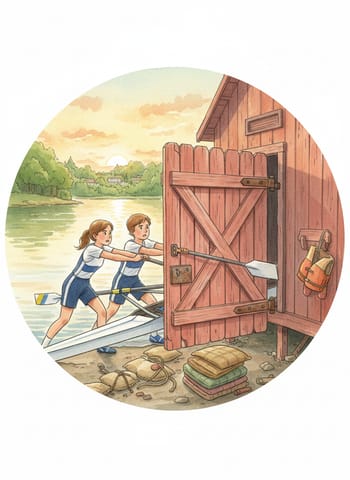
They lifted the boat onto their shoulders and shuffled toward the exit, one step at a time, like two ants carrying a banana. At the doorway, Koji gave the gate a push with his elbow. It swung open with a squeal, and he hurried through. The stern of the boat was halfway out when the gate swung back and slapped it with a loud clang.
他们把船扛到肩上,一步一步地往出口挪,活像两只扛着香蕉的蚂蚁。到门口时,浩二用胳膊肘推了一下门。门吱呀一声荡开,他赶紧挤了过去。船尾刚出去一半,门又荡了回来,哐当一声重重拍在船上。
"Ow!" said Gil, who was holding that end and felt the whole boat shiver.
“哎哟!”吉尔叫道,他扛着那一头,感觉整条船都在颤抖。
"I'm sorry. It didn't wait."
“对不起。它没等我们。”
"It never waits!"
“它从来不等!”
They put the boat down on the grass, rubbed their shoulders, and held a short meeting about the problem. Gil proposed the obvious solution first. He found a brick behind the boathouse and placed it against the bottom of the gate. The gate pushed straight over it, like a bull ignoring a flower.
他们把船放在草地上,揉了揉肩膀,针对这个问题开了个简短的会。吉尔先提出了最显而易见的办法。他在船屋后面找到一块砖头,抵在门底下。门径直从砖头上推了过去,像一头对花视而不见的公牛。
"Right," said Gil. "A bigger brick."
“好,”吉尔说,“换块大点的砖。”
The next brick was twice the size. The gate dragged it across the concrete with an unpleasant scraping noise, then stopped halfway and thought about its options. A moment later it shut with a small, defeated click.
下一块砖头大了一倍。门拖着它在水泥地上划过,发出刺耳的摩擦声,接着停在半路,像是在掂量自己的选择。过了一会儿,它轻轻“咔嗒”一声,败下阵来似的关上了。
"It's rolling downhill," Koji said, squinting. "Look. The path slopes toward the water. That's why it always swings in the same direction."
“它是在往下滚,”浩二眯起眼睛说,“你看。小路是朝着水边倾斜的。所以它总是朝同一个方向荡。”
"So we should tie it."
“那我们应该把它拴住。”
"To what?"
“拴在什么上?”
"To the fence."
“栅栏上。”
Gil took the rope from the launch box, a long blue one with a knot at the end. He tied the gate to a post, looping the rope round and round until it looked like the gate was being wrapped as a present. For a moment, it worked beautifully. Then the post leaned, the rope tightened, and the whole fence made a groaning noise that sounded alarmingly like an announcement.
吉尔从下水箱里拿出绳子,一根末端打了结的蓝色长绳。他把门拴在一根立柱上,一圈又一圈地缠,缠得那扇门像被包成了一份礼物。有那么一会儿,效果好极了。然后立柱歪了,绳子绷紧,整道栅栏发出呻吟般的声响,听上去简直像是一则通知。
"Let's not do that again," said Koji.
“咱们别再这么干了,”浩二说。
They untied it as quickly as they could. By now it was ten to six. The sky had turned pale, and a few early swans had appeared on the water. The boat lay in the grass like an enormous patient on a hospital bed.
他们以最快的速度把绳子解开。这时已经五点五十了。天空变得苍白,几只早起的天鹅出现在水面上。那条船躺在草地上,像一位巨大的病人躺在病床上。
"New plan," said Gil. "I hold the gate with my foot, and you carry the bow."
“新计划,”吉尔说,“我用脚顶着门,你抬船头。”
"And who carries the stern?"
“那谁抬船尾?”
"The boat can walk."
“船可以自己走。”
The boat did not walk. Instead, Gil balanced on one leg with his other foot pressed against the gate, while Koji lifted the bow alone and staggered forward. For about two metres the plan went well. Then the stern dropped, Gil hopped, and the gate escaped. The boat landed on the grass with a gentle thump. Gil landed beside it with a not-so-gentle one.
船没有自己走。结果是吉尔单腿站着,另一只脚抵在门上,浩二一个人抬起船头,踉踉跄跄地往前走。大约两米之内,计划进行得很顺利。然后船尾掉了下去,吉尔蹦了一下,门逃脱了。船轻轻“咚”的一声落在草地上。吉尔落在它旁边,那一声可就不那么轻了。
"I think," he said, lying on his back, "that the gate is winning."
“我觉得,”他仰面躺着说,“这扇门赢了。”
"It's not winning. It's just persistent."
“它没赢。它只是很顽强。”
"That's what winning is."
“那就是赢。”
Koji sat down on the grass next to him and looked at the gate for a long moment. It stood there, innocent and a little smug, its paint peeling in the early light. He noticed something he had missed on all the other mornings. The top hinge was fixed to the post with a long bolt. The bottom one sat slightly crooked, a few millimetres lower than it should have been.
浩二在他身旁的草地上坐下,久久地望着那扇门。它就站在那里,一脸无辜,又带着点得意,油漆在晨光里剥落。他注意到了一件之前每个早晨都没看到的事。上面的合页用一根长螺栓固定在立柱上。下面那个却有一点歪,比应有的位置低了几毫米。
"Gil," he said. "How many of those flat washers do we have in the oar box?"
“吉尔,”他说,“桨箱里有多少个平垫圈?”
"Hundreds. Why?"
“几百个。怎么了?”
"Because the gate isn't swinging because of the slope. It's swinging because the post leans a bit. If the bottom hinge sat higher, the gate would tilt the other way." Koji drew a quick sketch in the dirt with a stick. "Like a door that wants to open instead of close."
“因为这扇门不是因为斜坡才荡的,而是因为立柱有一点歪。要是下面的合页高一点,门就会朝另一边倾斜。”浩二拿一根树枝在泥地上飞快地画了张草图。“就像一扇想开不想关的门。”
Gil sat up. For the first time that morning, he looked at the gate with respect.
吉尔坐了起来。那天早上,他头一回带着敬意看着这扇门。
"That's either genius," he said, "or the stupidest thing you've ever said."
“这要么是天才之举,”他说,“要么是你说过的最蠢的话。”
"Let's find out."
“试试就知道。”
They worked in silence for ten minutes. Gil lifted the gate while Koji loosened the bottom bolt. He slid three metal washers over it and tightened it again with the spanner from the toolbox. The gate sat a little differently on its hinges, a little prouder. Koji took a deep breath, gave it a gentle shove, and stepped back.
他们默默干了十分钟。吉尔托着门,浩二拧松下面的螺栓。他往上面套了三个金属垫圈,再用工具箱里的扳手拧紧。门在合页上的姿态有了一点不同,显得更挺拔了些。浩二深吸一口气,轻轻推了它一下,退后一步。
It swung open.
它荡开了。
It kept swinging, all the way to the fence, slowly and politely, and then it stopped. It did not slam, and it did not move. It simply stayed there, wide and welcoming, exactly where a gate should be.
它一直荡,一路荡到栅栏边,缓慢而有礼貌,然后停住了。它没有砰地关上,也没有动。它就那样待在那里,敞得大大的,一副欢迎的样子,正是一扇门该在的地方。
"Oh," said Gil quietly.
“哦,”吉尔轻声说。
"Yes."
“嗯。”
"It's open."
“它开着。”
"I can see that."
“我看见了。”
They looked at each other and then both began to laugh, so hard that Gil had to hold onto the boat. After that the job was almost easy. They carried the eight through the open gate without a single clang. They lowered it into the river and stood on the dock with their hands on their hips like proud parents.
他们互相看了看,然后同时大笑起来,笑得吉尔不得不扶住那条船。从那以后,活儿几乎轻而易举。他们抬着八人艇穿过敞开的大门,没有发出一声哐当。他们把船放进河里,叉着腰站在码头上,像两位骄傲的家长。
At exactly six-thirty, Coach Brandt arrived. He walked down the path with a clipboard, stopped in front of the gate, and studied it for several seconds. He looked at the washers, then at the boat on the water, and finally at the two boys.
六点半整,布兰特教练到了。他拿着记事板沿小路走来,在门前停下,端详了几秒钟。他看看垫圈,看看水上的船,最后看看这两个男孩。
"Who fixed the gate?"
“谁修的门?”
"Koji did," said Gil.
“浩二修的,”吉尔说。
"Gil held it," said Koji.
“吉尔扶着的,”浩二说。
The coach said nothing. He gave the gate a small push with one finger, as though he did not trust it. It swung open and stayed open. Then, very slowly, he reached out, pulled it shut, and let go. The gate drifted open again, all by itself, and Coach Brandt very nearly smiled.
教练什么也没说。他用一根手指轻轻推了推门,仿佛不太信任它。门荡开了,一直敞着。接着,他非常缓慢地伸手把门拉上,松开了手。门又自己飘开了,布兰特教练差点就笑了。