The Gate That Would Not Stay Open
A free B2-level English story for language learners, readable online in 7 languages, with an option to listen via the free Storyteller app.
Two teenage rowers try every trick they can think of to stop a boathouse gate from slamming on their boat before practice.
That was the preview! Hear the full story in the free Storyteller app. Get the app
Audio isn't available right now.
The gate between the boathouse and the river had one job, and it did that job badly. It was supposed to stay open while rowers carried their boats to the water. Instead, it swung shut every time, like a very rude guard.
Koji and Gil had been fighting it for three weeks. Both of them were fifteen, and both had joined the rowing club to get fit. Neither had expected to spend the autumn arguing with a piece of metal.
"Five-thirty," Gil said, checking his phone on the Tuesday morning. "Coach comes at six-thirty. If we have the eight on the water by then, he'll say nice things about us."
"He has never said nice things about anybody," said Koji.
"Then it will be historic."
The two of them had volunteered to take the racing eight out early, because it sounded like a wonderful idea at nine o'clock at night. The boat was seventeen metres long and weighed as much as a heavy man. In theory, four people could carry it. In practice, two tired teenagers could manage it, but only if nothing got in their way.
The gate got in their way.
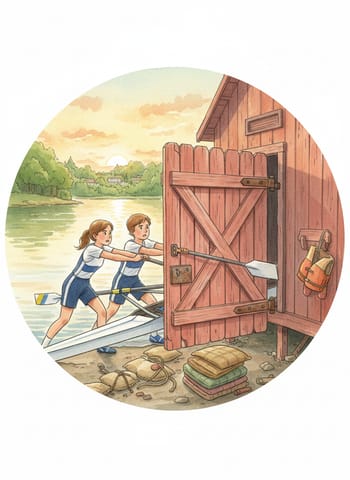
They lifted the boat onto their shoulders and shuffled toward the exit, one step at a time, like two ants carrying a banana. At the doorway, Koji gave the gate a push with his elbow. It swung open with a squeal, and he hurried through. The stern of the boat was halfway out when the gate swung back and slapped it with a loud clang.
"Ow!" said Gil, who was holding that end and felt the whole boat shiver.
"I'm sorry. It didn't wait."
"It never waits!"
They put the boat down on the grass, rubbed their shoulders, and held a short meeting about the problem. Gil proposed the obvious solution first. He found a brick behind the boathouse and placed it against the bottom of the gate. The gate pushed straight over it, like a bull ignoring a flower.
"Right," said Gil. "A bigger brick."
The next brick was twice the size. The gate dragged it across the concrete with an unpleasant scraping noise, then stopped halfway and thought about its options. A moment later it shut with a small, defeated click.
"It's rolling downhill," Koji said, squinting. "Look. The path slopes toward the water. That's why it always swings in the same direction."
"So we should tie it."
"To what?"
"To the fence."
Gil took the rope from the launch box, a long blue one with a knot at the end. He tied the gate to a post, looping the rope round and round until it looked like the gate was being wrapped as a present. For a moment, it worked beautifully. Then the post leaned, the rope tightened, and the whole fence made a groaning noise that sounded alarmingly like an announcement.
"Let's not do that again," said Koji.
They untied it as quickly as they could. By now it was ten to six. The sky had turned pale, and a few early swans had appeared on the water. The boat lay in the grass like an enormous patient on a hospital bed.
"New plan," said Gil. "I hold the gate with my foot, and you carry the bow."
"And who carries the stern?"
"The boat can walk."
The boat did not walk. Instead, Gil balanced on one leg with his other foot pressed against the gate, while Koji lifted the bow alone and staggered forward. For about two metres the plan went well. Then the stern dropped, Gil hopped, and the gate escaped. The boat landed on the grass with a gentle thump. Gil landed beside it with a not-so-gentle one.
"I think," he said, lying on his back, "that the gate is winning."
"It's not winning. It's just persistent."
"That's what winning is."
Koji sat down on the grass next to him and looked at the gate for a long moment. It stood there, innocent and a little smug, its paint peeling in the early light. He noticed something he had missed on all the other mornings. The top hinge was fixed to the post with a long bolt. The bottom one sat slightly crooked, a few millimetres lower than it should have been.
"Gil," he said. "How many of those flat washers do we have in the oar box?"
"Hundreds. Why?"
"Because the gate isn't swinging because of the slope. It's swinging because the post leans a bit. If the bottom hinge sat higher, the gate would tilt the other way." Koji drew a quick sketch in the dirt with a stick. "Like a door that wants to open instead of close."
Gil sat up. For the first time that morning, he looked at the gate with respect.
"That's either genius," he said, "or the stupidest thing you've ever said."
"Let's find out."
They worked in silence for ten minutes. Gil lifted the gate while Koji loosened the bottom bolt. He slid three metal washers over it and tightened it again with the spanner from the toolbox. The gate sat a little differently on its hinges, a little prouder. Koji took a deep breath, gave it a gentle shove, and stepped back.
It swung open.
It kept swinging, all the way to the fence, slowly and politely, and then it stopped. It did not slam, and it did not move. It simply stayed there, wide and welcoming, exactly where a gate should be.
"Oh," said Gil quietly.
"Yes."
"It's open."
"I can see that."
They looked at each other and then both began to laugh, so hard that Gil had to hold onto the boat. After that the job was almost easy. They carried the eight through the open gate without a single clang. They lowered it into the river and stood on the dock with their hands on their hips like proud parents.
At exactly six-thirty, Coach Brandt arrived. He walked down the path with a clipboard, stopped in front of the gate, and studied it for several seconds. He looked at the washers, then at the boat on the water, and finally at the two boys.
"Who fixed the gate?"
"Koji did," said Gil.
"Gil held it," said Koji.
The coach said nothing. He gave the gate a small push with one finger, as though he did not trust it. It swung open and stayed open. Then, very slowly, he reached out, pulled it shut, and let go. The gate drifted open again, all by itself, and Coach Brandt very nearly smiled.