The Golden Brush and the Double Claim
A free B2-level English story for language learners, readable online in 7 languages, with an option to listen via the free Storyteller app.
Two identical apprentices both claim the honour of painting a launch boat, until a boy selling lemonade asks what the prize really is.
That was the preview! Hear the full story in the free Storyteller app. Get the app
Audio isn't available right now.
The small shipyard at the end of the harbour has three slipways, one crane and a tradition that is older than the crane. On the day a new boat is launched, someone is given the Golden Brush. It is an ordinary paintbrush that was dipped in brass a long time ago. It sits on a velvet cushion in a glass case like a crown jewel.
This year the launch boat is a blue-and-white fishing cutter, and it looks beautiful. Every plank gleams. The name on the bow was painted with such care that visitors lean over to touch the letters to check they are real. The whole yard stands on the concrete with their arms folded, waiting for the manager to announce who painted it.
There is only one problem. Two people step forward at the same moment.
"It was me," says Gabi.
"It was me," says Adel.
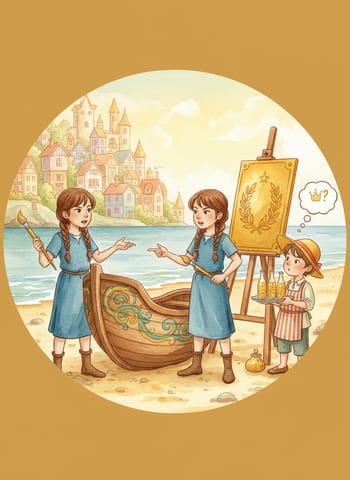
They are seventeen, they are the yard's only apprentices, and they are identical twins. They have the same dark curls and the same chipped front tooth. They even wipe their hands on the left leg of their overalls. For two years the manager has been calling them "you" when he needs them, because it saves him a lot of mistakes.
"That is impossible," the manager says, rubbing his forehead. "Only one of you painted it."
"Exactly," says Gabi. "And it was me."
"Exactly," says Adel. "And I am the one who did it."
The manager looks at the harbourmaster, who has come to hand over the prize. The harbourmaster looks at the cutter. Nobody looks at the twins' faces for long, because it is a little like looking into a mirror that has learned to argue.
"Let us settle this fairly," says the harbourmaster. "Each of you will explain exactly what you did."
Gabi goes first. He says he was up at five every morning for two weeks. He says he sanded the hull three times, mixed the paint himself and painted the lettering with a brush as thin as an eyelash. He says his shoulders still ache from the work, and he demonstrates, with a long groan.
Adel waits politely. Then he says he was up at five every morning for two weeks. He sanded the hull three times, mixed the paint himself and painted the lettering with a brush as thin as an eyelash. His shoulders ache as well. He groans for slightly longer than Gabi, to be safe.
"This is exactly what I said," says Gabi.
"I am afraid I said it first," says Adel.
"You said it second."
"I said it at the same time, which means first."
The harbourmaster takes a notebook out of his pocket and writes something, and then he crosses it out.
The investigation grows. The manager examines the lettering for a signature and finds none. The crane driver is called as a witness, but he admits he never looks at anything lower than his own cabin window. A retired shipwright suggests a test: each twin must paint the letter G on a spare board, and the judges will compare the handwriting. Both twins paint a perfect G. They look so similar that the shipwright leans back and says a word the harbourmaster pretends not to hear.
By midday a small crowd has gathered. Someone brings out folding chairs. A child sells lemonade from a wheelbarrow. The twins stand side by side in front of the cutter, still insisting, still identical, and still absolutely certain.
"If you had painted it," Gabi says to Adel, "you would know that the name on the bow is slightly crooked."
"It is not crooked," says Adel. "It is italic. And I know that, because I made it italic."
"You see? He admits it was done on purpose. That means he is the clever one, and I did all the hard work."
"That is not what I meant."
"It is what you said."
The argument is going to last until dinner, and everyone knows it. The harbourmaster has checked his watch twice. The manager has gone pale. Even the seagulls on the roof of the shed seem bored.
Then a small voice speaks from the back of the crowd.
"Excuse me," says the boy who sells the lemonade. "What does the winner actually get?"
The yard goes quiet.
It is a strange kind of quiet. It falls when a roomful of people all realise they should have asked something an hour ago. The twins turn around slowly. The manager opens his mouth and closes it again. The harbourmaster looks at the velvet cushion and then at the notebook in his hand.
"Well," he says, "the Golden Brush, of course."
"Sure, but what does that mean?" the boy asks. "Does the winner get money? A holiday? A medal?"
"Nobody has ever asked me that," the harbourmaster says honestly. He turns the page of his notebook, then another, then a third. His eyebrows slowly rise. "Ah."
"What is it?" says the manager.
"It says here that the holder of the Golden Brush is responsible for the yard's winter job." He reads the line again, as if hoping it will change. "Every year, from the first frost until the thaw, the holder must scrape and repaint the hull of the old harbour ferry. By hand. Alone. All forty metres of it."
Nobody says a word. A gull lands on the crane and then thinks better of it.
Gabi is the first to move. He takes one careful step backwards, away from the glass case, away from the cushion, and away from the cutter.
"Of course," he says, in a voice full of sudden generosity. "If it is going to make Adel so happy, I suppose I could let him have it."
"No, no, no," Adel says, holding up both hands. "You worked so hard. I could never take something that belongs to you."
"I insist."
"I insist more."
"You painted the lettering."
"I only painted the lettering because you told me to!"
"So you admit it!" says Gabi.
"I admit nothing!" says Adel.
The manager takes the Golden Brush from the cushion, walks across the concrete, and presses it gently into the hands of the nearest twin. Then he steps back and points a finger at the other one.
"Since you both painted it, and neither of you wants the prize, you will both scrape the ferry. Starting at six tomorrow. And please try to be different, just once, so that I can tell who is late."