The Golden Brush and the Double Claim
Una historia gratuita en inglés de nivel B2 para estudiantes, para leer en línea en 7 idiomas, con opción de escucharla en la app gratuita Storyteller.
Two identical apprentices both claim the honour of painting a launch boat, until a boy selling lemonade asks what the prize really is.
¡Ese fue el avance! Escucha la historia completa en la app gratuita Storyteller. Descargar la app
El audio no está disponible en este momento.
The small shipyard at the end of the harbour has three slipways, one crane and a tradition that is older than the crane. On the day a new boat is launched, someone is given the Golden Brush. It is an ordinary paintbrush that was dipped in brass a long time ago. It sits on a velvet cushion in a glass case like a crown jewel.
El pequeño astillero al final del puerto tiene tres gradas de botadura, una grúa y una tradición más antigua que la grúa. El día en que se bota un barco nuevo, alguien recibe el Pincel Dorado. Es un pincel común que fue bañado en latón hace mucho tiempo. Descansa sobre un cojín de terciopelo en una vitrina de vidrio como una joya de la corona.
This year the launch boat is a blue-and-white fishing cutter, and it looks beautiful. Every plank gleams. The name on the bow was painted with such care that visitors lean over to touch the letters to check they are real. The whole yard stands on the concrete with their arms folded, waiting for the manager to announce who painted it.
Este año el barco de la botadura es un cúter de pesca azul y blanco, y se ve hermoso. Cada tabla reluce. El nombre en la proa fue pintado con tanto cuidado que los visitantes se inclinan para tocar las letras y comprobar que son de verdad. Todo el astillero espera sobre el concreto con los brazos cruzados a que el gerente anuncie quién lo pintó.
There is only one problem. Two people step forward at the same moment.
Hay un solo problema. Dos personas dan un paso al frente al mismo tiempo.
"It was me," says Gabi.
«Fui yo», dice Gabi.
"It was me," says Adel.
«Fui yo», dice Adel.
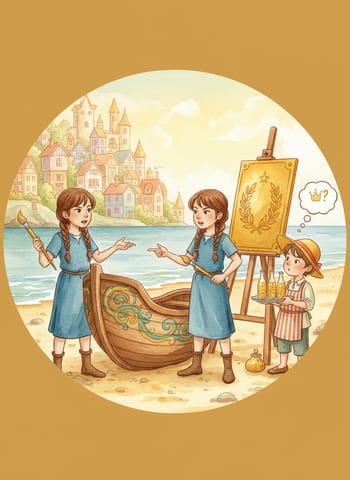
They are seventeen, they are the yard's only apprentices, and they are identical twins. They have the same dark curls and the same chipped front tooth. They even wipe their hands on the left leg of their overalls. For two years the manager has been calling them "you" when he needs them, because it saves him a lot of mistakes.
Tienen diecisiete años, son los únicos aprendices del astillero y son gemelos idénticos. Tienen los mismos rizos oscuros y el mismo diente delantero astillado. Incluso se limpian las manos en la pierna izquierda del overol. Durante dos años el gerente los ha llamado «tú» cuando los necesita, porque así se ahorra muchos errores.
"That is impossible," the manager says, rubbing his forehead. "Only one of you painted it."
«Eso es imposible», dice el gerente, frotándose la frente. «Solo uno de ustedes lo pintó».
"Exactly," says Gabi. "And it was me."
«Exacto», dice Gabi. «Y fui yo».
"Exactly," says Adel. "And I am the one who did it."
«Exacto», dice Adel. «Y yo soy el que lo hizo».
The manager looks at the harbourmaster, who has come to hand over the prize. The harbourmaster looks at the cutter. Nobody looks at the twins' faces for long, because it is a little like looking into a mirror that has learned to argue.
El gerente mira al capitán del puerto, que ha venido a entregar el premio. El capitán del puerto mira el cúter. Nadie mira por mucho tiempo las caras de los gemelos, porque es un poco como mirar un espejo que ha aprendido a discutir.
"Let us settle this fairly," says the harbourmaster. "Each of you will explain exactly what you did."
«Resolvamos esto con justicia», dice el capitán del puerto. «Cada uno explicará exactamente lo que hizo».
Gabi goes first. He says he was up at five every morning for two weeks. He says he sanded the hull three times, mixed the paint himself and painted the lettering with a brush as thin as an eyelash. He says his shoulders still ache from the work, and he demonstrates, with a long groan.
Gabi va primero. Dice que se levantó a las cinco todas las mañanas durante dos semanas. Dice que lijó el casco tres veces, mezcló la pintura él mismo y pintó las letras con un pincel fino como una pestaña. Dice que todavía le duelen los hombros del trabajo, y lo demuestra, con un largo gemido.
Adel waits politely. Then he says he was up at five every morning for two weeks. He sanded the hull three times, mixed the paint himself and painted the lettering with a brush as thin as an eyelash. His shoulders ache as well. He groans for slightly longer than Gabi, to be safe.
Adel espera con cortesía. Luego dice que se levantó a las cinco todas las mañanas durante dos semanas. Lijó el casco tres veces, mezcló la pintura él mismo y pintó las letras con un pincel fino como una pestaña. A él también le duelen los hombros. Gime un poco más largo que Gabi, por si acaso.
"This is exactly what I said," says Gabi.
«Esto es exactamente lo que dije yo», dice Gabi.
"I am afraid I said it first," says Adel.
«Me temo que lo dije yo primero», dice Adel.
"You said it second."
«Lo dijiste segundo».
"I said it at the same time, which means first."
«Lo dije al mismo tiempo, lo que significa que primero».
The harbourmaster takes a notebook out of his pocket and writes something, and then he crosses it out.
El capitán del puerto saca una libreta del bolsillo y escribe algo, y luego lo tacha.
The investigation grows. The manager examines the lettering for a signature and finds none. The crane driver is called as a witness, but he admits he never looks at anything lower than his own cabin window. A retired shipwright suggests a test: each twin must paint the letter G on a spare board, and the judges will compare the handwriting. Both twins paint a perfect G. They look so similar that the shipwright leans back and says a word the harbourmaster pretends not to hear.
La investigación crece. El gerente examina las letras en busca de una firma y no encuentra ninguna. Llaman al operador de la grúa como testigo, pero admite que nunca mira nada más abajo que la ventana de su cabina. Un carpintero de ribera jubilado sugiere una prueba: cada gemelo debe pintar la letra G en una tabla de repuesto, y los jueces compararán la caligrafía. Los dos gemelos pintan una G perfecta. Se parecen tanto que el carpintero se echa hacia atrás y dice una palabra que el capitán del puerto finge no oír.
By midday a small crowd has gathered. Someone brings out folding chairs. A child sells lemonade from a wheelbarrow. The twins stand side by side in front of the cutter, still insisting, still identical, and still absolutely certain.
Para el mediodía se ha reunido una pequeña multitud. Alguien saca sillas plegables. Un niño vende limonada desde una carretilla. Los gemelos están de pie lado a lado frente al cúter, todavía insistiendo, todavía idénticos y todavía absolutamente seguros.
"If you had painted it," Gabi says to Adel, "you would know that the name on the bow is slightly crooked."
«Si tú lo hubieras pintado», le dice Gabi a Adel, «sabrías que el nombre de la proa está ligeramente torcido».
"It is not crooked," says Adel. "It is italic. And I know that, because I made it italic."
«No está torcido», dice Adel. «Es cursiva. Y lo sé, porque yo la hice cursiva».
"You see? He admits it was done on purpose. That means he is the clever one, and I did all the hard work."
«¿Ves? Admite que lo hizo a propósito. Eso significa que él es el listo, y yo hice todo el trabajo duro».
"That is not what I meant."
«No es lo que quise decir».
"It is what you said."
«Es lo que dijiste».
The argument is going to last until dinner, and everyone knows it. The harbourmaster has checked his watch twice. The manager has gone pale. Even the seagulls on the roof of the shed seem bored.
La discusión va a durar hasta la cena, y todos lo saben. El capitán del puerto ha mirado su reloj dos veces. El gerente se ha puesto pálido. Hasta las gaviotas en el techo del cobertizo parecen aburridas.
Then a small voice speaks from the back of the crowd.
Entonces una vocecita habla desde el fondo de la multitud.
"Excuse me," says the boy who sells the lemonade. "What does the winner actually get?"
«Disculpen», dice el niño que vende la limonada. «¿Qué es lo que gana el ganador, en realidad?».
The yard goes quiet.
El astillero se queda en silencio.
It is a strange kind of quiet. It falls when a roomful of people all realise they should have asked something an hour ago. The twins turn around slowly. The manager opens his mouth and closes it again. The harbourmaster looks at the velvet cushion and then at the notebook in his hand.
Es un silencio extraño. Cae cuando una sala llena de gente se da cuenta a la vez de que debió haber preguntado algo hace una hora. Los gemelos se dan vuelta lentamente. El gerente abre la boca y la cierra otra vez. El capitán del puerto mira el cojín de terciopelo y luego la libreta que tiene en la mano.
"Well," he says, "the Golden Brush, of course."
«Bueno», dice, «el Pincel Dorado, por supuesto».
"Sure, but what does that mean?" the boy asks. "Does the winner get money? A holiday? A medal?"
«Claro, pero ¿qué significa eso?», pregunta el niño. «¿El ganador recibe dinero? ¿Unas vacaciones? ¿Una medalla?».
"Nobody has ever asked me that," the harbourmaster says honestly. He turns the page of his notebook, then another, then a third. His eyebrows slowly rise. "Ah."
«Nadie me lo había preguntado nunca», dice el capitán del puerto con sinceridad. Pasa la página de su libreta, luego otra, luego una tercera. Sus cejas suben lentamente. «Ah».
"What is it?" says the manager.
«¿Qué pasa?», dice el gerente.
"It says here that the holder of the Golden Brush is responsible for the yard's winter job." He reads the line again, as if hoping it will change. "Every year, from the first frost until the thaw, the holder must scrape and repaint the hull of the old harbour ferry. By hand. Alone. All forty metres of it."
«Aquí dice que quien tiene el Pincel Dorado es responsable del trabajo de invierno del astillero». Lee la línea otra vez, como esperando que cambie. «Cada año, desde la primera helada hasta el deshielo, el portador debe raspar y repintar el casco del viejo ferri del puerto. A mano. Solo. Los cuarenta metros completos».
Nobody says a word. A gull lands on the crane and then thinks better of it.
Nadie dice una palabra. Una gaviota se posa sobre la grúa y luego lo piensa mejor.
Gabi is the first to move. He takes one careful step backwards, away from the glass case, away from the cushion, and away from the cutter.
Gabi es el primero en moverse. Da un cuidadoso paso hacia atrás, lejos de la vitrina, lejos del cojín y lejos del cúter.
"Of course," he says, in a voice full of sudden generosity. "If it is going to make Adel so happy, I suppose I could let him have it."
«Por supuesto», dice, con una voz llena de repentina generosidad. «Si le va a dar tanta felicidad a Adel, supongo que podría dejar que se lo quede».
"No, no, no," Adel says, holding up both hands. "You worked so hard. I could never take something that belongs to you."
«No, no, no», dice Adel, levantando las dos manos. «Trabajaste tanto. Yo jamás podría quitarte algo que te pertenece».
"I insist."
«Insisto».
"I insist more."
«Yo insisto más».
"You painted the lettering."
«Tú pintaste las letras».
"I only painted the lettering because you told me to!"
«¡Solo pinté las letras porque tú me lo dijiste!».
"So you admit it!" says Gabi.
«¡Entonces lo admites!», dice Gabi.
"I admit nothing!" says Adel.
«¡No admito nada!», dice Adel.
The manager takes the Golden Brush from the cushion, walks across the concrete, and presses it gently into the hands of the nearest twin. Then he steps back and points a finger at the other one.
El gerente toma el Pincel Dorado del cojín, cruza el concreto y lo pone con suavidad en las manos del gemelo más cercano. Luego retrocede y señala con un dedo al otro.
"Since you both painted it, and neither of you wants the prize, you will both scrape the ferry. Starting at six tomorrow. And please try to be different, just once, so that I can tell who is late."
«Ya que los dos lo pintaron, y ninguno de los dos quiere el premio, los dos rasparán el ferri. Empezando mañana a las seis. Y por favor traten de ser distintos, aunque sea una vez, para que yo pueda saber quién llega tarde».