The Oven Gloves at the Taxi Rank
Una historia gratuita en inglés de nivel B2 para estudiantes, para leer en línea en 7 idiomas, con opción de escucharla en la app gratuita Storyteller.
An overheating taxi, a customer with a train to catch and a pair of crocodile oven gloves test two drivers at a small rank.
¡Ese fue el avance! Escucha la historia completa en la app gratuita Storyteller. Descargar la app
El audio no está disponible en este momento.
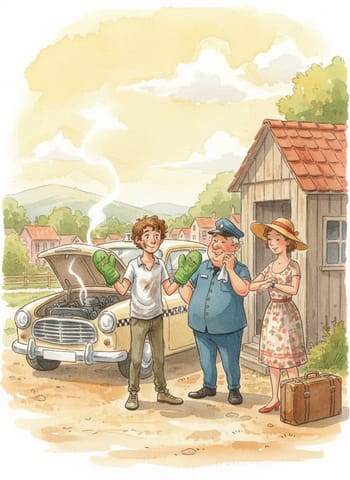
The taxi rank in Ostwick has room for four cars, one wooden hut and a single bench that nobody trusts. On a hot afternoon in July, three of the cars are empty. The fourth, Lorenzo's, is making a noise like a kettle with a grudge. White steam leaks from under the bonnet in thin, determined lines.
La parada de taxis de Ostwick tiene lugar para cuatro autos, una caseta de madera y una sola banca en la que nadie confía. En una tarde calurosa de julio, tres de los autos están vacíos. El cuarto, el de Lorenzo, hace un ruido como una tetera con rencor. Un vapor blanco se escapa por debajo del capó en finas líneas decididas.
Gunnar comes out of the hut with a sandwich in his hand. He has worked at this rank for twenty years, and he can diagnose most problems by sound alone.
Gunnar sale de la caseta con un sándwich en la mano. Lleva veinte años trabajando en esta parada, y puede diagnosticar la mayoría de los problemas solo por el sonido.
"That is not a good noise," he says.
«Ese no es un buen ruido», dice.
"It is a very good noise," says Lorenzo. "It tells me the engine is still alive. I just don't know how long it will stay that way."
«Es un ruido muy bueno», dice Lorenzo. «Me dice que el motor sigue vivo. Solo que no sé por cuánto tiempo».
Lorenzo is new. He bought the cab in spring from a man who promised that it was "full of character". So far, the character has included a broken radio, a door that opens only from outside and now this.
Lorenzo es nuevo. Compró el taxi en primavera a un hombre que prometió que estaba «lleno de carácter». Hasta ahora, el carácter ha incluido una radio rota, una puerta que solo abre desde afuera y ahora esto.
A customer is also waiting. She stands by the hut with a suitcase, looking at her watch. She needs to reach the junction station before the half-past-four train, and Lorenzo's cab is next in line. The next train after that, she mentions, is on Sunday.
También hay una clienta esperando. Está junto a la caseta con una maleta, mirando su reloj. Necesita llegar a la estación del empalme antes del tren de las cuatro y media, y el taxi de Lorenzo es el siguiente en la fila. El siguiente tren después de ese, menciona, es el domingo.
"Twenty minutes," she says. "I can wait twenty minutes. After that I have to find a horse."
«Veinte minutos», dice. «Puedo esperar veinte minutos. Después tendré que buscar un caballo».
"There is no horse," says Gunnar. "Only me."
«No hay caballo», dice Gunnar. «Solo yo».
"Then take me," she says. "Please."
«Entonces lléveme», dice ella. «Por favor».
"I can't," he says, with real regret. "My cab is at the garage. Today I am only the man who answers the phone."
«No puedo», dice él, con verdadero pesar. «Mi taxi está en el taller. Hoy solo soy el hombre que contesta el teléfono».
Lorenzo switches off the engine and lifts the bonnet. A cloud of steam rolls out and fogs his glasses. Under it, the radiator cap sits on its little metal neck, far too hot to touch. The manual says never to open it while the engine is warm, and for once the manual is right.
Lorenzo apaga el motor y levanta el capó. Una nube de vapor sale rodando y le empaña los anteojos. Debajo, la tapa del radiador está sobre su pequeño cuello de metal, demasiado caliente para tocarla. El manual dice que nunca se abra con el motor caliente, y por una vez el manual tiene razón.
"We need to cool it down," Lorenzo says. "Fast. Does anyone have a cold cloth?"
«Tenemos que enfriarlo», dice Lorenzo. «Rápido. ¿Alguien tiene un paño frío?»
Gunnar thinks. Then he disappears into the hut and returns with a pair of oven gloves shaped like crocodiles. They are bright green, with white felt teeth and round yellow eyes.
Gunnar piensa. Luego desaparece en la caseta y regresa con un par de guantes de horno con forma de cocodrilo. Son de un verde brillante, con dientes de fieltro blanco y ojos amarillos redondos.
"My wife made them," he says, a little defensive. "She sells pasties from the hut in summer. They were meant to be a joke, but they are surprisingly thick."
«Los hizo mi esposa», dice, un poco a la defensiva. «Vende empanadas desde la caseta en verano. Eran una broma, pero son sorprendentemente gruesos».
"They are very thick," Lorenzo agrees. "They are also staring at me."
«Son muy gruesos», concuerda Lorenzo. «Y también me están mirando».
Gunnar is a man of action, and he does not wait to be told. He puts both hands into the crocodiles and reaches for the cap with a look of great confidence. The cap lets out a sharp hiss, like a snake that has been woken up. Gunnar yelps, jumps back and drops one crocodile in the gutter.
Gunnar es un hombre de acción, y no espera a que se lo digan. Mete las dos manos en los cocodrilos y alcanza la tapa con una expresión de gran confianza. La tapa suelta un siseo agudo, como una serpiente a la que han despertado. Gunnar grita, salta hacia atrás y deja caer un cocodrilo en la cuneta.
"Well," says Lorenzo, "that was brave."
«Bueno», dice Lorenzo, «eso fue valiente».
"That was stupid," says Gunnar, shaking out his fingers. "I was in too much of a hurry. I nearly opened it like a jar of jam."
«Eso fue estúpido», dice Gunnar, sacudiéndose los dedos. «Tenía demasiada prisa. Casi la abro como un frasco de mermelada».
The customer checks her watch again. "Seventeen minutes."
La clienta vuelve a mirar su reloj. «Diecisiete minutos».
Lorenzo stares at the engine, and then at the crocodile in the gutter. It lies on its back with its yellow eyes fixed on the sky. Something about the way it is lying makes him think of the water barrel behind the hut. The drivers keep it there for washing their cars.
Lorenzo mira el motor, y luego el cocodrilo en la cuneta. Yace boca arriba con los ojos amarillos fijos en el cielo. Algo en la manera en que está tirado le hace pensar en el barril de agua detrás de la caseta. Los conductores lo guardan ahí para lavar sus autos.
"We don't touch the cap yet," he says slowly. "First we let the engine cool. Gunnar, soak both gloves in the barrel. Make them as wet as you can."
«Todavía no tocamos la tapa», dice despacio. «Primero dejamos que el motor se enfríe. Gunnar, empapa los dos guantes en el barril. Que queden lo más mojados que puedas».
"Wet gloves on a hot engine?" says Gunnar. "I thought the whole point of gloves was to keep hands dry."
«¿Guantes mojados sobre un motor caliente?», dice Gunnar. «Pensé que el sentido de los guantes era mantener las manos secas».
"The point is to keep my hands safe," Lorenzo answers. "Water takes the heat out of the metal. If we cool the hose and the cap, there is less pressure inside when we finally turn it."
«El sentido es mantener mis manos a salvo», responde Lorenzo. «El agua saca el calor del metal. Si enfriamos la manguera y la tapa, hay menos presión adentro cuando por fin la giremos».
Gunnar looks at him for a moment, then nods and runs. He comes back with the crocodiles dripping, one of them still wearing a leaf of lettuce on its nose. Lorenzo drapes the first glove over the top hose and the second over the cap, without touching either with his bare skin. They hiss at once and give off a thin smell of hot cotton. They wait one minute, and then another, while the customer watches in silence. Twice they dip the gloves again.
Gunnar lo mira un momento, luego asiente y echa a correr. Regresa con los cocodrilos goteando, uno de ellos todavía con una hoja de lechuga en la nariz. Lorenzo extiende el primer guante sobre la manguera superior y el segundo sobre la tapa, sin tocar ninguna de las dos con la piel desnuda. Sisean de inmediato y despiden un leve olor a algodón caliente. Esperan un minuto, y luego otro, mientras la clienta mira en silencio. Dos veces vuelven a mojar los guantes.
"Nine minutes," she says at last.
«Nueve minutos», dice ella por fin.
"I know," says Lorenzo. "Please don't say it again."
«Lo sé», dice Lorenzo. «Por favor, no lo repita».
The steam has faded into a faint tick. Lorenzo puts his hand near the hose, and it is warm now, not scalding. He tells Gunnar to stand well back. Then he takes the cap through a layer of wet felt, turns his face away and turns it only a quarter of a turn. A short breath of steam escapes. He waits until it stops. He turns it a little more, and the cap lifts away in his hand like a coin.
El vapor se ha reducido a un leve tic. Lorenzo acerca la mano a la manguera, y ahora está tibia, no hirviendo. Le dice a Gunnar que se aparte bien. Luego toma la tapa a través de una capa de fieltro mojado, aparta la cara y la gira solo un cuarto de vuelta. Se escapa un breve suspiro de vapor. Espera hasta que cesa. La gira un poco más, y la tapa se levanta en su mano como una moneda.
Inside, the radiator is almost empty. The water level has dropped far below the line.
Adentro, el radiador está casi vacío. El nivel del agua ha bajado muy por debajo de la línea.
"That is the whole problem," says Gunnar. "It was dry. Nothing is wrong with the engine, it is simply thirsty."
«Ese es todo el problema», dice Gunnar. «Estaba seco. No le pasa nada al motor, simplemente tiene sed».
"Then let's give it a drink," says Lorenzo. "Slowly. Is there anything in the hut?"
«Entonces démosle de beber», dice Lorenzo. «Despacio. ¿Hay algo en la caseta?»
The only liquid in the hut is a case of bottled spring water that Gunnar's wife delivered on Monday. Together they pour six bottles into the radiator, a little at a time. The customer holds the bonnet up with both hands, her suitcase balanced on one knee. The water gurgles down. The steam thins out, shrinks to a wisp and disappears.
El único líquido en la caseta es una caja de agua de manantial embotellada que la esposa de Gunnar entregó el lunes. Entre los dos vierten seis botellas en el radiador, un poco a la vez. La clienta sostiene el capó con las dos manos, con la maleta en equilibrio sobre una rodilla. El agua gorgotea hacia adentro. El vapor se adelgaza, se encoge hasta ser un hilillo y desaparece.
Lorenzo screws the cap back on, closes the bonnet, climbs in and turns the key. The engine coughs once, sighs, and begins to purr.
Lorenzo atornilla la tapa, cierra el capó, sube y gira la llave. El motor tose una vez, suspira y empieza a ronronear.
"Five minutes," announces the customer, already in the back seat. "Is it going to make it?"
«Cinco minutos», anuncia la clienta, ya en el asiento trasero. «¿Va a llegar?»
"It has to," says Lorenzo. "I have a reputation to build."
«Tiene que hacerlo», dice Lorenzo. «Tengo una reputación que construir».
He drives away from the rank slowly at first, to be safe, and then faster, down the long hill toward the junction. In his mirror he sees Gunnar standing in the road with a dripping crocodile on each hand. He waves them above his head like a man who has just won a small, strange war.
Se aleja de la parada despacio al principio, para estar seguro, y luego más rápido, por la larga cuesta hacia el empalme. En su espejo ve a Gunnar parado en la calle con un cocodrilo goteante en cada mano. Los agita sobre su cabeza como un hombre que acaba de ganar una guerra pequeña y extraña.
They reach the station with a minute to spare. The customer pays, runs across the car park with her suitcase bouncing behind her, and boards the train just as its doors begin to close.
Llegan a la estación con un minuto de sobra. La clienta paga, cruza corriendo el estacionamiento con la maleta rebotando detrás de ella y sube al tren justo cuando sus puertas empiezan a cerrarse.
When Lorenzo comes back to the rank, Gunnar is sitting on the untrustworthy bench with the gloves spread out to dry beside him. One of them is missing half a tooth.
Cuando Lorenzo regresa a la parada, Gunnar está sentado en la banca poco confiable con los guantes extendidos a su lado para que se sequen. A uno le falta medio diente.
"Good news," says Lorenzo. "She caught the train."
«Buenas noticias», dice Lorenzo. «Alcanzó el tren».
"Excellent," says Gunnar. He picks up the damaged crocodile and turns it over with a worried frown. "But tell me one thing. Who is going to explain to my wife that her best work has retired from the pasty business?"
«Excelente», dice Gunnar. Recoge el cocodrilo dañado y le da vuelta con el ceño preocupado. «Pero dime una cosa. ¿Quién le va a explicar a mi esposa que su mejor obra se ha retirado del negocio de las empanadas?»