The Flute and the Flower Carts
Una historia gratuita en inglés de nivel B1 para estudiantes, para leer en línea en 7 idiomas, con opción de escucharla en la app gratuita Storyteller.
A boy who never asks for help must cross a jammed flower market to reach his audition before the doors lock.
¡Ese fue el avance! Escucha la historia completa en la app gratuita Storyteller. Descargar la app
El audio no está disponible en este momento.
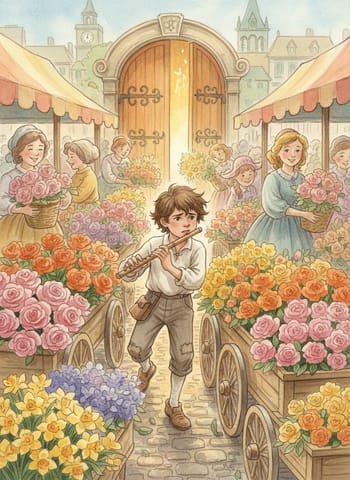
At four in the morning, the flower market is already louder than a school hall. Lorries beep as they back into the loading bays. Men shout prices across the aisles, and buckets of lilies clatter on the wet stone floor. Karim stands behind his mother's stall with a bunch of white roses in each hand. A flute case sits on a crate beside him, wrapped in a plastic flower sleeve.
A las cuatro de la mañana, el mercado de flores ya es más ruidoso que el salón de una escuela. Los camiones pitan al retroceder hacia los muelles de carga. Los hombres gritan precios de un pasillo a otro, y los baldes de lirios chocan contra el piso de piedra mojado. Karim está detrás del puesto de su madre con un ramo de rosas blancas en cada mano. Un estuche de flauta descansa sobre un cajón a su lado, envuelto en una funda de plástico de las que se usan para las flores.
Today is the day of his audition for the city youth orchestra. It starts at six o'clock, in the concert hall at the far end of the market district. The judges lock the doors at six exactly. A late player does not get a second turn.
Hoy es el día de su audición para la orquesta juvenil de la ciudad. Empieza a las seis en punto, en la sala de conciertos que está al otro extremo del barrio del mercado. Los jueces cierran las puertas exactamente a las seis. Un músico que llega tarde no tiene una segunda oportunidad.
"You should leave by five," his mother says. She is counting stems and does not look up. "I can manage the stall with the new boy."
«Deberías salir antes de las cinco», dice su madre. Está contando tallos y no levanta la vista. «Yo puedo atender el puesto con el muchacho nuevo».
"The delivery for the hotel isn't ready yet," Karim says. "I'll finish it first. Then I'll go."
«El pedido del hotel todavía no está listo», dice Karim. «Primero lo termino. Después me voy».
He always says this. Karim is the kind of person who thinks every job is his job. He does not like to ask for help. He does not like to leave a task half done. So he ties the hotel's flowers into forty neat bunches, and he checks each one twice.
Siempre dice esto. Karim es de los que piensan que todo trabajo es trabajo suyo. No le gusta pedir ayuda. No le gusta dejar una tarea a medias. Así que ata las flores del hotel en cuarenta ramos prolijos, y revisa cada uno dos veces.
At twenty past five, he finally lifts the flute case. Wilf is waiting at the end of the aisle with an empty hand trolley. He is sixteen and works for the biggest wholesaler in the market. He knows every corner of the building.
A las cinco y veinte, por fin levanta el estuche de la flauta. Wilf lo espera al final del pasillo con una carretilla de mano vacía. Tiene dieciséis años y trabaja para el mayor mayorista del mercado. Conoce cada rincón del edificio.
"You look terrible," Wilf says. "Did you sleep at all?"
«Te ves terrible», dice Wilf. «¿Dormiste algo?».
"No time to talk," says Karim. "I have forty minutes to cross the market. I'll take the main aisle."
«No hay tiempo para hablar», dice Karim. «Tengo cuarenta minutos para cruzar el mercado. Iré por el pasillo principal».
Wilf laughs. "The main aisle? Have you looked at it today?"
Wilf se ríe. «¿Por el pasillo principal? ¿Lo has mirado hoy?».
Karim turns round. The main aisle is a river of vans, carts and shouting people. A delivery lorry has stopped across the middle, and fifty florists are trying to squeeze past it. Nothing moves. A man is arguing with a driver who has locked his doors and gone for coffee.
Karim se da la vuelta. El pasillo principal es un río de camionetas, carretillas y gente gritando. Un camión de reparto se ha detenido atravesado en el medio, y cincuenta floristas intentan pasar apretándose a su lado. Nada se mueve. Un hombre discute con un conductor que cerró las puertas con llave y se fue por un café.
Karim's stomach drops. He tries the side aisles, one after another, but every one is full of crates. He climbs over a stack of empty buckets and runs along the wall. Ten minutes later he is back where he started. He has a wet shoe and a cut on his thumb. The clock above the fish stall says five forty.
A Karim se le encoge el estómago. Prueba los pasillos laterales, uno tras otro, pero todos están llenos de cajones. Trepa sobre una pila de baldes vacíos y corre pegado a la pared. Diez minutos después está de vuelta donde empezó. Tiene un zapato mojado y un corte en el pulgar. El reloj sobre el puesto de pescado marca las cinco y cuarenta.
"It is not possible," he says, breathing hard. "Twenty minutes, and the hall is half a kilometre away."
«No es posible», dice, respirando con dificultad. «Veinte minutos, y la sala queda a medio kilómetro».
"On the roads, yes," Wilf says. "But we are not going by the road."
«Por las calles, sí», dice Wilf. «Pero no iremos por la calle».
Karim frowns. "Where else is there?"
Karim frunce el ceño. «¿Por dónde más hay?».
"Come with me. And hold your flute high."
«Ven conmigo. Y sostén bien alta tu flauta».
Wilf pushes the trolley to a grey metal door behind the cold rooms. The market keeps its cut stems cool in there. The door is marked STAFF ONLY. Karim hesitates, because he has never broken a rule in his life. Then he sees the clock again. He follows Wilf inside.
Wilf empuja la carretilla hasta una puerta de metal gris detrás de las cámaras frías. Ahí el mercado mantiene frescos los tallos cortados. La puerta dice SOLO PERSONAL. Karim duda, porque nunca ha roto una regla en su vida. Entonces vuelve a ver el reloj. Sigue a Wilf hacia adentro.
The corridor is cold and white, and it smells of wet leaves. Rows of lilies stand in silent buckets on both sides. At the end of the corridor, a long line of flat carts waits beside a rubber belt. Every morning, the market sends the empty buckets along this belt to the washing yard behind the building.
El corredor es frío y blanco, y huele a hojas mojadas. A ambos lados hay hileras de lirios en baldes silenciosos. Al final del corredor, una larga fila de carros planos espera junto a una cinta de goma. Cada mañana, el mercado manda los baldes vacíos por esta cinta hasta el patio de lavado que está detrás del edificio.
"The belt runs the whole length of the market," Wilf explains. "It stops at the yard, and the yard has a back gate. That gate opens right onto the loading door of the concert hall. I have seen musicians carry their cellos through it."
«La cinta recorre todo el largo del mercado», explica Wilf. «Termina en el patio, y el patio tiene una puerta trasera. Esa puerta da justo al portón de carga de la sala de conciertos. He visto a músicos pasar sus violonchelos por ahí».
"Is that safe?" Karim asks.
«¿Es seguro?», pregunta Karim.
"If you lie flat and keep your head down, it is," says Wilf. "Climb on."
«Si te acuestas y mantienes la cabeza baja, sí», dice Wilf. «Sube».
Karim stares at the belt. Every part of him wants to find a safer plan. But the only other plan is to arrive late. He has already tried that one in his head. He climbs onto a flat cart and lies on his back. The case lands on his chest. Wilf jumps on the next cart and presses a green button.
Karim mira fijamente la cinta. Todo en él quiere encontrar un plan más seguro. Pero el único otro plan es llegar tarde. Ese ya lo probó en su cabeza. Se sube a un carro plano y se acuesta de espaldas. El estuche cae sobre su pecho. Wilf salta al carro siguiente y aprieta un botón verde.
The belt starts with a jerk. Karim slides through a rubber curtain into a tunnel full of fans and pipes. Buckets rattle past on both sides. Somewhere above them, he can hear the market, a loud, muffled sound like a crowd in another room. It is the strangest ride of his life, and for a moment he almost laughs.
La cinta arranca con una sacudida. Karim se desliza a través de una cortina de goma hacia un túnel lleno de ventiladores y tuberías. Los baldes pasan traqueteando a ambos lados. En algún lugar sobre ellos, se oye el mercado, un sonido fuerte y apagado como una multitud en otra habitación. Es el viaje más extraño de su vida, y por un momento casi se ríe.
Then the belt slows. A line of buckets blocks the exit, and the cart stops with a bump.
Entonces la cinta se frena. Una fila de baldes bloquea la salida, y el carro se detiene con un golpe.
"The yard is washing the last load," Wilf says from behind him. "We cannot get through this way. Not in time."
«El patio está lavando la última carga», dice Wilf desde atrás. «No podemos pasar por aquí. No a tiempo».
"What do we do?" Karim whispers. He looks at his watch. It says five fifty-two.
«¿Qué hacemos?», susurra Karim. Mira su reloj. Marca las cinco y cincuenta y dos.
Wilf thinks for a few seconds. "The hose room. Follow me and keep your case dry."
Wilf piensa unos segundos. «El cuarto de las mangueras. Sígueme y mantén seco tu estuche».
They crawl off the carts and squeeze between two machines. The hose room is full of steam and noise, and the floor is a lake of soapy water. Karim holds his flute above his head with both hands. Water runs down his sleeves and into his collar. He thinks about asking Wilf to go ahead, then stops. For the first time that morning, he understands that nobody is asking him to do this alone.
Bajan gateando de los carros y se aprietan entre dos máquinas. El cuarto de las mangueras está lleno de vapor y ruido, y el piso es un lago de agua jabonosa. Karim sostiene su flauta sobre la cabeza con las dos manos. El agua le corre por las mangas y le entra por el cuello. Piensa en pedirle a Wilf que se adelante, pero se detiene. Por primera vez esa mañana, entiende que nadie le está pidiendo que haga esto solo.
"Take my arm," says Wilf. "Left foot, then right."
«Tómate de mi brazo», dice Wilf. «Pie izquierdo, luego derecho».
They wade across together. At the far end, a small green door stands half open, and daylight comes in under it. Wilf kicks it wide. The back gate of the yard is just ahead. Behind it Karim sees the tall glass wall of the concert hall.
Cruzan vadeando juntos. Al fondo, una pequeña puerta verde está entreabierta, y la luz del día entra por debajo. Wilf la patea hasta abrirla del todo. La puerta trasera del patio está justo adelante. Detrás de ella Karim ve la alta pared de vidrio de la sala de conciertos.
They run. Karim's shoes squelch on the pavement, and the flute case bangs against his leg. A man in a black jacket stands at the loading door with a key in his hand. He is already turning the lock.
Corren. Los zapatos de Karim chapotean en la acera, y el estuche de la flauta le golpea la pierna. Un hombre con una chaqueta negra está parado junto al portón de carga con una llave en la mano. Ya está girando la cerradura.
"Wait, please," Karim shouts. "I am here for the audition!"
«Espere, por favor», grita Karim. «¡Vengo a la audición!».
The man looks at him for a long moment. He takes in the wet clothes, the cut thumb and the petals stuck in Karim's hair. Then he steps aside and holds the door. The clock in the hallway says five fifty-nine.
El hombre lo mira un largo momento. Se fija en la ropa mojada, el pulgar cortado y los pétalos pegados en el pelo de Karim. Luego se hace a un lado y sostiene la puerta. El reloj del vestíbulo marca las cinco y cincuenta y nueve.
Inside, Karim dries his hands on his shirt and takes the flute out of its sleeve. It is perfectly dry. He wipes his face, breathes in slowly and walks onto the stage. Three judges sit at a long table. One of them looks up from her papers and smiles at the petals.
Adentro, Karim se seca las manos en la camisa y saca la flauta de su funda. Está perfectamente seca. Se limpia la cara, respira hondo despacio y sube al escenario. Tres jueces están sentados a una larga mesa. Una de ellos levanta la vista de sus papeles y sonríe al ver los pétalos.
Karim lifts the flute to his lips. Then he lowers it again and turns to the judges. "Shall I start with the slow piece or the fast one?"
Karim se lleva la flauta a los labios. Luego la baja otra vez y se vuelve hacia los jueces. «¿Empiezo con la pieza lenta o con la rápida?».