The Doorbell in Aisle Nine
Una historia gratuita en inglés de nivel B1 para estudiantes, para leer en línea en 7 idiomas, con opción de escucharla en la app gratuita Storyteller.
Two night-shift workers hunt for the source of a loud doorbell ringing between the shelves of a quiet supermarket.
¡Ese fue el avance! Escucha la historia completa en la app gratuita Storyteller. Descargar la app
El audio no está disponible en este momento.
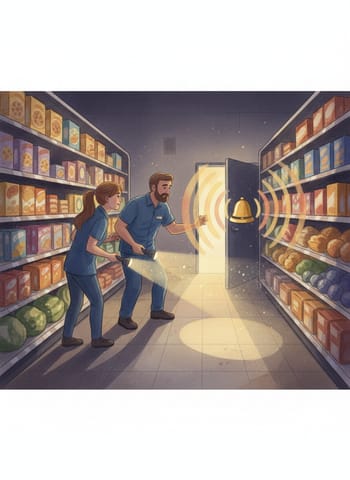
At two in the morning, a doorbell rang in aisle nine.
A las dos de la madrugada, sonó un timbre en el pasillo nueve.
Osei stopped pushing his trolley of tinned soup. The sound was not a soft chime. It was a loud, bright ring, like the bell on a front door. It bounced between the tall shelves of pasta and rice.
Osei dejó de empujar su carrito de latas de sopa. El sonido no era un suave campanilleo. Era un timbrazo fuerte y brillante, como el timbre de una puerta de entrada. Rebotaba entre los altos estantes de pasta y arroz.
"Did you hear that?" he called.
«¿Oíste eso?», gritó.
Jabu came around the corner with a craft knife in her hand. She was seventeen, the same age as Osei, and she had worked the night shift for three weeks. "I heard it," she said. "That's the fourth time tonight."
Jabu apareció por la esquina con un cúter en la mano. Tenía diecisiete años, la misma edad que Osei, y llevaba tres semanas en el turno de noche. «Lo oí», dijo. «Es la cuarta vez esta noche».
"Maybe it's a parrot," Osei said. "The day manager left a note. A customer saw a bird near the front doors yesterday."
«Quizás es un loro», dijo Osei. «La gerente del día dejó una nota. Un cliente vio un pájaro cerca de las puertas de entrada ayer».
"Parrots don't sound like doorbells."
«Los loros no suenan como timbres».
"Some of them do. They copy everything they hear."
«Algunos sí. Copian todo lo que oyen».
Jabu listened. The ring came again, exactly the same, with the same sharp second note. A real bird would have changed it at least once. "That's a machine," she said. "A bird would get bored."
Jabu escuchó. El timbrazo volvió, exactamente igual, con la misma segunda nota aguda. Un pájaro de verdad lo habría cambiado al menos una vez. «Eso es una máquina», dijo. «Un pájaro se aburriría».
"Then why is it so loud?"
«¿Entonces por qué es tan fuerte?».
"I don't know. But we've been told to find it before the delivery lorry arrives at five."
«No lo sé. Pero nos dijeron que lo encontráramos antes de que llegue el camión de reparto a las cinco».
Osei sighed. The store was almost empty at night. Only the freezers hummed, and the lights over the empty aisles buzzed like sleepy insects. Nobody had ever told him that a supermarket could feel so large. "All right," he said. "Let's find it."
Osei suspiró. La tienda estaba casi vacía de noche. Solo zumbaban los congeladores, y las luces sobre los pasillos vacíos vibraban como insectos soñolientos. Nadie le había dicho nunca que un supermercado pudiera sentirse tan grande. «Está bien», dijo. «Busquémoslo».
They started with the simplest plan. They stood in the middle of aisle nine and waited for the next ring. When it came, they walked toward it as fast as they could.
Empezaron con el plan más simple. Se pararon en medio del pasillo nueve y esperaron el siguiente timbrazo. Cuando llegó, caminaron hacia él lo más rápido que pudieron.
The sound seemed to come from the left. They hurried to the end of the aisle and found only a stack of empty boxes. Then the bell rang again, and now it sounded like it came from behind them. They turned around. Nothing was there.
El sonido parecía venir de la izquierda. Corrieron hasta el final del pasillo y solo encontraron una pila de cajas vacías. Entonces el timbre sonó de nuevo, y ahora parecía venir de detrás de ellos. Se dieron vuelta. No había nada.
"This is stupid," Jabu said. "The sound is bouncing off the shelves. It's coming from everywhere."
«Esto es una tontería», dijo Jabu. «El sonido rebota en los estantes. Viene de todas partes».
They tried again in aisle ten. Then in aisle eight. Each time, they ended up in the wrong place, with a wrong guess and sore feet. After twenty minutes, Osei sat on a crate of washing powder and put his head in his hands.
Lo intentaron de nuevo en el pasillo diez. Luego en el ocho. Cada vez terminaban en el lugar equivocado, con una suposición equivocada y los pies doloridos. Después de veinte minutos, Osei se sentó en una caja de detergente y se tomó la cabeza entre las manos.
"My first plan has completely failed," he said.
«Mi primer plan ha fracasado por completo», dijo.
"It was your plan?" Jabu asked.
«¿Era tu plan?», preguntó Jabu.
"I just said we should walk toward it. That counts."
«Solo dije que camináramos hacia él. Eso cuenta».
Jabu laughed, then stopped. She was looking at the ceiling, where the speakers were. "What if the sound isn't from the speakers at all?" she said. "We've been guessing by ear. Ears are bad at this."
Jabu rio, y luego se detuvo. Miraba al techo, donde estaban los altavoces. «¿Y si el sonido no viene de los altavoces?», dijo. «Hemos estado adivinando de oído. Los oídos son malos para esto».
"What else do we have?"
«¿Qué más tenemos?».
She took her phone from her pocket. "Two phones. Yours and mine. If one hears the ring a moment before the other, that tells us which way it comes from."
Sacó el teléfono del bolsillo. «Dos teléfonos. El tuyo y el mío. Si uno oye el timbre un instante antes que el otro, eso nos dice de qué lado viene».
Osei raised his head. "That's actually clever."
Osei levantó la cabeza. «Eso es realmente ingenioso».
"I watched a film about submarines last month. Don't tell anyone."
«El mes pasado vi una película de submarinos. No se lo cuentes a nadie».
They switched off the music and the little radio in the staff room. They even unplugged the drinks fridge by the door, which made a loud rattle. Then they put their phones on the floor at two ends of the aisle. The phones were thirty metres apart. They pressed record on both.
Apagaron la música y la radio pequeña de la sala del personal. Hasta desenchufaron el refrigerador de bebidas junto a la puerta, que hacía un fuerte traqueteo. Luego pusieron sus teléfonos en el suelo, en los dos extremos del pasillo. Los teléfonos estaban a treinta metros de distancia. Presionaron grabar en los dos.
The store became very quiet. Osei could hear his own heart. He felt silly, standing still in a shop with his arms folded, waiting for a ring.
La tienda quedó muy silenciosa. Osei podía oír su propio corazón. Se sentía tonto, de pie e inmóvil en una tienda con los brazos cruzados, esperando un timbrazo.
Then it came. The bright note rolled down the aisle, and both phones caught it.
Entonces llegó. La nota brillante rodó por el pasillo, y los dos teléfonos la captaron.
Jabu played the two recordings side by side on her screen. The lines of sound looked like two small mountains. "Look," she said. "Your phone heard it first. Not by much. A tiny bit."
Jabu reprodujo las dos grabaciones lado a lado en su pantalla. Las líneas de sonido parecían dos pequeñas montañas. «Mira», dijo. «Tu teléfono lo oyó primero. No por mucho. Un poquito».
"So it's closer to my end."
«Así que está más cerca de mi lado».
"Closer to your end, and low down. Your phone is on the floor, and the sound is stronger on it than on mine."
«Más cerca de tu lado, y abajo. Tu teléfono está en el suelo, y el sonido es más fuerte en él que en el mío».
They walked to Osei's end and knelt on the cold tiles. There was a big pallet of dog food there, wrapped in plastic. The delivery team had left it for the morning shift. Behind it, in the narrow gap against the wall, something blinked a small yellow light.
Caminaron hasta el extremo de Osei y se arrodillaron en las frías baldosas. Allí había una gran paleta de comida para perros, envuelta en plástico. El equipo de reparto la había dejado para el turno de la mañana. Detrás, en el estrecho hueco contra la pared, algo parpadeaba con una lucecita amarilla.
"There," Osei whispered.
«Ahí», susurró Osei.
They moved the pallet together, pushing it with their shoulders. The plastic squeaked. In the gap sat a small grey machine about the size of a cat. It had four soft wheels, a flat top and a tiny screen. One of its wheels was stuck in a loose strip of tape from a box.
Movieron la paleta juntos, empujándola con los hombros. El plástico chirrió. En el hueco había una pequeña máquina gris del tamaño de un gato. Tenía cuatro ruedas blandas, una parte superior plana y una pantallita. Una de sus ruedas estaba atascada en una tira suelta de cinta de una caja.
"It's a stock robot," Jabu said. "The kind the big stores use. I've seen them on videos."
«Es un robot de inventario», dijo Jabu. «De los que usan las tiendas grandes. Los he visto en videos».
"Our store doesn't have one."
«Nuestra tienda no tiene uno».
"It does now."
«Ahora sí».
The screen on the robot showed a sad little line of text. It said, "BATTERY LOW. NO HUMAN FOUND. RINGING FOR HELP." Then the doorbell rang again, so loud that both teenagers jumped.
La pantalla del robot mostraba una tristona línea de texto. Decía: «BATERÍA BAJA. NO SE ENCONTRÓ A NINGÚN HUMANO. LLAMANDO PIDIENDO AYUDA». Entonces el timbre volvió a sonar, tan fuerte que los dos adolescentes dieron un salto.
Osei put his hands over his ears. "It's ringing because it can't find anyone!"
Osei se tapó los oídos con las manos. «¡Está sonando porque no encuentra a nadie!».
"We were in the next aisle the whole time," Jabu said. She pulled the strip of tape from the wheel. The robot wiggled and rolled forward a little way, then stopped and rang again.
«Estuvimos en el pasillo de al lado todo el tiempo», dijo Jabu. Arrancó la tira de cinta de la rueda. El robot se meneó y rodó un trecho hacia adelante, luego se detuvo y volvió a sonar.
"Make it stop," Osei begged.
«Hazlo parar», suplicó Osei.
"I'm trying." Jabu turned the machine over. Underneath, there was a flat panel with a row of tiny symbols. One of them showed a plug. Another showed a bell with a line through it. "I think this one is the quiet button."
«Lo intento». Jabu dio vuelta a la máquina. Debajo había un panel plano con una fila de símbolos diminutos. Uno mostraba un enchufe. Otro mostraba una campana tachada con una línea. «Creo que este es el botón de silencio».
She pressed the bell symbol. The ringing stopped at once. The silence that followed was so deep that Osei laughed out loud.
Presionó el símbolo de la campana. El sonido se detuvo de inmediato. El silencio que siguió fue tan profundo que Osei rio en voz alta.
"Now it needs power," she said. "There's a charging spot in the back office. The manager's keys are hanging by the door."
«Ahora necesita energía», dijo ella. «Hay un lugar de carga en la oficina de atrás. Las llaves del gerente están colgadas junto a la puerta».
They lifted the robot together. It was heavier than it looked. Osei carried the front and Jabu carried the back. They walked slowly through the dark store, like two people carrying a sleeping child.
Levantaron el robot juntos. Pesaba más de lo que parecía. Osei cargó la parte delantera y Jabu la trasera. Caminaron despacio por la tienda a oscuras, como dos personas que cargan a un niño dormido.
In the office, they found the charging mat under a pile of paper. Jabu put the robot on it. A green light came on, and the small screen changed its message. It said, "CHARGING. THANK YOU, NIGHT STAFF."
En la oficina encontraron la base de carga bajo un montón de papeles. Jabu puso el robot sobre ella. Se encendió una luz verde, y la pantallita cambió su mensaje. Decía: «CARGANDO. GRACIAS, PERSONAL NOCTURNO».
"It knows who we are," Osei said.
«Sabe quiénes somos», dijo Osei.
"It knows the job we do. That's different." Jabu looked pleased all the same. She picked up a sheet of paper from the desk. It was a letter from the head office, and she read it with a frown. "Listen to this. 'The new stock robot will arrive on a trial basis. Please keep it in the back office until training day.' It has been lost since Tuesday."
«Sabe el trabajo que hacemos. Es distinto». Aun así, Jabu parecía complacida. Tomó una hoja de papel del escritorio. Era una carta de la oficina central, y la leyó con el ceño fruncido. «Escucha esto. “El nuevo robot de inventario llegará a modo de prueba. Por favor, manténgalo en la oficina de atrás hasta el día de capacitación”. Está perdido desde el martes».
"So the day manager's bird was this?"
«¿Entonces el pájaro de la gerente del día era esto?».
"A customer must have heard it ringing near the front doors. People think the strangest things."
«Un cliente debió de oírlo sonar cerca de las puertas de entrada. La gente piensa las cosas más raras».
Osei checked the clock on the wall. It was ten to four. They had an hour before the lorry came. He felt tired, but he also felt proud. They had solved a real puzzle together.
Osei miró el reloj de la pared. Eran las cuatro menos diez. Tenían una hora antes de que llegara el camión. Se sentía cansado, pero también orgulloso. Habían resuelto juntos un acertijo de verdad.
They went back to aisle nine and finished the soup. They worked in a comfortable silence. Now and then Osei glanced toward the office, where the green light glowed through the glass.
Volvieron al pasillo nueve y terminaron las sopas. Trabajaron en un cómodo silencio. De vez en cuando Osei miraba hacia la oficina, donde la luz verde brillaba a través del vidrio.
At five o'clock the lorry arrived. The driver looked at the two tired teenagers, and he looked at the empty shelves they had filled. "Quiet night?" he asked.
A las cinco llegó el camión. El conductor miró a los dos adolescentes cansados, y miró los estantes vacíos que habían llenado. «¿Noche tranquila?», preguntó.
"Very quiet," Jabu said. "Mostly."
«Muy tranquila», dijo Jabu. «Casi siempre».
When the driver went outside, Osei turned to her. "Do we tell the day manager about the robot?"
Cuando el conductor salió, Osei se volvió hacia ella. «¿Le contamos a la gerente del día lo del robot?».
"We'll leave her a note. A very short one." Jabu grinned. "I'll write that the parrot has been caught."
«Le dejaremos una nota. Muy corta». Jabu sonrió. «Escribiré que el loro ha sido capturado».
"Fine," Osei said. "But if that machine ever learns to sing, I'm quitting."
«Bien», dijo Osei. «Pero si esa máquina aprende alguna vez a cantar, renuncio».