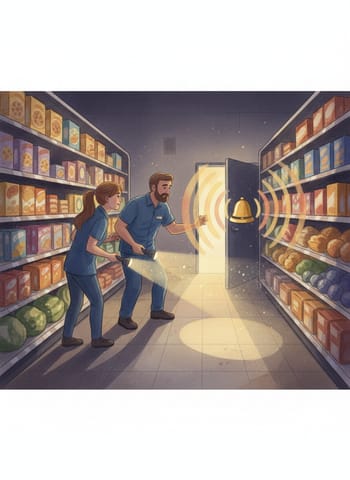
At two in the morning, a doorbell rang in aisle nine.
凌晨两点,九号货架通道里响起了门铃声。
Osei stopped pushing his trolley of tinned soup. The sound was not a soft chime. It was a loud, bright ring, like the bell on a front door. It bounced between the tall shelves of pasta and rice.
奥塞停下了推着汤罐头的小推车。那声音不是轻柔的叮咚,而是一声响亮清脆的铃声,像前门上的那种铃。它在高高的意面架和大米架之间来回弹跳。
"Did you hear that?" he called.
“你听到了吗?”他喊道。
Jabu came around the corner with a craft knife in her hand. She was seventeen, the same age as Osei, and she had worked the night shift for three weeks. "I heard it," she said. "That's the fourth time tonight."
贾布手里拿着美工刀,从拐角转了过来。她十七岁,和奥塞同岁,上夜班已经三个星期了。“听到了,”她说,“今晚这是第四次了。”
"Maybe it's a parrot," Osei said. "The day manager left a note. A customer saw a bird near the front doors yesterday."
“也许是只鹦鹉,”奥塞说,“白班经理留了张字条。昨天有顾客在前门附近看到一只鸟。”
"Parrots don't sound like doorbells."
“鹦鹉可不会发出门铃的声音。”
"Some of them do. They copy everything they hear."
“有些会。它们什么都学。”
Jabu listened. The ring came again, exactly the same, with the same sharp second note. A real bird would have changed it at least once. "That's a machine," she said. "A bird would get bored."
贾布侧耳听着。铃声又响了一次,一模一样,连那尖锐的第二个音也一样。真正的鸟至少会变一下。“这是机器,”她说,“鸟会厌烦的。”
"Then why is it so loud?"
“那为什么这么响?”
"I don't know. But we've been told to find it before the delivery lorry arrives at five."
“我不知道。但上面交代了,要在五点送货卡车到之前把它找出来。”
Osei sighed. The store was almost empty at night. Only the freezers hummed, and the lights over the empty aisles buzzed like sleepy insects. Nobody had ever told him that a supermarket could feel so large. "All right," he said. "Let's find it."
奥塞叹了口气。夜里这家店几乎是空的。只有冷柜嗡嗡作响,空荡荡的通道上方的灯像困倦的昆虫一样嗡嗡叫。从没有人告诉过他,超市可以让人觉得这么大。“好吧,”他说,“我们去找。”
They started with the simplest plan. They stood in the middle of aisle nine and waited for the next ring. When it came, they walked toward it as fast as they could.
他们从最简单的办法开始。两人站在九号通道中间,等着下一声铃响。铃一响,就拼命朝它走去。
The sound seemed to come from the left. They hurried to the end of the aisle and found only a stack of empty boxes. Then the bell rang again, and now it sounded like it came from behind them. They turned around. Nothing was there.
声音似乎来自左边。他们匆匆赶到通道尽头,只发现一摞空纸箱。接着铃又响了,这回听起来像是在他们身后。他们转过身,什么也没有。
"This is stupid," Jabu said. "The sound is bouncing off the shelves. It's coming from everywhere."
“这太蠢了,”贾布说,“声音在货架之间弹来弹去。它哪儿都像。”
They tried again in aisle ten. Then in aisle eight. Each time, they ended up in the wrong place, with a wrong guess and sore feet. After twenty minutes, Osei sat on a crate of washing powder and put his head in his hands.
他们在十号通道又试了一遍,接着是八号通道。每回都走到了错的地方,白猜一场,还走得脚疼。二十分钟后,奥塞坐在一箱洗衣粉上,双手捂住了头。
"My first plan has completely failed," he said.
“我的第一个办法彻底失败了,”他说。
"It was your plan?" Jabu asked.
“那是你的办法?”贾布问。
"I just said we should walk toward it. That counts."
“我只是说朝它走过去。这也算。”
Jabu laughed, then stopped. She was looking at the ceiling, where the speakers were. "What if the sound isn't from the speakers at all?" she said. "We've been guessing by ear. Ears are bad at this."
贾布笑了,随即停住。她望着天花板上的喇叭。“要是声音根本不是从喇叭里来的呢?”她说,“我们一直靠耳朵猜。耳朵最不擅长这个。”
"What else do we have?"
“那我们还有什么?”
She took her phone from her pocket. "Two phones. Yours and mine. If one hears the ring a moment before the other, that tells us which way it comes from."
她从口袋里掏出手机。“两部手机。你的和我的。如果一部比另一部早一点听到铃声,就能告诉我们它是从哪个方向来的。”
Osei raised his head. "That's actually clever."
奥塞抬起头。“这主意还真聪明。”
"I watched a film about submarines last month. Don't tell anyone."
“上个月我看了部潜艇电影。别告诉别人。”
They switched off the music and the little radio in the staff room. They even unplugged the drinks fridge by the door, which made a loud rattle. Then they put their phones on the floor at two ends of the aisle. The phones were thirty metres apart. They pressed record on both.
他们关掉了员工休息室里的音乐和那台小收音机,连门口的饮料冰柜也拔了电源,它嗡嗡震得厉害。然后他们把两部手机放在通道两端的地上。两部手机相距三十米。两人都按下了录音。
The store became very quiet. Osei could hear his own heart. He felt silly, standing still in a shop with his arms folded, waiting for a ring.
店里变得非常安静。奥塞能听到自己的心跳。他在商店里抱着胳膊一动不动地站着,等一声铃响,觉得自己挺傻的。
Then it came. The bright note rolled down the aisle, and both phones caught it.
接着铃声来了。那清脆的一声顺着通道滚过来,两部手机都录到了。
Jabu played the two recordings side by side on her screen. The lines of sound looked like two small mountains. "Look," she said. "Your phone heard it first. Not by much. A tiny bit."
贾布把两段录音并排放在屏幕上。声音的线条看起来像两座小山。“看,”她说,“你的手机先听到的。差得不多。一点点。”
"So it's closer to my end."
“那就是离我这头更近。”
"Closer to your end, and low down. Your phone is on the floor, and the sound is stronger on it than on mine."
“离你这头更近,而且位置很低。你的手机放在地上,声音在它上面比在我的上面更强。”
They walked to Osei's end and knelt on the cold tiles. There was a big pallet of dog food there, wrapped in plastic. The delivery team had left it for the morning shift. Behind it, in the narrow gap against the wall, something blinked a small yellow light.
他们走到奥塞这一头,跪在冰冷的瓷砖上。那里有一大托盘狗粮,用塑料膜裹着。送货组把它留给了早班。在它后面,靠墙的窄缝里,有什么东西闪着一点黄色的小灯。
"There," Osei whispered.
“在那儿,”奥塞低声说。
They moved the pallet together, pushing it with their shoulders. The plastic squeaked. In the gap sat a small grey machine about the size of a cat. It had four soft wheels, a flat top and a tiny screen. One of its wheels was stuck in a loose strip of tape from a box.
两人一起搬开托盘,用肩膀顶着它。塑料膜吱吱作响。缝隙里坐着一台灰色的小机器,大约有一只猫那么大。它有四个软轮子,平平的顶面,还有一块小小的屏幕。它的一个轮子被一条从纸箱上掉下来的松散胶带缠住了。
"It's a stock robot," Jabu said. "The kind the big stores use. I've seen them on videos."
“这是个盘货机器人,”贾布说,“大商场用的那种。我在视频上见过。”
"Our store doesn't have one."
“我们店没有这种东西。”
"It does now."
“现在有了。”
The screen on the robot showed a sad little line of text. It said, "BATTERY LOW. NO HUMAN FOUND. RINGING FOR HELP." Then the doorbell rang again, so loud that both teenagers jumped.
机器人的屏幕上显示着一行可怜的小字:“电量不足。未找到人类。正在呼叫求助。”接着门铃又响了,响得两个少年都吓了一跳。
Osei put his hands over his ears. "It's ringing because it can't find anyone!"
奥塞用手捂住耳朵。“它是因为找不到人才响的!”
"We were in the next aisle the whole time," Jabu said. She pulled the strip of tape from the wheel. The robot wiggled and rolled forward a little way, then stopped and rang again.
“我们一直就在隔壁通道,”贾布说。她把缠在轮子上的胶带扯了下来。机器人扭了扭,向前滚了一小段,随即停住,又响了一声。
"Make it stop," Osei begged.
“让它停下来,”奥塞央求道。
"I'm trying." Jabu turned the machine over. Underneath, there was a flat panel with a row of tiny symbols. One of them showed a plug. Another showed a bell with a line through it. "I think this one is the quiet button."
“我在试。”贾布把机器翻了过来。底部有一块平板,上面有一排小小的符号。其中一个是插头,另一个是被划了一道斜线的铃铛。“我觉得这个是静音键。”
She pressed the bell symbol. The ringing stopped at once. The silence that followed was so deep that Osei laughed out loud.
她按下了铃铛符号。铃声立刻停了。随后的寂静这么深,奥塞忍不住大声笑了起来。
"Now it needs power," she said. "There's a charging spot in the back office. The manager's keys are hanging by the door."
“现在它需要充电了,”她说,“后面办公室里有个充电位。经理的钥匙就挂在门边。”
They lifted the robot together. It was heavier than it looked. Osei carried the front and Jabu carried the back. They walked slowly through the dark store, like two people carrying a sleeping child.
两人一起把机器人抬了起来。它比看上去重。奥塞抬前面,贾布抬后面。他们慢慢穿过黑暗的店面,像两个抱着熟睡孩子的人。
In the office, they found the charging mat under a pile of paper. Jabu put the robot on it. A green light came on, and the small screen changed its message. It said, "CHARGING. THANK YOU, NIGHT STAFF."
在办公室里,他们在一堆纸下面找到了充电垫。贾布把机器人放了上去。一盏绿灯亮了,小屏幕上的信息变了。它写着:“充电中。谢谢夜班员工。”
"It knows who we are," Osei said.
“它知道我们是谁,”奥塞说。
"It knows the job we do. That's different." Jabu looked pleased all the same. She picked up a sheet of paper from the desk. It was a letter from the head office, and she read it with a frown. "Listen to this. 'The new stock robot will arrive on a trial basis. Please keep it in the back office until training day.' It has been lost since Tuesday."
“它知道我们干的是什么活儿。这不一样。”贾布还是显得很高兴。她拿起桌上的一张纸。那是总部发来的一封信,她皱着眉读了起来。“听这个。‘新的盘货机器人将作为试用品送达。请在培训日之前将其存放在后面的办公室里。’它从星期二起就丢了。”
"So the day manager's bird was this?"
“这么说白班经理说的那只鸟就是它?”
"A customer must have heard it ringing near the front doors. People think the strangest things."
“肯定是有顾客在前门附近听到它在响。人们会想到最奇怪的事情。”
Osei checked the clock on the wall. It was ten to four. They had an hour before the lorry came. He felt tired, but he also felt proud. They had solved a real puzzle together.
奥塞看了看墙上的钟。差十分钟四点。离卡车到还有一个钟头。他觉得累,但也觉得自豪。他们一起解开了一个真正的谜。
They went back to aisle nine and finished the soup. They worked in a comfortable silence. Now and then Osei glanced toward the office, where the green light glowed through the glass.
他们回到九号通道,把汤罐头摆完。两人干活时有种舒服的沉默。奥塞不时朝办公室瞥一眼,那盏绿灯正透过玻璃发着光。
At five o'clock the lorry arrived. The driver looked at the two tired teenagers, and he looked at the empty shelves they had filled. "Quiet night?" he asked.
五点钟,卡车到了。司机看了看两个疲惫的少年,又看了看他们摆满的空货架。“夜里挺安静?”他问。
"Very quiet," Jabu said. "Mostly."
“非常安静,”贾布说,“基本上吧。”
When the driver went outside, Osei turned to her. "Do we tell the day manager about the robot?"
司机出去之后,奥塞转向她。“我们要不要告诉白班经理机器人的事?”
"We'll leave her a note. A very short one." Jabu grinned. "I'll write that the parrot has been caught."
“我们给她留张字条。很短很短的那种。”贾布咧嘴笑了。“我就写,鹦鹉已经抓到了。”
"Fine," Osei said. "But if that machine ever learns to sing, I'm quitting."
“行,”奥塞说,“不过要是那台机器哪天学会唱歌,我就辞职。”